PLATTER & PLINTH

Alternatives to the Edifier R1280T

The R1280T is the default cheap powered pair for a turntable, and it leaves out two things on purpose. Five alternatives, each one answering a different omission.

By Stephen V.Last updated How we pick

The verdict

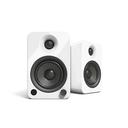
The Kanto YU4 is the alternative most turntable owners should buy. It fixes the one thing the R1280T actually forces you to solve yourself: it has a phono preamp built in, so a deck with no internal stage plugs straight into it and the extra box disappears from the shopping list. It costs roughly twice as much, which is the honest trade. If you only want the R1280T plus Bluetooth, the Edifier R1280DB is the same speaker with the inputs added. For a bigger room, the Fluance Ai41 brings 5-inch drivers and a published 90 W. The budget pick is the Micca MB42— but only if you already own an amplifier, because it has none.

Kanto YU4

Best alternative

Kanto YU4

$289.99 · View on Amazon

Price as of November 22, 2026. #ad How we’re funded

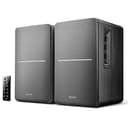
Edifier R1280DB

Closest sibling, adds Bluetooth

Edifier R1280DB

$139.99 · View on Amazon

$189.9926% off

Price as of November 22, 2026. #ad How we’re funded

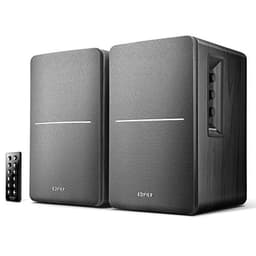
What the R1280T is known for, and what nothing on this page takes away from it: it is an active 2.0 pair rated 42 W RMS totalwith the amplifier inside the cabinet, two RCA line inputs so a turntable and a second source can both stay connected, bass and treble controls and a remote — at a price that undercuts almost every alternative here. It is the reason this site has recommended it as the cheapest route to a complete vinyl system for years, and our R1280T review covers it in full.

People go looking for an alternative for two specific, published reasons, and both are real. The R1280T has no phono preamp, so it needs a line-level signal — which means a turntable with its own switchable stage or a separate box. And it has no Bluetooth; that is the R1280DB’s job. A third reason is about size rather than features: 42 W and 4-inch woofers are sized for a desk or a small room, not for filling a large one.

One thing to settle before the picks, because it decides which half of this page applies to you. Four of the five alternatives are powered— amplifier inside, plug the turntable in, done. One is passive, which means it has no amplifier at all and cannot be plugged into a turntable directly; it needs an amp or receiver, and that is a second purchase. Our powered vs passive explainer is the longer version, and do I need a phono preamp settles the other half of the question in about thirty seconds.

How this is funded: we earn a commission if you buy through our links, at no extra cost to you. It never changes which product we recommend, and we’ll tell you plainly when to skip one. Full disclosure.

Quick picks

Ranked on published specs, drive/motor design and buyer fit. Select a row to jump to the full write-up. We have not heard most of these units — here is exactly what we do instead.

#ProductBest forPrice
1
Kanto YU4

Kanto YU4

The smaller of Kanto's two vinyl-ready pairs, and the one most people should buy: a built-in phono preamp means a preamp-less turntable plugs straight in, and the 4-inch Kevlar drivers fit a desk or a narrow shelf where the YU6 will not. You are paying for the phono stage and the cabinet, not for watts.

Best alternative
$289.99 · View on Amazon

Price as of November 22, 2026. #ad How we’re funded

2
Edifier R1280DB

Edifier R1280DB

The R1280T's more connected sibling: the same value formula plus Bluetooth, optical and coaxial inputs, so it handles a turntable and a TV and a phone. Still no phono preamp, so a deck needs its own stage — but as a do-everything desktop pair it's hard to beat.

Best for Bluetooth and a TV
$139.99 · View on Amazon

$189.9926% off

Price as of November 22, 2026. #ad How we’re funded

3
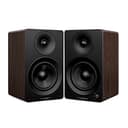
Fluance Ai41

Fluance Ai41

A step up in size and output from the entry powered speakers: 5-inch drivers, a 90-watt amp, Bluetooth, optical and a subwoofer output, in a properly finished cabinet. The pick when you want fuller sound and room to grow without moving to separates.

Best for a bigger room
$269.96 · View on Amazon

$299.9910% off

Price as of November 22, 2026. #ad How we’re funded

4
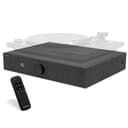
Andover Audio Spinbase 2

Andover Audio Spinbase 2

A single-box speaker system the turntable physically sits on top of, with the phono stage inside. Its patented ISOGroove anti-feedback design exists precisely because a deck on a speaker is normally a terrible idea — this is the one product built to make that arrangement work when you have one shelf and no more.

Best for one shelf
$299.00 · View on Amazon

$349.0014% off

Price as of November 22, 2026. #ad How we’re funded

5
Micca MB42

Micca MB42

The passive pick for people who want to choose their own amp: a compact two-way with a 4-inch carbon fiber woofer, a 0.75-inch silk dome tweeter and a published 60 Hz - 20 kHz response, sold as a pair for less than most powered speakers cost. It has no amplifier of its own, so buy these only if you have (or want) a separate amplifier or receiver — they will not work plugged straight into a turntable.

Best passive route
$79.99 · View on Amazon

Price as of November 22, 2026. #ad How we’re funded

The picks in full

#1Best alternative

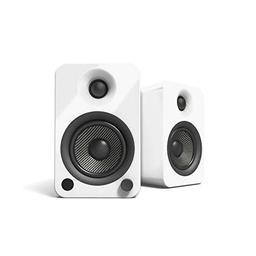
Kanto YU4

The smaller of Kanto's two vinyl-ready pairs, and the one most people should buy: a built-in phono preamp means a preamp-less turntable plugs straight in, and the 4-inch Kevlar drivers fit a desk or a narrow shelf where the YU6 will not. You are paying for the phono stage and the cabinet, not for watts.

Strengths

  • Built-in phono preamp — a turntable with no internal stage connects directly
  • Compact enough for a desk at 5.5 x 7.5 x 8.7 inches per cabinet
  • aptX Bluetooth and a remote, so the same pair serves streaming duty

Trade-offs

  • 4-inch drivers give up real low end to the 5.25-inch YU6
  • One phono input — a second source has to use the line or Bluetooth input
TypePowered (active) bookshelf
Phono preampYes — built in
Drivers4" Kevlar woofer, 1" silk dome tweeter
BluetoothYes — Qualcomm aptX
Peak power140 W (published)
Cabinet size5.5" W x 7.5" D x 8.7" H each

Note. Peak power is a marketing figure, not an RMS rating — Kanto does not publish RMS for this pair, so treat 140 W as a ceiling, not an output. The reason to buy it is the phono stage and the size, not the number. One timing note as of October 2026: Kanto has a next-generation YU4 listed as Coming Soon on its own site and has called this pair the outgoing version, so finishes are starting to disappear — the gloss black we linked before went unavailable. The new pair keeps the built-in phono preamp but is announced at a higher price, which makes the current YU4 a run-out buy rather than a mistake.

Specifications read from the manufacturer / product listing, on October 19, 2026. “Not published” means the maker does not state that figure.

#2Best for Bluetooth and a TV

Edifier R1280DB

The R1280T's more connected sibling: the same value formula plus Bluetooth, optical and coaxial inputs, so it handles a turntable and a TV and a phone. Still no phono preamp, so a deck needs its own stage — but as a do-everything desktop pair it's hard to beat.

Strengths

  • Bluetooth, optical and coaxial inputs on top of dual RCA
  • Same well-regarded value as the R1280T
  • Remote and tone controls

Trade-offs

  • No built-in phono preamp
  • Bluetooth codec is basic (SBC)
TypePowered (active) bookshelf
Power42W RMS total
InputsRCA x2, optical, coaxial, Bluetooth
Phono preampNo
ExtrasRemote, tone controls

Note. Pick this over the R1280T only if you want Bluetooth and digital inputs; for a pure turntable setup the cheaper R1280T is the same speaker.

Specifications read from the manufacturer / product listing, on July 24, 2026. “Not published” means the maker does not state that figure.

#3Best for a bigger room

Fluance Ai41

A step up in size and output from the entry powered speakers: 5-inch drivers, a 90-watt amp, Bluetooth, optical and a subwoofer output, in a properly finished cabinet. The pick when you want fuller sound and room to grow without moving to separates.

Strengths

  • 5-inch woven drivers and 90W of power fill a real room
  • Bluetooth, optical and RCA inputs, plus a subwoofer output
  • Handsome cabinet and included remote

Trade-offs

  • No built-in phono preamp — the turntable still needs a stage
  • Bigger footprint than the compact entry speakers
TypePowered (active) bookshelf
Power90W total
Drivers5-inch woven
InputsRCA, optical, Bluetooth 5
Phono preampNo
ExtrasSubwoofer output

Note. The subwoofer output is the standout here — it gives you an easy path to add low end later without changing speakers.

Specifications read from the manufacturer / product listing, on July 24, 2026. “Not published” means the maker does not state that figure.

#4Best for one shelf

Andover Audio Spinbase 2

A single-box speaker system the turntable physically sits on top of, with the phono stage inside. Its patented ISOGroove anti-feedback design exists precisely because a deck on a speaker is normally a terrible idea — this is the one product built to make that arrangement work when you have one shelf and no more.

Strengths

  • Phono input built in, so a preamp-less deck needs nothing else
  • ISOGroove anti-feedback design is engineered for a turntable placed on top of it
  • Bluetooth, analog, optical and USB inputs alongside the phono stage

Trade-offs

  • One cabinet means no stereo separation worth the name — soundstage is the price of the footprint
  • Not upgradeable: you cannot keep the speakers and add a better preamp later
TypeSingle-cabinet powered speaker system for turntables
Phono inputYes — built in
Other inputsBluetooth, analog, optical digital, USB
AmplificationDual Direct Drive (published)
IsolationPatented ISOGroove anti-feedback
ControlIR remote — input, volume, tone

Note. Andover does not publish an RMS power figure or a frequency response for the Spinbase 2, which is why neither appears above. Buy it for the footprint and the feedback engineering, not for a spec sheet.

Specifications read from the manufacturer / product listing, on August 19, 2026. “Not published” means the maker does not state that figure.

#5Best passive route

Micca MB42

The passive pick for people who want to choose their own amp: a compact two-way with a 4-inch carbon fiber woofer, a 0.75-inch silk dome tweeter and a published 60 Hz - 20 kHz response, sold as a pair for less than most powered speakers cost. It has no amplifier of its own, so buy these only if you have (or want) a separate amplifier or receiver — they will not work plugged straight into a turntable.

Strengths

  • Publishes real figures at a budget price — 4" carbon fiber woofer, 0.75" silk dome tweeter, 60 Hz - 20 kHz, 75 W each
  • A real two-way with a crossover and full-size five-way binding posts, unlike single-driver budget boxes
  • Lets you pick the amp and grow the system your way

Trade-offs

  • Passive — needs a separate amplifier or receiver AND a phono preamp
  • 85 dB sensitivity and a 6 dB/octave crossover: it wants a little more amplifier power than a more sensitive pair does
  • Not a plug-and-play choice for a first-time buyer
TypePassive (needs an amp)
Configuration2-way — 4" carbon fiber woofer, 0.75" silk dome tweeter
Crossover6 dB/octave, ported enclosure
Frequency response60 Hz - 20 kHz
Impedance4-8 ohms
Sensitivity85 dB 1W/1m
Power handling75 W each
Size9.5" H x 5.8" W x 6.5" D
AmplifierNone (external required)
Phono preampNone (external required)
Sold asPair

Note. These are the odd one out in a powered-speaker roundup on purpose: they show what the passive route costs in extra boxes. If the word 'amplifier' is new to you, buy powered speakers instead.

Specifications read from the manufacturer / product listing, on September 29, 2026. “Not published” means the maker does not state that figure.

How these were ranked

  • Does it remove a box, or add one?The R1280T’s real cost is not its price; it is the phono stage it assumes you already have. A pair with a built-in phono input makes a preamp-less deck work on its own, and that is the single most valuable upgrade on this page. Two picks do it: the Kanto YU4 and the Andover Spinbase 2.
  • Published power and driver size, not a peak figure.Where a maker prints an RMS rating we use it — 42 W total for both Edifiers, 90 W for the Fluance. Where a maker prints nothing, the table says so: Andover publishes neither an RMS power figure nor a frequency response for the Spinbase 2, which is recorded in its entry rather than filled in. Our page on how much power you need covers why the headline watt number matters less than it looks.
  • What it is actually for.Each pick answers one reason to leave the R1280T — the phono gap, the Bluetooth gap, room size, shelf space, or a preference for separates. No two picks here answer the same one, which is why there are five rather than ten.
  • Honest cons on every pick, including the top one. The YU4 costs double. The R1280DB still has no phono stage. The Ai41 is physically much bigger. The Spinbase 2 is one cabinet, so stereo separation is the price of its footprint. The Micca has no amplifier.
  • Live and in stock, checked the day this page was written.Every pick was confirmed as a live, purchasable listing before it was written about, and one came back with limited stock — which is why the buy button shows the current state rather than a figure typed into this page.

Match the alternative to your reason

Your turntable has no phono preamp. Buy the Kanto YU4. A deck like an entry belt-drivewith no internal stage needs one somewhere, and buying speakers that contain it is tidier and often cheaper than buying speakers plus a box. Check your deck first — what is a built-in phono preamp shows how to find the switch — because if you already have a switchable stage, you are paying for a feature twice and the R1280T stops looking like a compromise at all.

The other way to close that gap is to keep the R1280T and add the stage yourself, which is usually the cheaper of the two paths. Our phono preamps under $100 covers the solid-state boxes, and best tube phono preamps covers the valve ones, which bundle tone controls and a headphone output the speakers do not have. Either route gets a preamp-less deck playing; the difference is whether you end up with three boxes or two.

You want Bluetooth, or a TV on the same speakers. The R1280DB is the R1280T with Bluetooth, optical and coaxial inputs bolted on and the same 42 W amplifier inside. That is the cleanest possible alternative: nothing about the speaker changes, only the input list. It still has no phono stage, so it solves exactly one of the two omissions. If Bluetooth is the whole reason you are here, our Bluetooth speakers for vinyl roundup has the wider field.

The room is bigger than a desk.The Fluance Ai41 publishes 5-inch woven drivers and 90 W against the Edifier’s 4-inch drivers and 42 W, and adds a subwoofer output, which is the cheapest path to real low end later without replacing the speakers. It is also considerably larger, so measure the shelf. Our Ai41 review has the full specification, and best powered speakers ranks it against the rest of the category.

You have exactly one shelf.The Andover Spinbase 2 is a single cabinet the turntable sits on top of, with the phono stage inside and a patented anti-feedback design built specifically for that arrangement — which is normally a bad idea, and is why the engineering exists. You give up stereo separation worth the name, and you give up the ability to keep the speakers and upgrade the preamp later. For a one-shelf setup it is the only product here designed for the problem. Our guide to speaker placement for vinyl explains the feedback mechanism it is engineered around.

You would rather buy separates.The Micca MB42 is the passive route: a compact two-way with a published 60 Hz–20 kHz response, sold as a pair for less than the R1280T. Read the condition carefully — it has no amplifier, so it will not work plugged into a turntable, and the real cost is the pair plus an amp. What you get for that is an upgrade path: you can change the amp without changing the speakers, or the other way round. Our bookshelf speaker roundup covers the passive field and do you need an amp covers what the extra box has to do.

When the R1280T is still the right buy

Often. If your turntable already has a switchable built-in phono stage — most Fluance and Audio-Technica decks do — then the R1280T’s missing preamp costs you nothing, and none of the alternatives above gives you anything you need. On this page it remains the cheapest complete system by a clear margin, and the Micca only undercuts it on the sticker price, not on the price of a working setup.

That is worth saying plainly because the pattern we see in this category is people upgrading speakers to fix a problem that lives somewhere else. If your records sound dull or thin, the cause is more often the stylus, the tracking force or the phono stage than the speakers — our pages on why vinyl sounds muffled and how often to replace a stylus cover the cheaper diagnoses first. A new pair of speakers reproduces whatever arrives at them, including a worn tip.

The one case where the R1280T is genuinely the wrong buy is the one its specification states: you have a deck with no phono stage and you do not want to own a separate box. That is what the top pick on this page is for, and it is the only reason on the list that cannot be solved for less money somewhere else.

What changing speakers does and does not do

It changes output, dispersion and how much low end a cabinet can move — all of which are physical and all of which are real. It does not change the signal arriving at the inputs. A powered pair with no phono stage fed from a turntable with no phono stage will be nearly silent whichever model you buy, because that is a level problem and not a speaker problem; see phono vs line for why.

It also does not change placement, and placement is free. Getting a pair off a desk surface and onto stands, away from the wall behind them and roughly at ear height, is the single biggest improvement available to anyone on this page at no cost beyond the stands themselves — our speaker stand picks and placement guide cover it. Do that before you spend on a cabinet upgrade.
Frequently asked questions

What is a good alternative to the Edifier R1280T?

The Kanto YU4 for most turntable owners, because it has a phono preamp built in and the R1280T does not - so a deck with no internal stage works with it on its own, with no extra box to buy. It costs roughly twice as much, which is the trade. If all you want is the R1280T plus Bluetooth, optical and coaxial inputs, the Edifier R1280DB is the same speaker with the input list extended.

Why does the Edifier R1280T need a phono preamp?

Because its RCA inputs are line level. A turntable cartridge puts out a few thousandths of a volt and needs roughly 40 dB of gain plus RIAA equalization before any line input can use it. The R1280T has an amplifier but no phono stage, so that gain has to come from somewhere else - either your turntable's own switchable built-in preamp, or a separate box. Many modern decks have one, in which case the R1280T needs nothing added.

Does the Edifier R1280T have Bluetooth?

No. The R1280T is wired only: two RCA line inputs. The R1280DB is the model that adds Bluetooth along with optical and coaxial digital inputs, using the same 42 W RMS amplifier and the same cabinet. Neither model has a phono input, so a turntable still needs a preamp stage with either one.

Is the Kanto YU4 worth the extra money over the R1280T?

It depends entirely on one thing: whether your turntable already has a phono preamp. If it does not, the YU4's built-in phono input replaces a purchase you would otherwise make, and the gap narrows considerably. If your deck does have a switchable internal stage, you are paying extra for a feature you already own, and the cheaper R1280T does the same job.

Can I connect a turntable directly to the Micca MB42?

No. The MB42 is a passive speaker - it contains no amplifier at all, so there is nothing to drive it. It needs an amplifier or receiver between it and the turntable, and if the turntable has no built-in phono stage, a phono preamp as well. That is why it is listed here as the passive route rather than as a cheaper drop-in replacement.

Are powered speakers worse than passive speakers for vinyl?

Not inherently. A powered pair has the amplifier matched to its own drivers by the people who designed both, which removes a whole category of mismatch. What you give up is modularity: you cannot change the amplifier without changing the speakers. Passive pairs let you upgrade either half separately and generally cost less for the cabinet alone, at the price of a second box. Our powered versus passive page covers the trade in full.

What should I upgrade before buying new speakers?

Placement first, because it is free: speakers off the desk surface, away from the wall behind them, roughly at ear height. Then check the stylus - a worn tip sounds dull on any speaker, and a replacement costs far less than a pair of cabinets. Then the phono stage, if your deck is relying on a cheap internal one. Speakers reproduce what arrives at them, including the problems upstream.

Sources

  • Edifier R1280T — live retail listing (B016P9HJIA) — Cited as the listing rather than the maker page, deliberately: the Edifier R1280T URLs on edifier.com returned HTTP 404 to an automated request on this date and the regional mirrors redirect to the same 404. The listing title, resolved live through the Creators API on this date, reads "Edifier R1280T Powered Bookshelf Speakers - 2.0 Active 42 Watts RMS Powered..." — i.e. 42 W RMS total, an active 2.0 pair. Availability "In Stock" at $144.68 on 2026-11-16. The listing publishes NO phono input and NO Bluetooth for this model, which is the whole basis of the alternatives page: both omissions are real, and both are the reason a reader is looking (accessed November 16, 2026)
  • camelcamelcamel — Edifier R1280T price history (B016P9HJIA) — Third-party new: $129.99 on September 4, 2026, average $132.00 over a history that began in 2016 (the $1.54 "lowest" on August 26, 2016 is a listing artifact, not a price anyone paid). The site's top-pick powered speaker sits at its long-run average today (accessed September 13, 2026)
  • Kanto Audio — YU4 powered speakers — Manufacturer page for the built-in phono preamp, aptX Bluetooth and cabinet dimensions (accessed August 19, 2026)
  • Andover Audio — Spinbase 2 — Manufacturer page: phono input, ISOGroove anti-feedback design for a turntable placed on top (accessed August 19, 2026)
  • Crutchfield — Home speakers buying guide — Reference on choosing passive vs powered speakers, room size and amplifier pairing (accessed August 11, 2026)
  • Crutchfield — Understanding speaker and amplifier wattage ratings — On RMS versus peak power, and matching an amplifier's output to a speaker's rating (accessed August 11, 2026)

Keep reading