Klipsch RP-600M II Review
The most sensitive speaker in our registry, and the reason small tube amplifiers keep ending up in front of Klipsch. It is also 13 inches deep and will not fit your bookshelf.
How this is funded: we earn a commission if you buy through our links, at no extra cost to you. It never changes which product we recommend, and we’ll tell you plainly when to skip one. Full disclosure.
The short version
Klipsch RP-600M II
Buy it if the amplifier is modest, the stands are real and the pressings are good. Do not buy it as a bookshelf speaker, and do not buy it if the budget still has to cover an amplifier.
Strengths
- 94.5 dB published sensitivity - the highest here, and the reason low-watt amplifiers get paired with Klipsch
- A 6.5" Cerametallic woofer takes the published low end to 44 Hz, deep enough to skip a subwoofer for most records
- Dual binding posts for bi-wiring or bi-amping, and cork pads rather than rubber bumpers for stand use
Trade-offs
- Still passive: an amplifier and a phono stage are separate purchases on top of it
- Published at 15.75" tall and 13" deep - this is a big "bookshelf" speaker and it will not fit a shallow shelf
- The titanium tweeter on an expanded horn is the most forward treble in the lineup; it rewards good pressings and exposes bad ones
| Type | Passive 2-way bookshelf, bass-reflex (rear Tractrix port) |
|---|---|
| Woofer | 6.5" Cerametallic cone with Faraday rings |
| Tweeter | 1" titanium LTS vented, hybrid cross-section expanded Tractrix horn |
| Frequency response | 44 Hz - 25 kHz +/-3 dB |
| Sensitivity | 94.5 dB (2.83 V / 1 m, half-space anechoic, in-room) |
| Impedance | 8 ohms compatible |
| Crossover | 1,500 Hz |
| Power handling | 100 W continuous / 400 W peak |
| Inputs | Dual aluminum binding posts (bi-wire / bi-amp) |
| Cabinet | Internally braced MDF, 15.75 x 7.95 x 13", 18.1 lb |
Specifications read from the manufacturer / product listing, accessed 2026-09-29. We have not measured this unit — what we do instead.
Price as of October 26, 2026. #ad How we’re funded
What it is, in one paragraph
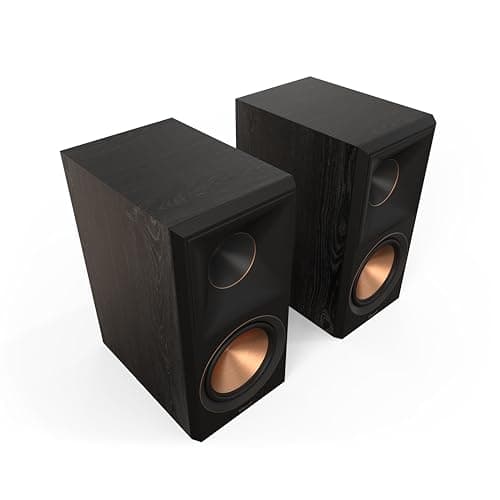
The RP-600M II is a passive two-way standmount from the second generation of Klipsch’s Reference Premiere range: a single 6.5-inch Cerametallic cone woofer with Faraday rings and a 1-inch titanium LTS vented tweeter on what Klipsch calls a hybrid cross-section expanded Tractrix horn, in an internally braced MDF cabinet with a rear-firing Tractrix port. It is sold in Ebony and Walnut. We have not heard this pair, and nothing below pretends otherwise: every figure on this page comes from Klipsch’s own published specification sheet, cited in Sources, and the rows Klipsch does not print are not filled in from a forum.
The sensitivity figure is the whole argument
Klipsch publishes 94.5 dB at 2.83 V / 1 m, with the same footnote the rest of the range carries — SPL at 1 m, half-space anechoic, with a 2.83 V input. It is the highest sensitivity of any passive pair in our registry, and it is the reason this speaker exists in the form it does.
Sensitivity is how much sound you get for a given electrical input, and because the scale is logarithmic the consequences are larger than the numbers look. Every 3 dB of sensitivity gained roughly halves the amplifier power needed for the same loudness. Against an 87 dB speaker — the Q Acoustics 3020c, for instance — the RP-600M II needs something close to a quarter of the power to reach the same level in the same room. A 20 W amplifier that embarrasses itself on a low-sensitivity pair is comfortable here.
That has a direct effect on a vinyl budget, which is not an abstract point. A record system is five purchases, not one: deck, cartridge, phono stage, amplifier, speakers. A speaker that lets the amplifier be small and cheap moves money to the parts of the chain where it buys more — which, on a turntable, is almost always the stylus. It is also why Reference Premiere keeps appearing on the end of low-power tube and class-A amplifiers: those designs produce few watts and sound best not straining, and a 94.5 dB speaker does not make them strain.
One honest qualification. Klipsch’s figure is measured half-space anechoic at 2.83 V, and makers do not all use the same condition — Q Acoustics quotes 2.83 Vrms at 1 kHz into a different reference, and a dB/mW figure from a headphone maker is a different test again. Read Klipsch numbers against Klipsch numbers first. Within the brand the comparison is clean, and that is exactly what our RP-600M II vs R-50M page is for.
Reading the frequency response honestly
Klipsch publishes 44 Hz – 25 kHz, ±3 dB. The window matters as much as the endpoints: ±3 dB is a stricter condition than the -6 dBlimit several British makers print, which allows the output to have fallen twice as far in decibel terms before the number is quoted. So the RP-600M II’s 44 Hz and a competitor’s 60 Hz at -6 dB are not two points on one scale, and the gap between them is wider than subtracting them suggests.
Forty-four hertz is more low-frequency reach than vinyl usually asks for. Bass below roughly 40 Hz is cut carefully on records, if at all, because large excursions at very low frequencies are what make a stylus lose the groove — one of the reasons 45 RPM pressings exist at all. A pair that is genuinely flat into the mid-40s from a braced cabinet is doing more for an LP than a bigger number achieved with a boomy port would.
The other end of the sheet is where the character lives. The crossover is published at 1,500 Hz, which is low for a 6.5-inch two-way — lower than the R-50M’s 1,560 Hz and the R-40M’s 1,770 Hz. A lower crossover hands more of the upper midrange to the horn and less to the woofer, which is the technical reason Reference Premiere sounds the way it does: vocals and strings sit in the horn’s territory rather than being split across the handover.
What the cabinet and the terminals tell you
- Internally braced MDF. Bracing stiffens the panels that would otherwise flex and radiate their own delayed version of the music. It is the least glamorous line on a spec sheet and one of the few that reliably correlates with a cabinet staying out of the way.
- Rear-firing Tractrix port.A ported design needs air behind it. Against a wall, the port’s output reflects back and the low end thickens; Klipsch’s own placement advice for the range is to leave room. This is the single most common way a good Klipsch pair ends up sounding muddled in a real room.
- Dual aluminum binding posts, bi-wire or bi-amp capable.Most people will never use them, and that is fine — the straps stay in and one pair of cables does the job. They are a sign of where the model sits in the range rather than a feature you need.
- Cork pads instead of rubber bumpers. Klipsch calls this out on the sheet, and it is a small tell that the speaker expects to live on a stand or a hard surface rather than on carpet or a shelf liner.
- 8 ohms compatible, 100 W continuous / 400 W peak.“8 ohms compatible” is Klipsch’s own wording across the range rather than a measured nominal impedance, and the power handling is a tolerance figure. Neither is a recommendation to buy a big amplifier.
What it needs around it
The shopping list is longer than the speaker, and pretending otherwise is how people end up disappointed. The RP-600M II is passive: it needs an amplifier, and the signal needs exactly one phono stagebetween the cartridge and that amplifier — in the deck, in the amplifier, or in a separate box. Thanks to the sensitivity, the amplifier can be the cheap part of that list for once.
It needs stands, not optionally. At 15.75 inches tall the tweeter lands near ear height on a 24-inch stand and well below it on a sideboard, and a 13-inch-deep cabinet overhangs most shelves. Stands are the cheapest meaningful improvement available once a speaker is chosen — ahead of any cable, by a distance.
And it needs a source worth the resolution. This is a pair that shows you what the deck in front of it is doing: tracking error, a worn stylus, a dirty record. The sensible partner is a deck with an adjustable counterweight and a decent elliptical or better cartridge, which is the territory of our picks under $1,000. A $150 automatic with a conical stylus will play perfectly well through it and will also make its own compromises audible — which is what a revealing speaker is for, but not what everyone wants.
Who should buy it, and who should not
Buy it if the amplifier is modest or already owned, there is space for stands, and the collection is in reasonable condition. For a low-power integrated amplifier or a small tube amp, this is close to the ideal passive partner: the sensitivity means nothing is being asked to strain, the published low end covers what a record carries, and the cabinet and crossover are doing real engineering rather than marketing.
Do not buy itin three cases, each of them real. First, if the budget still has to cover the amplifier and the phono stage — the price here buys drivers and a box, and a powered pair with a phono input buys a working system for less. Second, if the speakers must go on an actual bookshelf: the dimensions say no, and the port says it louder. Third, if most of your records are second-hand and played on a budget deck, a gentler dome-tweeter pair from our picks under $500 will be the happier long-term purchase. A speaker that tells you the truth is only a gift if you want to hear it.
Frequently asked questions
Is the Klipsch RP-600M II good for a turntable?
Yes, and for a specific reason: Klipsch publishes 94.5 dB sensitivity at 2.83 V / 1 m, which is high enough that a modest amplifier drives it to real levels. That matters on a vinyl budget, where the money has to stretch across deck, cartridge, phono stage, amplifier and speakers. The caveat is the other direction - it is a revealing, forward-sounding pair, so a worn stylus or a noisy pressing is audible rather than hidden.
What amplifier does the RP-600M II need?
Less than you would expect. At a published 94.5 dB and 8 ohms compatible, 20 to 30 W of honest power plays loudly in a normal room; the spec sheet's 100 W continuous rating is a ceiling for what the speaker tolerates, not a requirement. This is why Reference Premiere turns up on the end of small tube and class-A amplifiers so often. Our amplifier picks cover both the integrated amplifiers with a phono input and the cheaper boards that need a separate phono box.
How does the RP-600M II compare with the R-50M?
Klipsch prints both sheets in the same format, so the rows are directly comparable: 94.5 dB against 92 dB sensitivity, 44 Hz against 58 Hz at plus or minus 3 dB, 100 W against 75 W continuous power handling, a 6.5-inch Cerametallic woofer against a 5.25-inch spun-copper one, and dual bi-wire binding posts against single posts. The RP-600M II wins every row and costs substantially more. We have put the two side by side in full on our RP-600M II vs R-50M page.
Is 44 Hz deep enough without a subwoofer?
For records, almost always yes. Bass below roughly 40 Hz is cut sparingly on vinyl because large low-frequency excursions push a stylus out of the groove, which is part of why 45 RPM pressings exist. A pair honest to 44 Hz at plus or minus 3 dB from a braced, ported cabinet covers what an LP actually carries. A subwoofer buys you film and electronic music, not more of the record.
Will the RP-600M II fit on a bookshelf?
Probably not. Klipsch publishes 15.75 inches high, 7.95 inches wide and 13.00 inches deep at 18.1 lb each - a stand speaker that the category calls a bookshelf. A standard shelf is around 11 to 12 inches deep, and even where it fits, a rear-firing Tractrix port crammed against a panel exaggerates the low end and blurs the thing the braced cabinet exists to protect. Plan on stands.
Do I need a phono preamp with the RP-600M II?
Yes - somewhere in the chain, exactly once. The RP-600M II is passive: no amplification and no phono stage inside it, so a turntable cannot connect to it directly. The phono stage is either inside the deck, inside the amplifier, or in a separate box. Two in series is the most common wiring mistake in vinyl and it sounds like distorted, uncontrollable mud.
Is the titanium tweeter too bright for vinyl?
It is the most forward treble in the range, and whether that reads as detail or as hardness depends on what you feed it. On a clean pressing played with a well-aligned elliptical stylus it is genuinely revealing. On a worn stylus, a dirty record or a loud modern remaster it is unforgiving. If your collection is mostly thrift-shop copies, a softer dome-tweeter pair is the kinder purchase - that is a real argument against this speaker, not a formality.
Sources
- Klipsch — Reference Premiere RP-600M II spec sheet (PDF) — Manufacturer specification table, read live: frequency response 44 Hz - 25 kHz +/-3 dB, sensitivity "94.5dB @ 2.83V / 1m", power handling 100 W / 400 W, nominal impedance "8 Ohms Compatible", crossover 1,500 Hz, high-frequency driver "1" Titanium LTS Vented Tweeter with Hybrid Cross-Section Expanded Tractrix Horn", low-frequency driver "6.5" Cerametallic Cone Woofer with Faraday rings", enclosure "MDF (Internally Braced)", "Bass Reflex via rear-firing Tractrix Port", inputs "Dual aluminum binding posts/bi-wire/bi-amp", 15.75" (40.0 cm) H x 7.95" (20.2 cm) W x 13.00" (33.0 cm) D, 18.1 lb (8.20 kg), finishes Ebony and Walnut, and "Cork pads replace rubber bumpers for security on a stand or table". Same sensitivity footnote as the Reference sheets (accessed September 29, 2026)
- Klipsch — Reference R-50M spec sheet (PDF) — Manufacturer specification table, read live: frequency response 58 Hz - 21 kHz +/-3 dB, sensitivity 92 dB (In-Room), power handling 75 W / 300 W, nominal impedance "8 ohms Compatible", crossover 1,560 Hz, high-frequency driver "1" Aluminum LTS tweeter mated to a 90 x 90 square Tractrix Horn", low-frequency driver "Single 5.25" spun-copper TCP woofer", enclosure MDF, "Bass-Reflex via rear-firing ports", inputs "Single Gold Plated Binding Posts", 13.9" (354 mm) H x 7" (178 mm) W x 9" (229 mm) D, 11 lbs (5 kg), Black Textured Wood Grain Vinyl. The sensitivity asterisk reads "SPL at 1M, half-space anechoic with 2.83V input". Read alongside the R-40M sheet, which is printed in the identical format — the two are directly comparable line for line (accessed September 29, 2026)
- Klipsch — Reference R-40M spec sheet (PDF) — Manufacturer specs: 91 dB in-room sensitivity, 71 Hz - 21 kHz +/-3 dB, 8 ohms compatible, 1,770 Hz crossover, 50 W / 200 W power handling (accessed August 28, 2026)
- Crutchfield — Home speakers buying guide — Reference on choosing passive vs powered speakers, room size and amplifier pairing (accessed August 11, 2026)
- Crutchfield — Understanding speaker and amplifier wattage ratings — On RMS versus peak power, and matching an amplifier's output to a speaker's rating (accessed August 11, 2026)
Keep reading
Klipsch RP-600M II vs R-50M
Reference Premiere against Reference, on the eleven published rows that differ and the two that do not.
Compare themBest Klipsch Speakers for Vinyl
Where this pair sits in the range, powered and passive, with the sensitivity figures side by side.
See the picksBest Bookshelf Speakers for Vinyl
The passive field compared on the two specs that decide which amplifier you need.
See the picksBest Amplifiers for a Turntable
What a 94.5 dB speaker lets you get away with, and what it does not.
See the picks