Why Does My Vinyl Sound Muffled or Dull?
Six causes, ordered by how often each one turns out to be the answer. The first costs nothing and takes ten seconds, and it is right more often than everything below it combined.
How this is funded: we earn a commission if you buy through our links, at no extra cost to you. It never changes which product we recommend, and we’ll tell you plainly when to skip one. Full disclosure.
The short answer: clean the stylus. A compacted ball of dust on the diamond is the most common cause of dull, muffled vinyl by a wide margin, it builds up over a handful of sides, and brushing it off costs nothing and takes ten seconds. If that does not fix it, the next four causes — a worn stylus, tracking force, dirty records and speaker placement — account for almost everything else, and this page works through them in that order deliberately. Diagnose from cheapest and likeliest to most expensive and least likely, not the other way round.
1. A dirty stylus
The diamond is traced in micrometers, and the groove detail it reads is finer still. A speck of dust visible to your eye is therefore enormous at the scale that matters: it physically holds the tip away from the high-frequency modulation of the groove wall, and it adds mass right where mass does the most damage to transients. The result is exactly what people describe — the music is all there, but as though someone had drawn a curtain across it.
Brush it front to back only, in the direction the record travels, with a dry carbon-fiber stylus brush. Never side to side: the cantilever is a thin tube and lateral force bends it. Our stylus cleaning guide covers the wet-clean options and which ones to avoid.
Then make it a habit. Every few sides is enough, and it is the cheapest maintenance in the hobby.
2. A worn stylus
A worn diamond sounds dull and harsh at the same time, which is an odd combination until you picture the tip: once a flattened facet forms, it loses the fine detail and starts to mistrack the loud passages, so the top end disappears while sibilance gets edgier.
Specialist dealers put the usable life of a conical or elliptical diamond in the several-hundred to roughly one-thousand-hour range, depending on the tip profile and how clean the records are. The figure matters less than the question it raises: if you cannot remember when the stylus was last changed, that is your answer. A stylus swap on a VM95 or AT3600L body is a tool-free job that takes about a minute, and it does not disturb the cartridge alignment.
This is also the cause most likely on a secondhand deck, where the hours are unknowable — see buying a used turntable.
3. Tracking force, in either direction
Tracking force decides how the tip sits in the groove, and both errors are audible. Too heavy and it rides too deep: thick, dull, lifeless, with the life squeezed out of the midrange. Too light and it skips across the groove wall rather than tracing it: thin and bright, with distortion on loud choruses that clears up on quiet passages.
The fix is a published number, not a judgement call. Audio-Technica publishes 1.8 to 2.2 g for the AT-VM95E (2.0 g typical) and Ortofon publishes 1.6 to 2.0 g for the 2M Red and 2M Blue (1.8 g recommended). Set the counterweight to that figure — our tonearm guidewalks through it — and then confirm it with a gauge rather than trusting the dial, because the dial is calibrated to the arm and not to your cartridge.
One caveat worth knowing: decks with a fixed tonearm and no counterweight — the AT-LP60X, most all-in-ones, every suitcase player — cannot be adjusted at all. On those, this cause is off the list and the next one matters more.
4. Dirty records
Dust in the groove does two things at once: it muffles, and it supplies the crackle underneath. If the records in question have lived without inner sleeves, or have been played with a dirty stylus (the dirt transfers both ways), the discs are now part of the problem.
A dry carbon-fiber brush before each side keeps clean records clean. Records that are already grubby need a wet clean, which is what a cleaning kit is for, and a collection bought secondhand may justify a washer or a machine. Then sleeve them properly, because cleaning a record and returning it to a torn paper sleeve is a short-lived victory.
5. The speakers and the room
Here is the test that saves a lot of wasted effort: play something streamed through the same speakers. If that sounds equally veiled, the turntable was never the problem.
Two things to check. First, polarity— both speakers wired positive to positive. A pair wired out of phase sounds vague, thin in the bass and strangely distant, and it is an easy mistake to make with bare wire. Second, placement: a rear-ported speaker pushed hard against a wall or firing into a bookshelf loses clarity before it loses volume, and getting the tweeter to ear height is usually worth more than any component upgrade at this end of the market. Our placement guide covers both, and neither costs anything.
6. The cartridge doing exactly what it was built to do
If everything above checks out and the sound is still soft at the top, the stylus profile may simply be the limit. A conical tip has one spherical radius and cannot enter the finest high-frequency modulation in the groove wall; an elliptical tip has two radii and traces more of it; a micro-linear profile more again. That is a design ceiling rather than a fault.
It is also the cheapest real upgrade available on most decks. An AT-LP60X takes the ATN3600LE elliptical stylus in place of its conical one, and the VM95 family on the AT-LP70X, AT-LP120XUSB and AT-LP5X climbs from conical to elliptical to micro-linear with no remounting at all. Our cartridge roundup and upgrade order guide cover which rung is worth paying for on which deck.
What this is not
If the sound is quiet and thin rather than muffled, stop reading this page: that is a missing phono stage, not a stylus. Without one, the gain is absent and the RIAA curve is never reversed, which sounds bass-light and distant rather than dull. Do I need a phono preamp settles that in one look at the back panel, and does a better one make a difference covers what changes once you have one.
And if the problem comes and goes with particular records rather than across the collection, the pressing may be the variable: how to spot a bad pressing covers what a dull reissue actually sounds like.
What fixes each cause, with live prices
In the order the page works through them: a stylus brush for the dirty-stylus case, a replacement stylus for the worn one, a force gauge to confirm the arm is set to the cartridge's published figure, and a cleaning kit for records that have been played without sleeves. Nothing here is expensive, and the first two cover most dull-sounding systems.
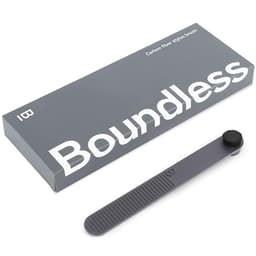
Boundless Audio Carbon Fiber Stylus Brush
The every-few-plays stylus habit
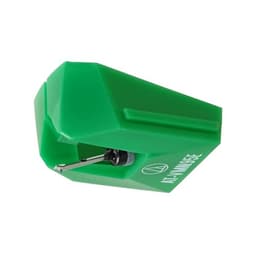
Audio-Technica AT-VMN95E Replacement Stylus
Replacing a worn stylus without touching the alignment
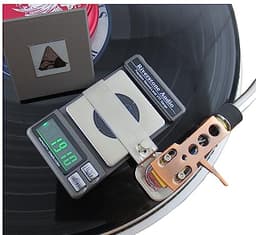
Riverstone Audio Record-Level Stylus VTF Gauge
Anyone who has set tracking force once and wants to know it was right
Price as of October 16, 2026. #ad How we’re funded
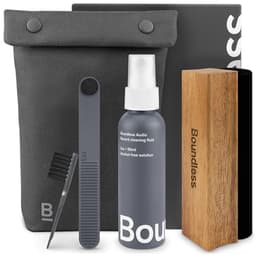
Boundless Audio Record Cleaning Kit
A complete starter record-cleaning routine
Frequently asked questions
Why does my vinyl sound muffled?
Most often because the stylus is dirty. A compacted ball of dust on the diamond physically stops it reaching the high-frequency detail in the groove wall, and it builds up over a handful of sides. Brush it front-to-back with a carbon-fiber stylus brush and listen again before you investigate anything else. After that, in order of likelihood: a worn stylus, tracking force set too high or too low, dirty records, speaker placement, and a conical stylus doing what conical styli do.
Can a dirty stylus make records sound dull?
Yes, and it is the single most common cause of a system that used to sound fine and now does not. The stylus tip is traced in micrometers, so a visible speck is enormous relative to the groove detail it is meant to read. Dust also adds mass at the tip, which blunts transients. It is a ten-second fix that people skip for months.
Does a worn stylus sound muffled?
It sounds dull and increasingly harsh at the same time - detail disappears while sibilance gets edgier, because a flattened tip can no longer trace the groove wall accurately. Specialist dealers generally quote several hundred to around a thousand hours for a conical or elliptical diamond. If you cannot remember replacing yours and the system has lost its top end, replace it before suspecting anything else.
Can tracking force make vinyl sound muffled?
Yes, in both directions. Too heavy and the stylus sits too deep, which sounds thick, dull and lifeless; too light and it skates over the groove wall, which sounds thin and bright with mistracking on loud passages. Set it to the figure the cartridge maker publishes - 1.8 to 2.2 g for an Audio-Technica AT-VM95E, 1.6 to 2.0 g for an Ortofon 2M Red - and confirm it with a gauge rather than trusting the dial.
Do I need to clean my records to fix dull sound?
If they have been stored without inner sleeves or played with a dirty stylus, yes. Dust in the groove is both the muffling and the source of the surface noise underneath it. A dry carbon-fiber brush before each side keeps clean records clean; records that are already grubby need a wet clean, which is what a cleaning kit or a washer is for.
Could my speakers be the reason vinyl sounds dull?
They can be the reason everything sounds dull, which is a useful distinction - if streaming through the same speakers sounds equally veiled, the turntable is not the problem. Check that both speakers are wired the same way round, positive to positive: a pair wired out of phase sounds vague, thin in the bass and oddly distant. Then check placement, because a speaker firing into a bookcase or pushed hard against a wall loses clarity before it loses volume.
Is a conical stylus the reason my records sound muffled?
Partly, and it is the one cause on this list that is working as designed. A conical tip has a single spherical radius and cannot sit in the finest high-frequency modulation of the groove wall; an elliptical tip has two radii and traces more of it. That is why the first upgrade on an AT-LP60X is the ATN3600LE elliptical stylus, and why the VM95 family on the AT-LP70X and AT-LP120XUSB can climb from conical to elliptical to micro-linear without remounting anything.
Why does my vinyl sound quiet and thin rather than muffled?
That is a different fault with a different cause: there is no phono stage in the chain, so neither the gain nor the RIAA equalization has been applied. Quiet and bass-light points at a missing phono preamp, not at the stylus. Our 'do I need a phono preamp' guide covers how to tell in one look at the back panel.
Sources
- Elusive Disc — Elliptical or Shibata stylus, and when to replace one — Retailer reference: "Replace the stylus every 800-1000 hours (dependent on usage and model)" (accessed August 19, 2026)
- Library of Congress — Caring for and cleaning grooved discs — Preservation guidance on cleaning and storing records to prevent damage (accessed July 24, 2026)
- Audio-Technica — AT-VMN95E replacement stylus — Manufacturer page for the elliptical VM95-series replacement stylus and its fitment list (accessed August 11, 2026)
- Audio-Technica — ATN3600LE elliptical replacement stylus — The AT-LP60X's one upgrade rung, from the maker: "This elliptical bonded stylus makes it easy to upgrade the sound quality of any turntable equipped with an ATN3600L or ATN3600LC conical stylus, such as the turntables in our popular AT-LP60X series"; stylus shape "Elliptical bonded", dimensions "0.3 x 0.7 mil"; "Vertical Tracking Force 3.0 to 4.0 g (3.5 g standard)"; stylus life "Approx. 300 hours"; the same compatibility list as the ATN3600LC. Read alongside the VM95C page, this is the fact the comparison turns on: the LP60X's elliptical option still tracks at 3.5 g, because the force is set by the arm and the cartridge body it was designed for, not by the stylus (accessed September 18, 2026)
- Audio-Technica — AT-VM95E cartridge — Manufacturer specs: 0.3 x 0.7 mil elliptical stylus on an aluminum cantilever, 4.0 mV output at 1 kHz / 5 cm/sec, 1.8-2.2 g tracking force (2.0 g standard), 20-22,000 Hz, 20 dB channel separation at 1 kHz, half-inch mount, AT-VMN95E replacement stylus, and the maker's own statement that "all VM95 Series share the same body" so the stylus "can be replaced with any of the six interchangeable AT-VMN95 replacement styli". Re-read on the access date below, which corrected a tracking-force range previously noted here as 1.8-2.3 g (accessed September 26, 2026)
- Riverstone Audio — Record-Level Stylus VTF Pressure Gauge (Graphite) — The maker's own page, and the argument the whole page is ranked on: "For accurate VTF measurement, the stylus tip should be at the same vertical position as the record surface - that is, at \"record level\"." With the patented arm (US Patent D878232) "vertical tracking force is measured approx. 2 mm to 3 mm from the surface of a turntable mat or platter - which is the height of a stylus tip resting on an LP record (LP's have a thickness range of 1.9 mm to 2.9 mm)", while "less expensive gauges typically have a stylus tip measurement distance between 6 and 8 mm". Published figures: 0.005 g resolution; "All gauges we ship will have a measurement error within +/-0.005 g" after "a rigorous multi-point calibration procedure"; two calibration masses (5 g and 20 g) supplied; re-calibratable "for use up to 100 g" with additional masses; housing "durable plastic", arm "316 stainless steel, a premium non-ferromagnetic grade", locking screw "machined from brass"; 52 mm x 91 mm x 12 mm; one AAA alkaline, not included; a warning about counterfeit copies of the design on marketplaces; and the honest line that fitting the arm "requires a good pair of glasses, a bit of technical savvy, and a good dose of patience" (accessed September 15, 2026)
- Audio-Technica — Balancing the tonearm and setting tracking force — Manufacturer procedure for zero-balancing an arm, then dialing tracking force and anti-skate (accessed August 19, 2026)
- Crutchfield — Phono cartridge guide — Reference on cartridge types, styli and mounting (accessed July 24, 2026)
Keep reading
How to Clean a Turntable Stylus
The ten-second fix that is the answer here more often than anything else - done the safe way.
Read the guideHow to Balance a Tonearm
Setting tracking force to the cartridge's published figure, with and without a gauge.
Read the guideBest Replacement Styli
What to fit when the diamond is the problem, by cartridge family rather than by brand.
See the picksWhy Is My Record Skipping?
The neighboring fault, with an overlapping cause list - tracking force sits in both.
Read the guide