PLATTER & PLINTH

The Best Audio-Technica Turntables

Audio-Technica sells the same three ideas at six prices. The row that decides which one you want is not the price — it is the cartridge socket, because that is what fixes how far the deck can ever go.

By Stephen V.Last updated How we pick

The verdict

The best Audio-Technica turntable for most people is the AT-LP120XUSB, because it is the cheapest deck in the range with the three things that let a turntable grow: a standard half-inch cartridge mount, an adjustable counterweight and anti-skate, and a third speed. It is for the buyer who expects to still own this deck in ten years and to have changed the cartridge twice by then. If you do not want to learn tonearm setup at all, the AT-LP60X is the one to buy — it is fully automatic, it cannot be set up wrong, and its fixed arm is the honest trade for that. Between those two sits the AT-LP70X, the only automatic in the range with a VM95-series cartridge and therefore the only automatic with a real stylus ladder above it. The rest of this page is about the one spec that separates those three answers.

Audio-Technica is the brand most people meet first, and the range is deliberately laid out as a ladder: an entry automatic, a step-up automatic, a direct-drive manual deck, and wireless versions of two of them. What the model numbers do not tell you is that the ladder has a break in it, and the break is not where the price jumps.

Every deck here carries a cartridge. Two of them carry the AT3600Lfamily, a fixed cartridge body with exactly two styli available for it from the maker — the conical one it ships with, and one elliptical upgrade. The rest carry the VM95 series, a half-inch mount whose single socket accepts conical, elliptical, micro-linear and Shibata styli, so the same cartridge body can be re-tipped upward several times. That is the real ladder, and it is invisible on a spec sheet that lists both as a replaceable stylus.

So this page ranks on four things Audio-Technica publishes: which cartridge socket the deck has, because it caps the upgrade path; whether the tonearm has a counterweight, because that decides whether you can set tracking force to a cartridge’s own specification; how many speeds, because only the direct-drive decks here play 78s; and what outputs are on the back, since every deck in this range has a switchable phono preamp but only some add USB or Bluetooth. Prices are live on each button and dated. Nothing is written into the copy.

How this is funded: we earn a commission if you buy through our links, at no extra cost to you. It never changes which product we recommend, and we’ll tell you plainly when to skip one. Full disclosure.

Quick picks

Read the Operation column first: it splits this range in half far more usefully than price does. Every figure comes from Audio-Technica’s own published specification or from the listing cited under each deck, read on the date shown there. Prices are live and dated on each button. Select a row to jump to the full write-up — we have not heard these decks, here is exactly what we do instead.

#ProductBest forPrice
1
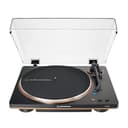
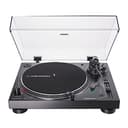
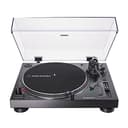
Audio-Technica AT-LP120XUSB

Audio-Technica AT-LP120XUSB

The tinkerer's deck: a direct-drive, fully manual turntable with adjustable tracking force, anti-skate, selectable pitch and a USB output for digitizing records. It ships with the VM95E elliptical and a switchable preamp, so it's ready to play and ready to grow.

Best overall
$349.00 · View on Amazon

$449.0022% off

Price as of October 6, 2026. #ad How we’re funded

2
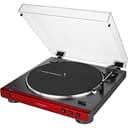
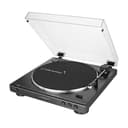
Audio-Technica AT-LP60X

Audio-Technica AT-LP60X

The default first turntable for a reason: it's fully automatic, so you press one button and it cues, plays and returns the arm on its own — nothing to set up wrong. The built-in switchable preamp lets it plug into anything, and it tracks safely enough to trust with your records.

Best first deck
$179.00 · View on Amazon

$199.0010% off

Price as of October 6, 2026. #ad How we’re funded

3
Audio-Technica AT-LP70X

Audio-Technica AT-LP70X

The automatic that grew up: it keeps the one-button convenience of the LP60X but adds a proper VM95-series cartridge and a die-cast platter, so it sounds a clear step better while still cueing itself. The natural pick if you want automation without the budget-deck ceiling.

Best automatic
$249.00 · View on Amazon

Price as of October 6, 2026. #ad How we’re funded

4
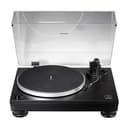
Audio-Technica AT-LP5X

Audio-Technica AT-LP5X

The grown-up direct-drive Audio-Technica: a J-shaped tonearm modeled on the brand's 1960s designs, a removable AT-HS6 headshell, the AT-VM95E cartridge and three speeds including 78 RPM. It is fully manual and aimed at listeners rather than DJs, which is exactly what separates it from the LP120X.

Best for changing cartridges
$599.00 · View on Amazon

Price as of October 6, 2026. #ad How we’re funded

5
Audio-Technica AT-LP60XBT

Audio-Technica AT-LP60XBT

The AT-LP60X with Bluetooth added: the same safe, fully automatic belt-drive deck, but able to stream straight to a wireless speaker or headphones. The easiest way to get records playing wirelessly without dropping to a novelty player.

Best wireless automatic
$279.00 · View on Amazon

$299.007% off

Price as of October 6, 2026. #ad How we’re funded

6
Audio-Technica AT-LP120XBT-USB

Audio-Technica AT-LP120XBT-USB

The AT-LP120X with every output it could reasonably have: analog RCA, USB to a computer, and Bluetooth with aptX Adaptive to a wireless speaker. Direct drive with a DC servo motor, fully manual with adjustable anti-skate — so the extra connectivity sits on top of a serious deck rather than replacing one.

Best for every output at once
$440.02 · View on Amazon

Price as of October 6, 2026. #ad How we’re funded

The picks in full

#1Best overall

Audio-Technica AT-LP120XUSB

The tinkerer's deck: a direct-drive, fully manual turntable with adjustable tracking force, anti-skate, selectable pitch and a USB output for digitizing records. It ships with the VM95E elliptical and a switchable preamp, so it's ready to play and ready to grow.

Strengths

  • Direct drive with high torque — instant speed and a stable, DJ-style platter
  • USB output records vinyl straight to a computer
  • Full manual control: counterweight, anti-skate, pitch, and three speeds including 78 RPM

Trade-offs

  • Fully manual — no auto return
  • Heavier and larger than the belt-drive decks; overkill if you only ever play at home casually
DriveDirect drive
OperationManual
CartridgeAudio-Technica AT-VM95E (elliptical)
Built-in preampYes — switchable
Speeds33 1/3, 45 and 78 RPM
USB outputYes

Note. 78 RPM plus USB makes this the obvious deck for archiving older records, but note that true 78s need a dedicated stylus — the stock elliptical is cut for modern microgroove records.

Specifications read from the manufacturer / product listing, on October 5, 2026. “Not published” means the maker does not state that figure.

#2Best first deck

Audio-Technica AT-LP60X

The default first turntable for a reason: it's fully automatic, so you press one button and it cues, plays and returns the arm on its own — nothing to set up wrong. The built-in switchable preamp lets it plug into anything, and it tracks safely enough to trust with your records.

Strengths

  • Fully automatic — start and stop at the touch of a button, no manual cueing
  • Switchable built-in preamp connects to powered speakers or a receiver
  • Tracks at a sane force with a replaceable Audio-Technica stylus

Trade-offs

  • Fixed tonearm — no counterweight or anti-skate to adjust
  • Conical (spherical) stylus is a rung below the elliptical on step-up decks
DriveBelt drive
OperationFully automatic
CartridgeAudio-Technica AT3600L (conical, replaceable stylus)
Built-in preampYes — switchable
Speeds33 1/3 and 45 RPM
Bluetooth / USBNo

Note. The fixed tonearm is the trade for the automation: you can't adjust tracking force, but you also can't set it wrong. That's the right trade for a first deck.

Specifications read from the manufacturer / product listing, on July 24, 2026. “Not published” means the maker does not state that figure.

#3Best automatic

Audio-Technica AT-LP70X

The automatic that grew up: it keeps the one-button convenience of the LP60X but adds a proper VM95-series cartridge and a die-cast platter, so it sounds a clear step better while still cueing itself. The natural pick if you want automation without the budget-deck ceiling.

Strengths

  • Fully automatic operation, like the LP60X
  • Integral AT-VM95C cartridge takes any VM95-series replacement stylus — a real upgrade ladder
  • Anti-resonance die-cast aluminum platter

Trade-offs

  • Costs more than the LP60X for a similar convenience level
  • Still no on-arm tracking-force adjustment
DriveBelt drive
OperationFully automatic
CartridgeAudio-Technica AT-VM95C (conical, VM95 series)
Built-in preampYes — switchable
Speeds33 1/3 and 45 RPM
PlatterDie-cast aluminum

Note. Because it uses the VM95 cartridge body, you can later drop in a VM95E elliptical or higher stylus without changing the whole cartridge — a real upgrade path the LP60X doesn't offer.

Specifications read from the manufacturer / product listing, on October 5, 2026. “Not published” means the maker does not state that figure.

#4Best for changing cartridges

Audio-Technica AT-LP5X

The grown-up direct-drive Audio-Technica: a J-shaped tonearm modeled on the brand's 1960s designs, a removable AT-HS6 headshell, the AT-VM95E cartridge and three speeds including 78 RPM. It is fully manual and aimed at listeners rather than DJs, which is exactly what separates it from the LP120X.

Strengths

  • J-shaped tonearm with a removable AT-HS6 headshell makes cartridge swaps trivial
  • Ships with the elliptical AT-VM95E, whose stylus upgrades snap straight on
  • Three speeds including 78 RPM for shellac and early pressings

Trade-offs

  • Fully manual — no auto return, no auto lift
  • Costs meaningfully more than the AT-LP120XUSB without adding USB
DriveDirect drive, low-noise motor
OperationFully manual
TonearmJ-shaped, AT-HS6 removable headshell
CartridgeAudio-Technica AT-VM95E (dual moving magnet, elliptical)
Built-in preampYes — switchable phono/line output
Speeds33 1/3, 45 and 78 RPM

Note. The removable headshell is the underrated feature here: it turns a cartridge change from a fiddly alignment job into a two-minute swap, which matters if you plan to keep the deck for a decade.

Specifications read from the manufacturer / product listing, on August 11, 2026. “Not published” means the maker does not state that figure.

#5Best wireless automatic

Audio-Technica AT-LP60XBT

The AT-LP60X with Bluetooth added: the same safe, fully automatic belt-drive deck, but able to stream straight to a wireless speaker or headphones. The easiest way to get records playing wirelessly without dropping to a novelty player.

Strengths

  • Fully automatic and easy — same proven platform as the LP60X
  • Bluetooth output pairs directly with a wireless speaker or headphones
  • Switchable built-in preamp for wired use too

Trade-offs

  • Bluetooth trades a little fidelity versus the wired output
  • Fixed tonearm — no tracking-force adjustment
DriveBelt drive
OperationFully automatic
WirelessBluetooth output
CartridgeAudio-Technica AT3600L (conical, replaceable stylus)
Built-in preampYes — switchable
Speeds33 1/3 and 45 RPM

Note. It's the wireless version of our top beginner pick, so everything in that review applies — you're paying the small premium purely for Bluetooth out.

Specifications read from the manufacturer / product listing, on September 29, 2026. “Not published” means the maker does not state that figure.

#6Best for every output at once

Audio-Technica AT-LP120XBT-USB

The AT-LP120X with every output it could reasonably have: analog RCA, USB to a computer, and Bluetooth with aptX Adaptive to a wireless speaker. Direct drive with a DC servo motor, fully manual with adjustable anti-skate — so the extra connectivity sits on top of a serious deck rather than replacing one.

Strengths

  • Three ways out — RCA, USB and Bluetooth with aptX Adaptive — without dropping the manual tonearm controls
  • Direct-drive DC servo motor with adjustable dynamic anti-skate
  • Built-in switchable phono preamp, so it drives powered speakers today and an external stage later

Trade-offs

  • Meaningfully more expensive than the wired AT-LP120XUSB for the Bluetooth alone
  • Bluetooth is a convenience path, not the good-sounding one — use the RCA output when you can
DriveDirect drive, DC servo motor
OperationFully manual, adjustable dynamic anti-skate
WirelessBluetooth output with aptX Adaptive
DigitalUSB output to a computer
Built-in preampYes — switchable
Speeds33 1/3, 45 and 78 RPM

Note. If you will never stream to a wireless speaker, buy the plain AT-LP120XUSB instead and put the difference toward a cartridge or a phono preamp — the two decks are otherwise closely related.

Specifications read from the manufacturer / product listing, on August 11, 2026. “Not published” means the maker does not state that figure.

How we ranked them

Four criteria, in this order. All four are things the maker either prints or declines to print — none of them is an impression of how a deck sounds, because we own none of them.

  1. The cartridge socket. A VM95-series deck can be re-tipped from conical to micro-linear without removing the cartridge. An AT3600L deck has one upgrade available to it, ever. This is the most consequential difference in the range and it is never the headline feature.
  2. Whether the arm has a counterweight. A counterweight lets you set tracking force to the cartridge’s published range. A fixed arm sets it for you, which is safer for a beginner and a hard ceiling for everyone else.
  3. Speeds. Only the direct-drive decks and the AT-LP5X publish 78 RPM. If there are shellac records in the house that cuts the range down fast — see our 78 RPM turntable picks for what else that job needs.
  4. Outputs. Every deck here has a switchable built-in phono preamp, so all of them drive powered speakers on day one. USB and Bluetooth are the genuine differentiators, and they cost real money.

The AT3600L ceiling, stated plainly

The AT-LP60X and AT-LP60XBT share a cartridge body Audio-Technica designed around a published tracking force of 3.0 to 4.0 grams, with 3.5 g standard. For that body the maker lists a conical replacement stylus with a published life of roughly 300 to 500 hours, and one elliptical upgrade with a published life of roughly 300 hours. That is the whole ladder. There is no micro-linear tip for it, and no way to fit a VM95 cartridge in its place, because the arm has no removable headshell and no counterweight to rebalance.

None of that makes the AT-LP60X a bad turntable — it is still the deck we recommend most often to someone who has never owned one, and a fixed arm genuinely is the safest thing to hand a first-time owner. It makes the LP60X a deck with a known ceiling, which is useful to know before you spend money trying to raise it. The one upgrade that exists is worth doing, and it is covered in our cartridge picks for Audio-Technica decks.

Where the VM95 range starts

The AT-LP70X is the cheapest deck here with a VM95-series cartridge, and it is still fully automatic. That combination is the reason it exists: one-button operation with an upgrade path above it. Audio-Technica publishes the AT-VM95C it ships with at 1.8 to 2.2 grams against the AT3600L family’s 3.0 to 4.0 — roughly half the force on the groove, from a deck that is barely more complicated to use.

Above it, the AT-LP120XUSB and AT-LP5X both take any half-inch cartridge at all. The AT-LP5X adds the thing that makes cartridge swapping genuinely painless: a removable AT-HS6 headshell, so a second cartridge can live pre-mounted on a second shell and the change takes a minute rather than an evening. The AT-LP120XUSB keeps a removable headshell too and adds the USB output, which is why it leads our guide to digitizing records.

What the wireless versions actually cost you

The AT-LP60XBT and AT-LP120XBT-USB are the AT-LP60X and AT-LP120XUSB with a Bluetooth transmitter added. Nothing mechanical improves. That is a fair deal if a wireless speaker is the system you already own, and a poor one if you are going to run an RCA cable anyway — Audio-Technica itself keeps both wired models in the range, which tells you how it reads the trade. If wireless is the point of the purchase, read our Bluetooth turntable picks first, because the competition at that price is stronger than in the wired range. If headphones rather than a speaker are the destination, the headphone routes guide compares the wireless option against two wired ones.

How this range compares with the obvious alternative

At nearly every price here there is a Fluance deck arguing for the same money, and the two brands split on a predictable line: Audio-Technica puts its budget into automation, outputs and a direct-drive motor, and Fluance puts its budget into the platter, the arm and the factory cartridge. We put the two most cross-shopped models head to head in RT81 vs AT-LP120XUSB, and the whole Fluance ladder is in our Fluance turntable picks.
Frequently asked questions

Which Audio-Technica turntable is best overall?

The AT-LP120XUSB, for the buyer who wants one deck for a long time. It is the cheapest model in the range with a standard half-inch cartridge mount, an adjustable counterweight and anti-skate, and a third speed, so almost every future upgrade stays open to it. If you do not want to adjust anything, the fully automatic AT-LP60X is the better answer and costs much less.

What is the difference between the AT-LP60X and the AT-LP70X?

Both are fully automatic belt-drive decks, so they behave the same way at the button. The difference is the cartridge: the LP60X carries the AT3600L family, which Audio-Technica publishes at 3.0 to 4.0 grams of tracking force with two styli available for it; the LP70X carries an AT-VM95C, published at 1.8 to 2.2 grams, and its socket accepts any VM95-series stylus including elliptical and micro-linear. The LP70X also has a die-cast aluminum platter.

Can you upgrade the cartridge on an AT-LP60X?

Not the cartridge, only the stylus. The arm has no removable headshell and no counterweight, so there is no way to fit a different cartridge body and rebalance for it. Audio-Technica does sell one upgrade for the stylus it ships with, an elliptical tip in place of the conical, and that is the end of the ladder for this deck.

Which Audio-Technica turntables play 78 RPM records?

In this selection, the direct-drive models and the AT-LP5X: the AT-LP120XUSB, the AT-LP120XBT-USB and the AT-LP5X all publish 33 1/3, 45 and 78 RPM. The AT-LP60X, AT-LP60XBT and AT-LP70X publish two speeds only. Playing a 78 properly also needs a wider stylus than any of these ships with, which is a separate purchase.

Do Audio-Technica turntables need a separate phono preamp?

No. Every deck on this page has a switchable built-in phono preamp, so it connects to powered speakers, a line input or an aux input as it comes. The switch matters later: when you add a better external phono stage, you set the deck back to PHONO so the signal is not amplified twice.

Is the AT-LP120XUSB or the AT-LP5X the better buy?

The AT-LP120XUSB, unless you specifically want the J-shaped arm or you will never digitize a record. They share the direct-drive motor, the half-inch cartridge mount, a removable headshell, the AT-VM95E cartridge and three speeds. The LP5X costs more and has no USB output; what it adds is the arm geometry and the AT-HS6 headshell.

Is an Audio-Technica turntable better than a Fluance?

They are built to different priorities at the same prices. Audio-Technica tends to spend the budget on automation, extra outputs and a direct-drive motor; Fluance tends to spend it on the platter, the tonearm and a better factory cartridge. If you want one-button operation, USB or Bluetooth, look at this page. If you want the most platter and cartridge per dollar and you already have a phono stage, look at the Fluance range.

Does Audio-Technica make a turntable with no preamp in it?

Not in this selection. Every deck here publishes a switchable built-in phono stage, which is one of the brand's consistent decisions across the range. If you want the shorter signal path of a deck with no onboard electronics at all, that is a Fluance RT82 or RT85 argument rather than an Audio-Technica one.

Sources

  • Audio-Technica — AT-LP60X turntable — Manufacturer specs for the fully automatic belt-drive AT-LP60X (accessed August 11, 2026)
  • Audio-Technica — AT-LP60X user manual — The light end of the same question: 359.5 mm (14.15 in) wide x 97.5 mm (3.84 in) high x 373.3 mm (14.70 in) deep, 2.6 kg (5.73 lb). It fits every platform here with room to spare — and at about 1.4 lb per corner it sits below the load range every compliant isolator on this page publishes (accessed September 11, 2026)
  • Audio-Technica — AT-LP70X fully automatic belt-drive turntable — The maker's own product page and specification table. Features as published: "Fully automatic belt-drive turntable operation with two speeds: 33-1/3, 45 RPM"; "A fixed-body AT-VM95C Integral Dual Moving Magnet phono cartridge is compatible with any VM95 Series replacement stylus"; "Stylish three-piece chassis construction dampens resonance for improved sound quality*" with the footnote "*Compared to AT-LP60X"; "J-shaped tonearm is engineered to minimize tracking errors"; "Tonearm lock reduces risk of stylus damage"; "Built-in switchable phono/line pre-amplifier"; "Anti-resonance, die-cast aluminum platter with felt mat"; "Includes detachable RCA output cable (dual RCA male to dual RCA male with ground), 45 RPM adapter, and removable hinged dust cover"; "Available in Black/Gray, Black/Bronze, and White/Silver". Spec table: DC motor; belt drive; die-cast aluminum platter; signal-to-noise > 55 dB; "This product is equipped with an AT-VM95C Dual Moving Magnet Stereo Cartridge. The cartridge cannot be removed."; output PHONO 4.0 mV and LINE 252 mV nominal at 1 kHz, 5 cm/sec; phono pre-amp gain 36 dB nominal, RIAA equalized; power consumption 1.5 W; 400 mm (16 in) W x 330 mm (13 in) D x 110 mm (4.3 in) H; approx. 2.9 kg (6.4 lb); effective arm length 220 mm (8.7 in); overhang 18 mm (0.71 in); tracking error angle less than 2.0 degrees; replacement stylus AT-VMN95C; AC adapter 12 V DC, 0.5 A. The upgrade-path block on the same page lists the AT-VMN95C, AT-VMN95E, AT-VMN95EN, AT-VMN95ML and AT-VMN95SH as compatible styli, and the description states the stylus "can also be easily upgraded with any other styli (elliptical, micro linear, or Shibata) in our VM95 Series". The wow-and-flutter cell on the web table was empty on the access date; the figure is taken from the manual instead (accessed September 18, 2026)
  • Audio-Technica — AT-LP70X user manual (EN) — The published manual (351709420-02-01 ver.1, 2024.07.15). Turntable specifications: "Wow and flutter < 0.25% (WTD)", "Signal-to-noise ratio > 55 dB", output PHONO 4.0 mV / LINE 252 mV, pre-amp gain 36 dB. Tonearm: effective length 220 mm, overhang 18 mm, tracking error less than 2.0 degrees. Cartridge: "This product is equipped with an AT-VM95C Dual Moving Magnet Stereo Cartridge. The cartridge cannot be removed."; stylus "0.6 mil bonded conical"; cantilever "Aluminum pipe"; recommended load 47,000 ohms. Rear panel lists a pre-amplifier selector switch, stereo output terminals, a ground (earth) terminal and the power input jack; the tonearm carries a 12 in / 7 in size selector, a lift control lever and a "tonearm rest with clamp". Also states: "This product does not have a power switch"; "As a rule of thumb, replace the stylus after 300 hours of use"; "As a rule of thumb, we suggest replacing the belt once a year"; "Do not use a disk stabilizer"; "Automatic operation may not work with the start or end of songs on some records"; and, on the tracking-force question, nothing — the manual publishes no set force for the arm (accessed September 18, 2026)
  • Audio-Technica — AT-LP120XUSB user manual, full published specification — The complete published table, re-read in full on this date (this manual was previously cited on this site only for the deck's dimensions). Turntable: type "Direct drive", motor "DC servo motor", "3-speed, fully manual operation" at 33-1/3, 45 and 78 RPM, die-cast aluminum platter, starting torque "> 1.0 kgf.cm", braking system "Electronic brake", wow and flutter "< 0.2% WRMS (33 RPM) at 3 kHz", signal-to-noise "> 50 dB", output PHONO "4 mV nominal at 1 kHz, 5 cm/sec" and LINE (MM) "240 mV nominal at 1 kHz, 5 cm/sec", phono pre-amp gain "36 dB nominal, RIAA equalized". Tonearm: "Static balanced S-shaped tonearm", effective length 230.5 mm, overhang 16 mm, maximum tracking error angle "Less than 3", stylus pressure adjustment range "0 to 4 g", applicable cartridge weight range "3.5 to 8.5 g". Cartridge and headshell: AT-VM95E, VM type, 47,000 ohms recommended load, 4.0 mV output, "0.3 x 0.7 mil bonded elliptical stylus", aluminum pipe cantilever, tracking force range "1.8 to 2.2 g (2.0 g standard)", cartridge weight 6.1 g, headshell AT-HS6 at 9 g including lead wire, headshell overhang adjustment "+/- 5 mm". USB function "16 bit 44.1 kHz or 48 kHz USB A/D, D/A selectable", computer interface "USB 1.1 Compliant". General: 452.0 mm (17.80") x 352.0 mm (13.86") x 141.6 mm (5.57"), 8 kg (17.6 lbs) without dust cover, 2.75 W, replacement stylus AT-VMN95E, replacement headshell AT-HS6, with a stylus target light, USB cable and RCA audio cable in the box (accessed October 5, 2026)
  • Audio-Technica — AT-LP120XUSB user manual — The published dimensions and weight of the deck that decides the footprint question on this page: 452.0 mm (17.80 in) wide x 352.0 mm (13.86 in) deep x 141.6 mm (5.57 in) high, 8 kg (17.6 lb) without the dust cover. At 17.80 in across it is wider than the Fluance IB40's published 17.13 in footprint limit and wider than the 17 in zaZen I platform (accessed September 11, 2026)
  • Audio-Technica — VM95 Series cartridges — The shared-body VM95 range and its interchangeable stylus upgrade path (accessed July 24, 2026)
  • Audio-Technica — AT-VM95C cartridge — The cartridge the AT-LP70X is built around, on its own spec page: frequency response 20-20,000 Hz; channel separation 18 dB at 1 kHz; vertical tracking force "1.8-2.2 g (2.0 g standard)"; stylus construction "Bonded round shank", shape "0.6 mil conical"; cantilever "Aluminum pipe"; output 4.0 mV (1 kHz, 5 cm/sec); recommended load 47,000 ohms and 100-200 pF; replacement stylus AT-VMN95C; and the line the whole upgrade argument rests on: "Compatible with any AT-VMN95 replacement stylus". This page describes the half-inch-mount version; the AT-LP70X carries a fixed-body variant with the same stylus socket (accessed September 18, 2026)
  • Audio-Technica — AT-VM95E cartridge — Manufacturer specs: 0.3 x 0.7 mil elliptical stylus on an aluminum cantilever, 4.0 mV output at 1 kHz / 5 cm/sec, 1.8-2.2 g tracking force (2.0 g standard), 20-22,000 Hz, 20 dB channel separation at 1 kHz, half-inch mount, AT-VMN95E replacement stylus, and the maker's own statement that "all VM95 Series share the same body" so the stylus "can be replaced with any of the six interchangeable AT-VMN95 replacement styli". Re-read on the access date below, which corrected a tracking-force range previously noted here as 1.8-2.3 g (accessed September 26, 2026)
  • Audio-Technica — ATN3600LC replacement stylus — The replacement conical stylus for the AT3600L cartridge fitted to the AT-LP60X, and the only place Audio-Technica publishes that cartridge's tracking-force range: "Vertical Tracking Force 3.0 to 4.0 g (3.5 g standard)"; "Conical bonded", 0.6 mil; stylus life "Approx. 300-500 hours"; compatible with the AT-LP60X series, AT-LP60 series, AT-LP2D series, AT-PL300 series, AT-SB727, AT-SB2022, AT-LPGO-BT and AT-PL50 (accessed September 18, 2026)
  • Audio-Technica — ATN3600LE elliptical replacement stylus — The AT-LP60X's one upgrade rung, from the maker: "This elliptical bonded stylus makes it easy to upgrade the sound quality of any turntable equipped with an ATN3600L or ATN3600LC conical stylus, such as the turntables in our popular AT-LP60X series"; stylus shape "Elliptical bonded", dimensions "0.3 x 0.7 mil"; "Vertical Tracking Force 3.0 to 4.0 g (3.5 g standard)"; stylus life "Approx. 300 hours"; the same compatibility list as the ATN3600LC. Read alongside the VM95C page, this is the fact the comparison turns on: the LP60X's elliptical option still tracks at 3.5 g, because the force is set by the arm and the cartridge body it was designed for, not by the stylus (accessed September 18, 2026)
  • Crutchfield — How to choose the right turntable — Buying-guide reference on drive type, cartridges, preamps and setup (accessed July 24, 2026)

Keep reading