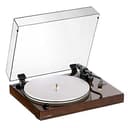
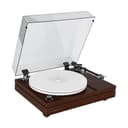
How we ranked them
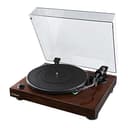
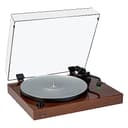
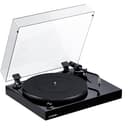
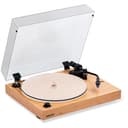
- Whether there is a phono stage inside. This is first because it changes the total cost of ownership by the price of another box. The RT81 and RT81+ publish a switchable PHONO/LINE output with a full bypass; the RT82, RT85, RT85N and RT87 publish none.
- The cartridge. On this ladder the cartridge is most of what the extra money buys. It runs from an Audio-Technica AT95E through an AT-VM95E and an Ortofon OM10 to a 2M Blue and a Nagaoka MP-110.
- The published figures that move. Wow and flutter goes 0.2% on the RT81 and RT81+, 0.07% on the RT85 and RT85N, 0.06% on the RT87. Signal-to-noise goes from 67 dB or higher on the RT81+ to 68.5 dB on the RT85N and 71 dB on the RT87. Those are Fluance’s own numbers and they are comparable because one company measured them the same way — which is exactly what you cannot do across brands.
- What the chassis does about the motor. The RT82 and up add a servo-controlled motor; the RT87 goes further and puts the motor on a separate lower plinth on seven-point silicone isolation.
The discontinued-cartridge footnote on the cheapest deck
The RT81 ships with an Audio-Technica AT95E, and both that cartridge and its ATN95E replacement stylus are badged discontinued on Audio-Technica’s own site. The deck is unaffected — it takes any standard half-inch cartridge — but it does mean the first consumable you buy for an RT81 will probably be a different cartridge rather than a like-for-like stylus. That is the whole argument for the RT81+, which arrives with the current AT-VM95E instead, plus an acrylic mat and adjustable feet, and keeps the switchable preamp. Mechanically the two are the same deck: same motor, same arm, same published 0.2% wow and flutter.
RT85 and RT85N are one turntable, not two tiers
Fluance publishes the same acrylic platter, the same 224 mm S-type arm and the same 0.07% wow and flutter for both, at the same list price. The only difference that matters is the pickup: an Ortofon 2M Blue with a nude elliptical diamond on the RT85, a Nagaoka MP-110 with a bonded superfine polished elliptical on the RT85N. Fluance publishes a marginally lower weighted signal-to-noise figure for the RT85N — 68.5 dB against 69 dB — which is not a tier change. Choose by cartridge character, and if that choice is unfamiliar, our cartridge types guide and the RT85 vs RT85N comparison lay out what each one is doing differently.
What the RT87 adds, and the two numbers to check first
The RT87 is the only deck in the range where Fluance’s own figures improve rather than just the fittings: 0.06% wow and flutter, 71 dB signal-to-noise, a one-piece carbon-fiber arm with 6 mm of VTA adjustment, a 22 mm 4.1 lb acrylic platter, and a dual plinth that isolates the motor and electronics from the platter and arm. It is also the only Fluance Reference deck that publishes a third speed, which puts it on our 78 RPM shortlist.
Two practical numbers before you buy one: it weighs 21 lb, and it is 16.5 inches wide with a 6.3-inch height envelope. Measure the shelf and the clearance above it — the dust cover needs room to swing. If the deck is going on anything that flexes, read our isolation picks at the same time, because a heavy deck on a light shelf is a worse result than a light deck on a solid one.
What you still have to buy
For four of these six decks, a phono stage. Our phono preamp picks cover that from under $100 up, and do I need one settles the question if you are unsure whether your amplifier already has one. For all six, eventually, a replacement stylus — the Ortofon and Nagaoka cartridges here are all re-tippable rather than disposable, which is a large part of why they are fitted in the first place.