How these were ranked
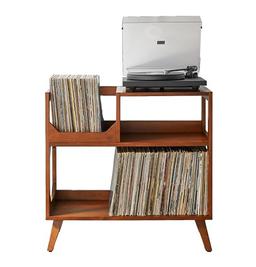
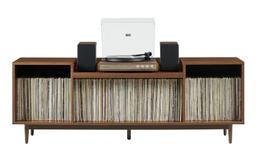
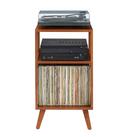
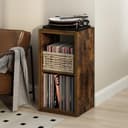
- The published weight limit of the surface the deck sits on. First criterion, and the one that reorders the whole category. The Eugene publishes 80 lb for its recessed top; both Ashevilles publish 50 lb; the Furinno publishes 30 lb per shelf and 90 lb total; the Pangea wall shelf publishes 40 lb. The Manchester publishes nothingfor its top, which is exactly why it is ranked last. For scale: the heaviest turntable this site covers is around 21 lb, so a rated 50 lb top is not a close call — the point is that the maker committed to a number at all.
- Whether the deck can be made level. A turntable platter has to sit level or the stylus rides unevenly in the groove and the arm pulls to one side. Both Ashevilles publish tapered legs with adjustable levelers, which is the only mechanism here for fixing a floor that is out of true. The Eugene, the Manchester and the Furinno publish no leveling feet; the wall shelf is adjusted at mounting instead. Our leveling guide covers what to do when the furniture cannot help.
- How the cables leave.Only the Eugene publishes real cable management — one pre-cut hole in the console top for the deck’s leads, plus three more on the back with swivel covers for speaker and power cords. The Furinno’s open-back cubes achieve the same thing by having no back. Everything else routes cables over the front or side edge, which is cosmetic until a tugged lead moves a playing deck.
- Published record capacity, and whether it comes with a rating. A capacity claim without a weight limit beside it is marketing. Crosley gives both: 320 records across three rated sections on the Eugene (160 at 80 lb, 80 at 40 lb twice), 215 across two on the Asheville Medium, 65 at 35 lb on the narrow Asheville. The Furinno publishes roughly 55 records per cube at 30 lb each. The Manchester publishes two different capacities on one listing — see below.
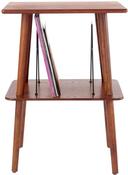
- Whether the stand is heavier than the thing on it.Mass is the cheap, boring answer to resonance. The Eugene is published at 72.2 lb, the Asheville Medium at 40.7 lb, the narrow Asheville at 26.9 lb — and the Manchester at 9.9 lb, which is lighter than several decks we rank. A light frame passes footfall straight into the plinth.
The Manchester’s two capacities, reported rather than resolved
One finding is worth stating plainly because it is the kind of thing this site exists to catch. The Crosley Manchester’s listing contradicts itself on capacity: the title reads “Holds Up to 40 Standard Records” while its own feature text reads “holds approximately 20 records.” We have not counted them, so we report both numbers and rank the stand on what is not in dispute — 9.9 lb, 13.5 inches of published depth, and no published weight limit for the top at all. That is a fine stand under a 6 lb suitcase player, which is precisely what Crosley publishes it as a match for. It is not what we would put a belt-drive hi-fi deck on.
Height is a real spec, and it is the one nobody checks
A stand’s published height decides how you use the deck every single day, and it splits this page cleanly in two. The two Ashevilles stand at roughly 31 inches, which puts the platter near standing hand height: you cue the arm without bending, and the dust cover opens without fouling a shelf above. The Eugene is 24.1 inches tall, which is television-console height — beautiful under a TV, and a lean every time you flip a side.
The second half of the question is clearance above. A full-size deck needs its dust cover to swing up, which is typically another 12 to 14 inches of empty air. That rules out a shelf in a bookcase for most decks and is the reason a dedicated stand usually wins over a repurposed side table. Measure the deck, measure the cover arc, and compare against the published top dimensions — 18 by 16 inches on the Ashevilles, 15.75 inches deep on the Eugene, 13.5 inches deep on the Manchester. Our setup guide walks through the rest of the siting decisions.
The one problem furniture cannot solve
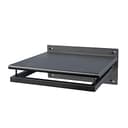
If walking past the turntable makes the stylus jump, the stand is not your problem and no stand will fix it. A suspended wooden floor is a large, springy diaphragm, and anything standing on it is standing on the problem. The only structural answer is to leave the floor entirely, which is what the Pangea Audio Premier SE MKIIwall shelf does: a one-piece welded steel frame bolted into studs, published at 40 lb with the fastener combination that rating assumes stated in Pangea’s own words.
The trade is honest and worth naming. You have to drill into studs, the rating assumes at least two screws into wood plus drywall anchors, a masonry or steel-stud wall needs fasteners Pangea does not supply, and once it is up, moving it means patching the wall. It also stores no records. If a wall shelf is not possible, isolation feet under the deck are the next best thing — our isolation picks rank them on published load rating, and the hum and grounding guide covers the other noise you may be blaming the furniture for.
Where the records go, and why that is a separate decision
Four of these six store records as well as holding the deck, and that is the main reason people buy a stand rather than a table. It is worth being clear about what a rated shelf buys: a standard LP weighs roughly 0.4 lb, so Crosley’s 150 records at 75 lb works out to half a pound each — a figure that holds up, and a useful sanity check on any capacity claim in this class.
Store them vertically and snugly, never leaning and never stacked flat, because a leaning stack warps and a flat stack dishes under its own weight. Our storage guide covers the details and the vertical-storage question answers the one people ask most. If what you actually want is storage rather than a stand — crates, cubes and sleeves rather than a surface for the deck — the record storage roundup is the right page.
Last thing, and it is free: whatever the stand, get the deck away from the speakers. Acoustic feedback through the plinth is the most common cause of muddy, booming vinyl sound, and a console that puts the turntable between a pair of speakers builds that problem into the furniture. Our placement guide has the distances, and a pair of speaker stands is often the real fix.