How to Connect a Turntable to a Soundbar
A soundbar already contains the amplifier and the speakers, which makes it a tempting destination for a record player. The catch is the input list — and on a lot of current bars, there is no analog input on it at all.
How this is funded: we earn a commission if you buy through our links, at no extra cost to you. It never changes which product we recommend, and we’ll tell you plainly when to skip one. Full disclosure.
The short answer: a soundbar can play records, but only through an analog input or Bluetooth, and the signal has to be at line level before it gets there. So the decision tree is short. If your bar has a 3.5 mm or RCA input, feed it from a turntable whose built-in preamp is switched to LINE, or add a phono preamp. If your bar takes Bluetooth audio, buy a turntable that transmits and skip the cable. If your bar has only HDMI and optical — which is increasingly common — the analog signal has to be converted, usually by routing it through a television that has an analog input of its own.
Why this is harder than it looks
A soundbar is an amplifier and a set of speakers in one cabinet, which is exactly what a turntable needs. The problem is that soundbars were designed for televisions, and a television sends audio digitally. So the input list is usually HDMI, optical and Bluetooth, with an analog aux socket as an afterthought when it exists at all.
On top of that, no soundbar we are aware of has a phono input. A phono input is a special case: it applies the RIAA equalization curve and a large amount of gain, because a cartridge’s output is a tiny, deliberately bass-reduced signal. Plug a raw turntable output into a line input and you get something quiet and thin with no low end — which is the single most common complaint behind this question. Our do I need a phono preamp page covers that in full, and phono vs line explains why the two sockets are not interchangeable.
Route one: the soundbar has an analog input
This is the best case and it is a cable plus, possibly, one small box. You need a line-level signal, and there are two ways to produce one. The cheaper way is a deck with a switchable built-in phono preamp — set it to LINE, run RCA to the bar, done. Most current entry turntables have this, including every deck in our built-in preamp roundup.
If your deck has no preamp inside — which is normal once you get above the entry tier, and true of most Fluance Reference decks — then a standalone phono stage goes between the two. It takes the phono signal in, applies RIAA and gain, and puts line level out. Our picks under $100 cover the price range that makes sense next to a soundbar; spending more than the bar cost is a decision to make deliberately.
Route two: the soundbar takes Bluetooth
If the bar accepts a Bluetooth audio source, a turntable that transmits Bluetooth connects to it directly with nothing else at all — no phono preamp, no cable, no settings. That is the tidiest version of this setup and the reason the Bluetooth deck is on this page.
One trap to avoid: a great many record players advertise Bluetooth and only receive it, so you can stream a phone through the player’s own speakers. That is useless here. The listing has to say the deck sends, transmits or outputs Bluetooth. Our Bluetooth turntable picks only include decks that transmit, which is most of the work of that page. If headphones are a likelier destination than the bar, the headphone routes guide covers the same decision for a private listening chain.
Route three: the soundbar has neither
If the input list is HDMI and optical only, there is no way to hand it an analog signal directly. Two honest options remain. The first costs nothing: if the bar is already connected to a television over HDMI-ARC or optical, and that television has an analog input, plug the line-level signal into the television and let the audio pass through to the bar. Whether this works depends entirely on your television, because analog inputs are disappearing from them too.
The second is a converter that turns line-level analog into optical or HDMI. We do not rank one — there is no verified listing for that class of product in our registry and we will not invent a pick to finish a page. If you reach this point, it is worth comparing the total cost of the converter route against a pair of powered speakers, because at that stage the soundbar has stopped being the cheap option.
Two problems specific to soundbars
Grounding. Many turntables have a thin ground wire intended for a grounding terminal on a phono preamp or an amplifier. Soundbars do not have one. If you are using an external phono stage, the ground goes there. If you are running a deck’s own line output straight to the bar, there is nowhere for it to go, and a constant hum usually means the deck wants a ground it cannot have in that configuration.
Feedback. Soundbars very often come with a subwoofer, and a subwoofer is a machine for putting low-frequency energy into the floor. A stylus is a vibration sensor. If the bass booms or howls as the volume rises, that is the loop closing — move the turntable onto different furniture from the bar and the sub, and if it continues, put the deck on an isolation platform or wall shelf. This is the same failure mode we describe on our tower speaker page, and it has the same fix.
Is a soundbar actually the right destination?
It is the right destination if you already own one and the alternative is not listening to records. It is not the right destination if you are buying from scratch: both channels come out of one cabinet, so stereo separation is limited by the width of the bar, and most are voiced for dialogue rather than music. A pair of powered bookshelf speakers at the same money gives you two separated sources, a line input as standard and, on some models, a phono input so no extra box is needed at all — that class is ranked on our speakers with a built-in phono preamp page.
The spec matrix
Three ways to make the connection, depending on what you already own: add a phono stage, buy a deck that transmits Bluetooth, or buy a deck with the preamp already inside.
| Specification | PA10Fluance | AT-LP60XBTAudio-Technica | RT81Fluance |
|---|---|---|---|
| What it is | Standalone moving-magnet phono preamp | Fully automatic turntable with Bluetooth output | Manual turntable with a switchable built-in phono preamp |
| Which problem it solves | Your deck has no preamp and your soundbar has an analog input | Your soundbar has Bluetooth and you would rather not run a cable | You are buying the deck too and want no extra boxes |
| Phono stagesame | Yes - RIAA equalization, moving magnet only | Yes - switchable, inside the deck | Yes - switchable PHONO/LINE with a full bypass |
| Output | Line-level RCA | Bluetooth out, and a switchable wired output | RCA, switchable between phono and line level |
| Soundbar input it needs | An analog aux or RCA input | Bluetooth audio in, or an analog input if you go wired | An analog aux or RCA input |
| Gain adjustment | Fixed | Not published | Not published |
| Cartridge supportsame | Moving magnet (MM) | Fitted AT3600L, moving magnet | Fitted Audio-Technica AT95E, moving magnet |
Values are read from each maker’s published specification or the listing cited under that product below, on the date shown there. Not published means the maker does not state it. Prices are live on each button and dated. “Not published” means the figure is not stated in the sources cited below — it is never a value we estimated. Rows marked same are the ones where these decks do not differ.
The three routes, with live prices
Which one is right depends entirely on the input list of your soundbar and on whether you already own a turntable.
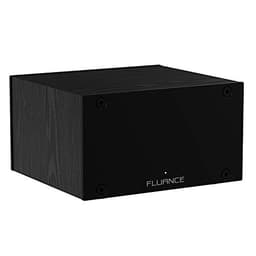
Fluance PA10
A solid mid-priced MM upgrade
Price as of October 6, 2026. #ad How we’re funded
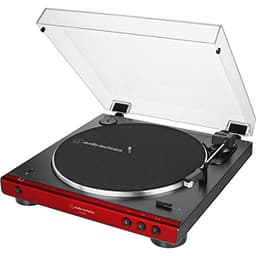
Audio-Technica AT-LP60XBT
A safe automatic deck that streams wirelessly
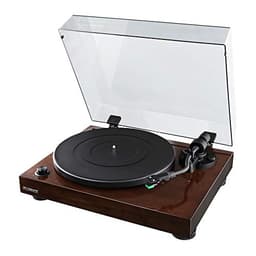
Fluance RT81
First serious turntable that you won't outgrow in a year
Price as of October 6, 2026. #ad How we’re funded
Frequently asked questions
Can you connect a record player to a soundbar?
Yes, if the soundbar has either an analog input or Bluetooth audio in. With an analog input you need a line-level signal, which means either the turntable's own built-in preamp switched to LINE or a separate phono preamp. With Bluetooth you need a turntable that transmits rather than one that only receives. If the bar has only HDMI and optical, the analog signal has to be converted first, usually by routing it through a television.
Can I plug a turntable straight into a soundbar's aux input?
Only if the turntable has a built-in phono preamp and it is switched to LINE. A raw phono output is a fraction of line level and still carries the RIAA equalization curve, so plugged straight in it sounds very quiet and thin with almost no bass. A deck with a switchable preamp solves it with a switch; a deck without one needs an external phono stage.
How do I connect a record player to a soundbar without an aux input?
Two options. If the soundbar is connected to a television over HDMI-ARC or optical, and that television has an analog input, plug the line-level signal into the television and let it pass the audio on to the bar. Otherwise you need a converter that turns the analog signal into an optical or HDMI one, which we do not rank, and which adds a box the Bluetooth route avoids entirely.
Is Bluetooth good enough for vinyl on a soundbar?
It is a convenience route rather than a fidelity one, and on a soundbar that trade is usually easy to accept: a bar's own acoustic limits are a bigger factor than the codec. What matters more is the direction of the link - the turntable must send Bluetooth, not just receive it - and that your bar accepts a Bluetooth audio source rather than only pairing to a phone app.
Will a soundbar sound as good as proper speakers for records?
No, and the reason is structural rather than a matter of taste. A soundbar puts both channels in one cabinet a few feet wide, so stereo separation is limited by physics, and most bars are tuned for dialogue clarity. A pair of powered bookshelf speakers at a similar price gives you two separated sources and a flatter balance. The soundbar's advantage is that you already own it.
Why does my turntable hum when connected to a soundbar?
Check the ground wire first. Many turntables have a thin ground lead meant to be attached to a grounding terminal on a phono preamp or amplifier, and soundbars have no such terminal - so with an external phono stage, the ground goes to the phono stage, not to the bar. If the hum appears only at volume rather than constantly, it is more likely feedback than grounding.
Why does the bass boom or howl when I play a record through a soundbar?
That is acoustic feedback: the bar or its subwoofer is vibrating the surface the turntable is standing on, the stylus reads that vibration as signal, and the loop reinforces itself. Move the turntable onto a different piece of furniture from the bar, keep it away from the subwoofer, and if the problem persists put the deck on an isolation platform or wall shelf.
Do I need a phono preamp for a soundbar?
You need one somewhere in the chain unless the turntable already has it inside. A soundbar's analog input is a line input - it has no phono stage and no grounding terminal - so either the deck's switchable preamp or a separate box has to do the RIAA equalization and gain before the signal reaches the bar.
Sources
- Crutchfield — How to choose a phono preamp — On why a phono signal needs a preamp and never running two at once (accessed July 24, 2026)
- Crutchfield — How to choose the right turntable — Buying-guide reference on drive type, cartridges, preamps and setup (accessed July 24, 2026)
- Elliott Sound Products — Phono preamp / RIAA equalization — Technical reference on RIAA pre-emphasis and the inverse playback curve (accessed July 24, 2026)
- Sonos — Listen to your turntable on Sonos — Manufacturer support article: which Sonos speakers accept line-in, the Era Line-In Adapter, and the phono-stage requirement (accessed August 19, 2026)
- Fluance — RT81 Elite turntable, published specifications — Manufacturer specification table, read live: belt drive, DC motor on three-point rubber isolation, 33 1/3 and 45 RPM (78 RPM "No"), speed variation +/- 1.00%, wow and flutter 0.2%, signal-to-noise "67 dB or higher (A-weighted, 20 kHz LPF)" and "60 dB or higher (unweighted, 20 kHz LPF)", aluminum platter 12 in / 1.22 lb (553 g) / 0.62 in (16 mm) with a rubber mat, static-balanced S-type aluminum tonearm 8.82 in (224 mm) effective length and 0.99 oz (28.2 g) effective mass, adjustable 100 g counterweight, anti-skating, cueing lever, pivot bearing, H-4 bayonet headshell 0.38 oz (10.7 g), "Audio Technica: AT95E" dual moving magnet cartridge with a 0.4 x 0.7 mil bonded elliptical diamond on an aluminum cantilever at 2.0 g tracking force, 20-20,000 Hz, 20 dB channel separation at 1 kHz, 3.5 mV phono output and 140 mV (-17 dBV) line output, switchable PHONO/LINE preamp with full bypass and a ground terminal, MDF plinth in real wood veneer, tinted dust cover, defeatable auto-stop, suspension isolation feet, 14.1 lb (6.4 kg), 1.5 W. Listed at 299.99 USD on the access date with no discontinuation notice. Re-read live on 2026-10-05 for the RT81 vs AT-LP120XUSB head-to-head and the 2M Blue review, every figure above unchanged and still listed at 299.99 USD; two rows quoted on those pages are confirmed verbatim from the same table — "Supported Cartridge Weight: 0.12 to 0.23 oz (3.5 to 6.5 g)", which EXCLUDES the 7.2 g Ortofon 2M Blue, and "Cartridge Weight: 5.7 g (+/- 0.5 g)" (accessed September 26, 2026)
- Audio-Technica — AT-LP60X turntable — Manufacturer specs for the fully automatic belt-drive AT-LP60X (accessed August 11, 2026)
Keep reading
How to Connect a Turntable to Sonos
The same problem on a named platform, where only some models have an input.
Read the guideConnect a Turntable Without a Receiver
The four general routes when there is no amplifier in the room.
Read the guideBest Phono Preamps Under $100
The box that makes an analog input usable, ranked.
See the picksBest Powered Speakers for a Turntable
What to buy when the soundbar turns out to be the limit.
See the picks