PLATTER & PLINTH

The Best Phono Preamps for Audio-Technica Turntables

Start here: your deck almost certainly has one already. This page is about the switch on the back, and the three reasons to put a better box after it.

By Stephen V.Last updated How we pick

The verdict

If you own an AT-LP60X, AT-LP70X, AT-LP120XUSB or AT-LP5X, you do not need to buy anything to play records — Audio-Technica publishes a switchable built-in phono stage on all of them, which is why they connect to powered speakers out of the box. The reason to add an external stage is that the internal one is the cheapest circuit in the deck. The Fluance PA10 is the upgrade that makes sense for most AT owners (a metal-cased moving-magnet stage with accurate RIAA equalization), the ART DJ PRE II is the version of that answer for half the money with adjustable gain, and the Pro-Ject Phono Box is the one to buy if you are also fitting a better cartridge, because it is the only pick here with adjustable loading.

Audio-Technica builds the phono stage in across its whole current range, and every deck this site covers publishes it: AT-LP60X (“yes — switchable”), AT-LP70X (“yes — switchable”), AT-LP120XUSB (“yes — switchable”), AT-LP120XBT-USB and AT-LP5X (“switchable phono/line output”). So unlike a Fluance RT85, an AT deck is never silent for want of a preamp.

What the switch actually does is choose between two signal paths: PHONO sends the cartridge’s raw few millivolts out untouched, for a receiver or an external stage to handle; LINE routes it through the deck’s own amplification and RIAA equalization first. The rule that governs everything below is that exactly one phono stage belongs in the chain. Buy an external preamp and the switch goes to PHONO. Leave it on LINE and the external box is amplifying an already-amplified signal, which sounds loud, harsh and wrong.

Three things make the external box worth buying: a noise floor lower than a circuit sharing a chassis with a motor, gain you can match to the cartridge, and loading you can set once you have fitted something better than the stock stylus. If none of those describe you, keep the switch on LINE and spend the money on records.

How this is funded: we earn a commission if you buy through our links, at no extra cost to you. It never changes which product we recommend, and we’ll tell you plainly when to skip one. Full disclosure.

Quick picks

Ranked on published specs, drive/motor design and buyer fit. Select a row to jump to the full write-up. We have not heard most of these units — here is exactly what we do instead.

#ProductBest forPrice
1
Fluance PA10

Fluance PA10

A clean, no-nonsense moving-magnet preamp with proper RIAA equalization in a solid metal case — the sweet-spot upgrade for anyone whose turntable or receiver has a weak built-in stage. It does one job well and stays out of the way.

Best overall upgrade
$99.99 · View on Amazon

Price as of October 16, 2026. #ad How we’re funded

2
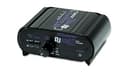
ART DJ PRE II

ART DJ PRE II

The default budget recommendation for years: a moving-magnet preamp with adjustable gain and a low-frequency rumble filter, at a price that makes adding a phono stage a no-brainer. Not fancy, but genuinely good value.

Best value
$52.49 · View on Amazon

$69.9925% off

Price as of October 16, 2026. #ad How we’re funded

3
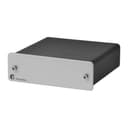
Pro-Ject Phono Box

Pro-Ject Phono Box

A tidy MM/MC preamp from a company that only makes vinyl gear: switchable for both cartridge types with adjustable loading, in a compact metal case. The natural match for a Pro-Ject or U-Turn deck, and a clean upgrade over any built-in stage.

Best with a cartridge upgrade
$140.00 · View on Amazon

$149.006% off

Price as of October 16, 2026. #ad How we’re funded

4
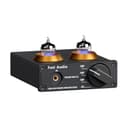
Fosi Audio Box X2

Fosi Audio Box X2

A moving-magnet phono stage with three switchable gain settings — 39, 42 or 45 dB — and a pair of small signal tubes in the output. The gain switch is the real feature: it is the cheapest way to match a quiet cartridge properly instead of running the volume knob at three-quarters all night.

Best gain matching
$69.99 · View on Amazon

Price as of October 16, 2026. #ad How we’re funded

5
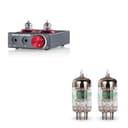
Douk Audio T4 PRO

Douk Audio T4 PRO

A moving-magnet tube phono stage that is also a headphone amp — an NE5532-based output rated for 32 to 300 ohm headphones, plus a 3.5 mm aux input and a multi-level gain knob. As a way to get a turntable into headphones for well under $100, nothing else is this tidy.

Best for headphone listening
$84.99 · View on Amazon

$94.9811% off

Price as of October 16, 2026. #ad How we’re funded

The picks in full

#1Best overall upgrade

Fluance PA10

A clean, no-nonsense moving-magnet preamp with proper RIAA equalization in a solid metal case — the sweet-spot upgrade for anyone whose turntable or receiver has a weak built-in stage. It does one job well and stays out of the way.

Strengths

  • Accurate RIAA equalization with low noise
  • Metal chassis, better isolated than the tiny plastic boxes
  • Simple, reliable, and fairly priced

Trade-offs

  • Moving-magnet only — no moving-coil support
  • No adjustable gain or loading
Cartridge supportMoving magnet (MM)
EqualizationRIAA
OutputLine-level RCA
ChassisMetal
GainFixed

Note. For the overwhelming majority of setups — a moving-magnet cartridge into powered speakers — this is all the preamp you need.

Specifications read from the manufacturer / product listing, on July 24, 2026. “Not published” means the maker does not state that figure.

#2Best value

ART DJ PRE II

The default budget recommendation for years: a moving-magnet preamp with adjustable gain and a low-frequency rumble filter, at a price that makes adding a phono stage a no-brainer. Not fancy, but genuinely good value.

Strengths

  • Adjustable gain — useful for matching different cartridges and inputs
  • Switchable low-cut (rumble) filter
  • Very affordable and widely trusted

Trade-offs

  • Moving-magnet only
  • Plastic-ish build and a wall-wart power supply
Cartridge supportMoving magnet (MM)
GainAdjustable
FilterSwitchable low-frequency (rumble)
EqualizationRIAA
OutputLine-level RCA

Note. The adjustable gain is the feature that earns its keep — it lets you match the output to a quiet or loud cartridge, which the fixed-gain budget boxes can't.

Specifications read from the manufacturer / product listing, on July 24, 2026. “Not published” means the maker does not state that figure.

#3Best with a cartridge upgrade

Pro-Ject Phono Box

A tidy MM/MC preamp from a company that only makes vinyl gear: switchable for both cartridge types with adjustable loading, in a compact metal case. The natural match for a Pro-Ject or U-Turn deck, and a clean upgrade over any built-in stage.

Strengths

  • Handles both moving-magnet and moving-coil cartridges
  • Adjustable loading for matching different cartridges
  • Compact metal chassis from a vinyl-focused brand

Trade-offs

  • Pricier than the entry MM-only boxes
  • Overkill if you'll only ever run a basic MM cartridge
Cartridge supportMM and MC
EqualizationRIAA
LoadingAdjustable
OutputLine-level RCA
ChassisMetal

Note. If you're pairing it with a moving-coil cartridge, check the loading options against your cartridge's recommended impedance — that matching is the whole reason to buy an MC-capable stage.

Specifications read from the manufacturer / product listing, on July 24, 2026. “Not published” means the maker does not state that figure.

#4Best gain matching

Fosi Audio Box X2

A moving-magnet phono stage with three switchable gain settings — 39, 42 or 45 dB — and a pair of small signal tubes in the output. The gain switch is the real feature: it is the cheapest way to match a quiet cartridge properly instead of running the volume knob at three-quarters all night.

Strengths

  • Three switchable gain modes (39/42/45 dB) — rare at this price
  • Ships with two vacuum tubes, and the tube sockets take common 6J1/GE5654-family types
  • 3.5 mm aux input lets it double as a small line preamp

Trade-offs

  • Moving magnet only — no MC support at all
  • Tube rolling is a rabbit hole, and the stock tubes are the cheap part of the build
Cartridge supportMoving magnet (MM)
GainSwitchable 39, 42 or 45 dB
EqualizationRIAA
TubesTwo included; 6K4/6J1/6J4/GE5654/6AK5 compatible
Extra input3.5 mm aux
PowerDC 12 V adapter (included)

Note. Gain matching is not cosmetic. A 2.5 mV cartridge into a fixed 35 dB stage lands quiet; the 45 dB setting here fixes that without touching your amp.

Specifications read from the manufacturer / product listing, on August 11, 2026. “Not published” means the maker does not state that figure.

#5Best for headphone listening

Douk Audio T4 PRO

A moving-magnet tube phono stage that is also a headphone amp — an NE5532-based output rated for 32 to 300 ohm headphones, plus a 3.5 mm aux input and a multi-level gain knob. As a way to get a turntable into headphones for well under $100, nothing else is this tidy.

Strengths

  • Built-in headphone amp rated for 32-300 ohm cans
  • Multi-level gain control rather than a single fixed setting
  • Ships with JAN5654 tubes rather than the cheapest 6J1 types

Trade-offs

  • Moving magnet only
  • A tube stage at this price is voiced for character, not neutrality — that is a preference, not an upgrade
Cartridge supportMoving magnet (MM)
Headphone output3.5 mm, rated 32-300 ohms
GainMulti-level control
TubesJAN5654 (included)
Extra input3.5 mm aux
EqualizationRIAA

Note. Treat the tube stage as a flavor, not a fidelity claim. What actually earns this box its place is the headphone output — a phono stage with no headphone jack means buying a second box to hear records privately.

Specifications read from the manufacturer / product listing, on September 29, 2026. “Not published” means the maker does not state that figure.

Which Audio-Technica do you have?

DeckFitted cartridgeBuilt-in preampIs an external stage worth it?
AT-LP60X / AT-LP60XBTAT3600L, conical, replaceable stylus onlyYes — switchableRarely. The fixed arm and conical stylus limit it first
AT-LP70XAT-VM95C (conical, VM95 body)Yes — switchableAfter a VM95E or VM95ML stylus, yes
AT-LP120XUSBAT-VM95E (elliptical, 4.0 mV)Yes — switchableYes — the clearest case on this list
AT-LP120XBT-USBAT-VM95E (elliptical)Yes — switchableYes, for the wired path; Bluetooth out bypasses the question
AT-LP5XAT-VM95E on a removable AT-HS6 headshellYes — switchable phono/lineYes, and the headshell makes the cartridge upgrade easy too

The pattern is that the external stage earns its place from the AT-LP70X upward, because those decks use the VM95 cartridge body: the stylus can be upgraded from conical to elliptical to micro-linear without remounting anything, and each rung resolves more than the deck’s internal circuit comfortably shows. On an AT-LP60X the limiting part is the fixed tonearm and the conical tip, and no preamp fixes either.

Matching the stage to a VM95 cartridge

  • Moving magnet is all you need. The VM95 series is a dual moving-magnet design and the AT3600L is moving magnet too, so an MM-only stage like the PA10 or the DJ PRE II is a correct match rather than a compromise. The MM/MC picks here are bought for their adjustability.
  • Gain against a 4 mV output.Audio-Technica publishes 4.0 mV for the AT-VM95E, which is a healthy moving-magnet level — but a fixed low-gain stage into a quiet amplifier still leaves you playing records at three-quarters volume. The Fosi Box X2 switches between 39, 42 and 45 dB and the DJ PRE II has a gain control, which is the cheapest cure for that.
  • Loading, once you fit a better stylus. The Pro-Ject Phono Box is the only pick with adjustable loading. That is the pick to buy alongside an AT-VMN95ML stylus or an Ortofon 2M, where the manufacturer publishes a load the stage has to meet.
  • A headphone output, if the deck lives on a desk. An AT-LP120XUSB next to a computer is the commonest setup on this list, and a phono stage with no headphone jack means buying a second box to listen privately. The Douk Audio T4 PRO has one rated for 32 to 300 ohm headphones, which is why it is here rather than on specification alone.
  • USB is a separate path.The AT-LP120XUSB’s USB output carries its own converted signal to a computer and does not go through an external preamp at all. If you are digitizing records, the preamp choice does not touch that route — our recording guide covers it.

How to switch over without breaking anything

Set the deck’s rear switch to PHONO. Run the deck’s RCA cables into the preamp’s input, the preamp’s output into any line input on your amplifier or powered speakers, and move the ground wirefrom wherever it currently lands onto the preamp’s ground post — the earth belongs on whichever box holds the phono stage. Start the volume low: you have just added 40-odd decibels of gain to the chain.

If it hums after the swap, that is the ground wire and not the box: hum and grounding works through it in order. If it is quiet and thin, the switch is still on PHONO with nothing amplifying it, or on LINE into a PHONO input. And if you want the whole field rather than the Audio-Technica-shaped slice of it, our phono preamp roundup and picks under $100 rank everything we cover. Fluance owners should start at the Fluance version of this page instead, because on an RT82 and above the stage is mandatory rather than optional.
Frequently asked questions

Do Audio-Technica turntables need a phono preamp?

No. Every Audio-Technica deck this site covers - AT-LP60X, AT-LP60XBT, AT-LP70X, AT-LP120XUSB, AT-LP120XBT-USB and AT-LP5X - publishes a switchable built-in phono stage, so each one can feed powered speakers or a line input as it comes. An external preamp is an upgrade, not a requirement, and when you add one the deck's switch must be moved to PHONO.

What is the best phono preamp for an AT-LP120XUSB?

The Fluance PA10 for most owners: a metal-cased moving-magnet stage with accurate RIAA equalization, which is a clear step up from a circuit sharing a chassis with a direct-drive motor. If you are also upgrading the stylus on the stock AT-VM95E, the Pro-Ject Phono Box is the better buy because its loading is adjustable. On a budget, the ART DJ PRE II does the job with adjustable gain and a rumble filter.

Is the built-in preamp on an Audio-Technica any good?

Good enough that it is not the thing holding your system back on an AT-LP60X, and the weakest link on an AT-LP120XUSB once you have fitted a better stylus. Audio-Technica does not publish gain or noise figures for the internal stage, which is itself informative - the external boxes on this page do publish theirs, and that is most of what you are buying.

Do I set the switch to PHONO or LINE?

PHONO when something else in the chain has a phono stage - an external preamp, a receiver's PHONO input, or powered speakers with a phono input. LINE when nothing else does, which is the case with ordinary powered speakers or an AUX input. Exactly one phono stage in the chain: zero sounds quiet and thin, two sounds loud and harsh.

Does a phono preamp help an AT-LP60X?

Less than almost any other upgrade. The AT-LP60X has a fixed tonearm with no counterweight and a conical AT3600L cartridge whose body cannot be changed, so the cartridge and the arm set the ceiling long before the preamp does. The ATN3600LE elliptical replacement stylus is the one upgrade that deck can really take.

Do I need a moving-coil preamp for an Audio-Technica cartridge?

Not for any cartridge Audio-Technica fits to these decks. The VM95 series is dual moving magnet and the AT3600L is moving magnet, so an MM input is the correct match. Buy an MM/MC stage like the Phono Box or the Zen Air Phono 2 for the adjustable loading and the published noise figures, not for the MC setting.

Will an external preamp affect the USB output?

No. The USB path on an AT-LP120XUSB, AT-LP120XBT-USB or AT-LP5X converts the signal inside the deck and sends it straight to a computer, so it bypasses anything you connect to the RCA outputs. Changing your phono preamp changes what your speakers hear and leaves your digital transfers exactly as they were.

Sources

  • Audio-Technica — AT-LP120XUSB user manual, full published specification — The complete published table, re-read in full on this date (this manual was previously cited on this site only for the deck's dimensions). Turntable: type "Direct drive", motor "DC servo motor", "3-speed, fully manual operation" at 33-1/3, 45 and 78 RPM, die-cast aluminum platter, starting torque "> 1.0 kgf.cm", braking system "Electronic brake", wow and flutter "< 0.2% WRMS (33 RPM) at 3 kHz", signal-to-noise "> 50 dB", output PHONO "4 mV nominal at 1 kHz, 5 cm/sec" and LINE (MM) "240 mV nominal at 1 kHz, 5 cm/sec", phono pre-amp gain "36 dB nominal, RIAA equalized". Tonearm: "Static balanced S-shaped tonearm", effective length 230.5 mm, overhang 16 mm, maximum tracking error angle "Less than 3", stylus pressure adjustment range "0 to 4 g", applicable cartridge weight range "3.5 to 8.5 g". Cartridge and headshell: AT-VM95E, VM type, 47,000 ohms recommended load, 4.0 mV output, "0.3 x 0.7 mil bonded elliptical stylus", aluminum pipe cantilever, tracking force range "1.8 to 2.2 g (2.0 g standard)", cartridge weight 6.1 g, headshell AT-HS6 at 9 g including lead wire, headshell overhang adjustment "+/- 5 mm". USB function "16 bit 44.1 kHz or 48 kHz USB A/D, D/A selectable", computer interface "USB 1.1 Compliant". General: 452.0 mm (17.80") x 352.0 mm (13.86") x 141.6 mm (5.57"), 8 kg (17.6 lbs) without dust cover, 2.75 W, replacement stylus AT-VMN95E, replacement headshell AT-HS6, with a stylus target light, USB cable and RCA audio cable in the box (accessed October 5, 2026)
  • Audio-Technica — AT-LP120XUSB user manual — The published dimensions and weight of the deck that decides the footprint question on this page: 452.0 mm (17.80 in) wide x 352.0 mm (13.86 in) deep x 141.6 mm (5.57 in) high, 8 kg (17.6 lb) without the dust cover. At 17.80 in across it is wider than the Fluance IB40's published 17.13 in footprint limit and wider than the 17 in zaZen I platform (accessed September 11, 2026)
  • Audio-Technica — AT-LP60X user manual — The light end of the same question: 359.5 mm (14.15 in) wide x 97.5 mm (3.84 in) high x 373.3 mm (14.70 in) deep, 2.6 kg (5.73 lb). It fits every platform here with room to spare — and at about 1.4 lb per corner it sits below the load range every compliant isolator on this page publishes (accessed September 11, 2026)
  • Audio-Technica — AT-LP70X fully automatic belt-drive turntable — The maker's own product page and specification table. Features as published: "Fully automatic belt-drive turntable operation with two speeds: 33-1/3, 45 RPM"; "A fixed-body AT-VM95C Integral Dual Moving Magnet phono cartridge is compatible with any VM95 Series replacement stylus"; "Stylish three-piece chassis construction dampens resonance for improved sound quality*" with the footnote "*Compared to AT-LP60X"; "J-shaped tonearm is engineered to minimize tracking errors"; "Tonearm lock reduces risk of stylus damage"; "Built-in switchable phono/line pre-amplifier"; "Anti-resonance, die-cast aluminum platter with felt mat"; "Includes detachable RCA output cable (dual RCA male to dual RCA male with ground), 45 RPM adapter, and removable hinged dust cover"; "Available in Black/Gray, Black/Bronze, and White/Silver". Spec table: DC motor; belt drive; die-cast aluminum platter; signal-to-noise > 55 dB; "This product is equipped with an AT-VM95C Dual Moving Magnet Stereo Cartridge. The cartridge cannot be removed."; output PHONO 4.0 mV and LINE 252 mV nominal at 1 kHz, 5 cm/sec; phono pre-amp gain 36 dB nominal, RIAA equalized; power consumption 1.5 W; 400 mm (16 in) W x 330 mm (13 in) D x 110 mm (4.3 in) H; approx. 2.9 kg (6.4 lb); effective arm length 220 mm (8.7 in); overhang 18 mm (0.71 in); tracking error angle less than 2.0 degrees; replacement stylus AT-VMN95C; AC adapter 12 V DC, 0.5 A. The upgrade-path block on the same page lists the AT-VMN95C, AT-VMN95E, AT-VMN95EN, AT-VMN95ML and AT-VMN95SH as compatible styli, and the description states the stylus "can also be easily upgraded with any other styli (elliptical, micro linear, or Shibata) in our VM95 Series". The wow-and-flutter cell on the web table was empty on the access date; the figure is taken from the manual instead (accessed September 18, 2026)
  • Audio-Technica — VM95 Series cartridges — The shared-body VM95 range and its interchangeable stylus upgrade path (accessed July 24, 2026)
  • Audio-Technica — AT-VM95E cartridge — Manufacturer specs: 0.3 x 0.7 mil elliptical stylus on an aluminum cantilever, 4.0 mV output at 1 kHz / 5 cm/sec, 1.8-2.2 g tracking force (2.0 g standard), 20-22,000 Hz, 20 dB channel separation at 1 kHz, half-inch mount, AT-VMN95E replacement stylus, and the maker's own statement that "all VM95 Series share the same body" so the stylus "can be replaced with any of the six interchangeable AT-VMN95 replacement styli". Re-read on the access date below, which corrected a tracking-force range previously noted here as 1.8-2.3 g (accessed September 26, 2026)
  • Audio-Technica — AT-VM95C cartridge — The cartridge the AT-LP70X is built around, on its own spec page: frequency response 20-20,000 Hz; channel separation 18 dB at 1 kHz; vertical tracking force "1.8-2.2 g (2.0 g standard)"; stylus construction "Bonded round shank", shape "0.6 mil conical"; cantilever "Aluminum pipe"; output 4.0 mV (1 kHz, 5 cm/sec); recommended load 47,000 ohms and 100-200 pF; replacement stylus AT-VMN95C; and the line the whole upgrade argument rests on: "Compatible with any AT-VMN95 replacement stylus". This page describes the half-inch-mount version; the AT-LP70X carries a fixed-body variant with the same stylus socket (accessed September 18, 2026)
  • Crutchfield — How to choose a phono preamp — On why a phono signal needs a preamp and never running two at once (accessed July 24, 2026)
  • Elliott Sound Products — Phono preamp / RIAA equalization — Technical reference on RIAA pre-emphasis and the inverse playback curve (accessed July 24, 2026)

Keep reading