Audio-Technica AT-LP70X Review
One button, a die-cast platter and a cartridge you can upgrade five times without changing the deck. The automatic that stopped making the usual automatic compromise - and the two places it still makes it.
How this is funded: we earn a commission if you buy through our links, at no extra cost to you. It never changes which product we recommend, and we’ll tell you plainly when to skip one. Full disclosure.
The short version
Audio-Technica AT-LP70X
The automatic turntable that kept a proper cartridge. One press starts it, returns the arm and stops the platter, but underneath the convenience is an AT-VM95C tracking at 1.8-2.2 g with five published stylus upgrades open to it - where the cheaper automatic below it tracks at 3.0-4.0 g and has one. Buy it if you want a deck that cues itself and still rewards money spent on it later. Do not buy it if you want to change the cartridge, level the plinth on its own feet, or adjust anything at all.
Strengths
- Fully automatic operation, like the LP60X
- Integral AT-VM95C cartridge takes any VM95-series replacement stylus — a real upgrade ladder
- Anti-resonance die-cast aluminum platter
Trade-offs
- Costs more than the LP60X for a similar convenience level
- Still no on-arm tracking-force adjustment
| Drive | Belt drive |
|---|---|
| Operation | Fully automatic |
| Cartridge | Audio-Technica AT-VM95C (conical, VM95 series) |
| Built-in preamp | Yes — switchable |
| Speeds | 33 1/3 and 45 RPM |
| Platter | Die-cast aluminum |
Specifications read from the manufacturer / product listing, accessed 2026-10-05. We have not measured this unit — what we do instead.
Price as of October 6, 2026. #ad How we’re funded
The automatic that stopped paying for automation at the cartridge
Every cheap automatic turntable makes the same bargain, and we argue it at length in automatic versus manual turntables: the mechanism that lifts, travels, lowers and returns the arm for you is paid for at the arm. A light tube, a fixed force, no anti-skate adjustment, and a cartridge chosen because it will tolerate being dragged across a record by a machine rather than because it is good.
The AT-LP70X is interesting because it declines half of that bargain. The automation is intact — Audio-Technica publishes fully automatic belt-drive operation with the arm returning and the platter stopping at the end of the side. But the cartridge is an AT-VM95C, from the same VM95 series fitted to decks several times the price, and Audio-Technica publishes its tracking force at 1.8–2.2 g, 2.0 g standard. The automatic one rung below it, the AT-LP60X, carries an AT3600L-family cartridge published at 3.0–4.0 g. That is the whole review in two numbers, and we settle the pair directly in AT-LP60X versus AT-LP70X.
We have not had this deck in our hands and we have measured nothing — what we do instead is read the maker’s own manual and specification table line by line, and then read the people who did have one. In this case that is one hands-on review, by Jez Ford for Sound+Image, which is the only source here for how the deck behaves on an inner groove.
What Audio-Technica actually built
The published figures are modest and, importantly, complete — this is not a deck with blank cells where the embarrassing numbers would go. The manual gives a DC motor, belt drive, 33-1/3 and 45 RPM, a die-cast aluminum platter under a felt mat, wow and flutter below 0.25% (WTD) and a signal-to-noise ratio above 55 dB. Output is 4.0 mV nominal on PHONO and 252 mV nominal on LINE, both at 1 kHz and 5 cm/sec, with the internal stage rated 36 dB nominal, RIAA equalized.
The arm is a J-shaped tube with an effective length of 220 mm (8.7 in), 18 mm of overhang and a maximum tracking error angle of less than 2.0 degrees. The whole deck is 400 × 330 × 110 mm (16 × 13 × 4.3 in) and weighs approximately 2.9 kg (6.4 lb), which makes it one of the lightest decks we cover — relevant if you are shopping isolation feet and platforms, because compliant isolators have a published load range and a 6.4 lb deck sits at the bottom of most of them.
Put the 0.25% wow-and-flutter figure in context rather than in a league table. Fluance publishes 0.2% for the RT81 and 0.07% for the RT85, and those are different measurement conditions published by a different company, so the gap is indicative rather than a score. What the figure does tell you honestly is that this is a budget belt drive doing a budget belt drive’s job, and that Audio-Technica was willing to print it.
The five-rung ladder is the reason to buy it
Audio-Technica’s own product page lists the styli this cartridge body accepts: the AT-VMN95C it ships with, then the VMN95E (bonded elliptical), VMN95EN (nude elliptical), VMN95ML (micro-linear) and VMN95SH (Shibata). The description says the stylus can also be easily upgraded with any other styli (elliptical, micro linear, or Shibata) in our VM95 Series, and the AT-VM95C’s own page says it is compatible with any AT-VMN95 replacement stylus.
That matters more than any other sentence on the spec sheet, because it changes what the deck is. A fixed-cartridge automatic is normally a closed object: you buy the sound it makes and that is the end of it. Here the cartridge is fixed but the diamond is not, and the diamond is most of what you hear. The Sound+Image reviewer makes the same point from the other end, noting that the stock VMN95C is cheap to replace and that you might instead step up to the VMN95E — the even-better-regarded green stylus of the AT-VM95E, a cartridge that ships on decks costing many times this one — and keep climbing to the Shibata.
One practical warning from the same review: the stylus is a tight fit, so take your time pulling it off and pressing the new one on. Our guide to replacing a turntable stylus covers the job, and best replacement styli covers what each tip profile is actually for. The contrast with the deck below is stark: the AT-LP60X’s cartridge has exactly one upgrade, the ATN3600LE elliptical, and Audio-Technica publishes that at the same 3.0–4.0 g, because force is set by the arm and the body it was designed around rather than by the tip.
Using it: two settings, one button, and no power switch
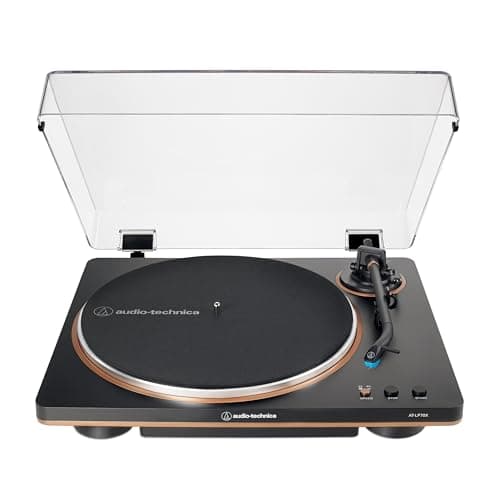
Playing a record is genuinely one press. The arm lifts, travels, lowers into the lead-in groove, plays the side, returns to its rest and stops the platter. Stop does the same thing on demand. There is a platter speed button for 33-1/3 or 45, and — this is the part people miss — a separate size selector up at the tonearm mount for 12-inch or 7-inch records, because that is how the mechanism knows where the groove starts. Change one and not the other and the arm lands in the wrong place. The manual also warns you to stop the platter before moving the size selector.
Two quirks are worth knowing before you own it rather than after. First, there is no power switch: the manual states it outright and adds that a standby current is always running, so the deck is live whenever the AC adapter is plugged in. Second, Audio-Technica itself says automatic operation may not work with the start or end of songs on some records — an honest admission that a mechanical system reading a disc’s geometry is working from averages. On most pressings it is invisible. On an unusually long side it may lift early.
The one genuine setup job the deck leaves you is leveling. The Sound+Image reviewer found none of the feet adjustable and ended up shimming theirs with CD cases; our turntable setup guide explains why level matters on an arm with a fixed force, and isolation feet and platforms is where you solve it properly if your shelf is not flat.
Fixed anti-skate: where the economy shows up
Anti-skate counteracts the small force pulling a pivoted arm toward the center of the record. Expensive decks let you adjust it. This one applies it with a spring at a fixed value, set for the cartridge’s 2.0 g.
That is the one place an independent listener found an audible limit, and the detail is worth repeating because it is specific rather than vague. On the final, innermost track of a side, the Sound+Image review noted a slight instability on the left side of vocal imaging, attributed to the fixed anti-skate, while adding that the effect was relatively light and that the piano stayed true. More usefully for anyone who buys singles: the effect was more apparent at 45 RPM, because a 7-inch disc’s run-out sits even closer to the spindle.
So the honest shape of this deck’s performance is: fine for the first three-quarters of a side, slightly compromised in the run-out, and more so on singles than on albums. That is the cost of not having an adjustment, and it is a cost you cannot buy your way out of later — unlike the stylus.
The phono stage, and the ground wire story
The rear panel carries a pre-amplifier selector switch, stereo output terminals, a ground (earth) terminal and the power input. The box includes a detachable RCA cable with a ground line, which is a better arrangement than the captive leads fitted to several rivals, because a damaged cable is a replacement rather than a repair.
On LINE, the internal stage raises the signal to 252 mV and feeds anything with an aux input — powered speakers, a receiver’s line input, a computer sound card. On PHONO, you bypass it and hand the 4.0 mV cartridge output to a separate phono preamp. We rank the entire built-in-stage category on whether that switch exists in best turntables with a built-in preamp, because a stage you cannot switch off caps the deck forever.
Two things the Sound+Image review settles about that choice. The ground wire is not optional on PHONO: running the deck into an external phono stage without the earth link produced a buzz they described as tremendous, and connecting it left only a hum inaudible under the music. And the upgrade is real but modest — moving to an outboard stage gave a little more insight into the mixes but no great revelatory change. Their conclusion is the one we would give: the internal stage does not much hold the deck back, so spend the money on the stylus first and the phono stage later, if ever.
What it feels like, and what it is made of
The chassis is a three-piece construction Audio-Technica credits for damping resonance — with the footnote, in the maker’s own copy, compared to AT-LP60X, which is the only comparison it claims. The reviewer’s sample was the black-and-gray finish rather than the black-and-bronze, and they were blunt that it looked and felt very much as something of the plastic age, though they noted the layered build may add rigidity and that the electronics module slung underneath adds some mass. If the look matters to you, their advice was simply to buy the bronze.
None of that affects the sound, and their verdict on the sound was warm: the deck didn’t short change the effect in any of the key hi-fi ways, and what they kept returning to was how much music the AT-LP70x does insert into your system for the money. Treat that as the ceiling and the floor at once. A better deck opens the presentation up further; this one does not embarrass itself.
Living with it: the consumables nobody mentions
Audio-Technica publishes two maintenance intervals, and the second is unusual enough to plan around. The stylus should be replaced after about 300 hours of use; the drive belt once a year, and the replacement is an AT-LP70X-specific part sold separately. Budget for both, because a stretched belt shows up as speed drift long before anything sounds broken, and a worn stylus damages records.
One hard limit: the manual says do not use a disk stabilizer. If you have read our roundup of record weights and clamps, this deck is one of the ones that argument excludes — the automatic mechanism and the belt are specified around the platter as supplied. Mats are a gentler question, and best turntable mats explains why thickness changes your arm geometry, which on a deck with no adjustable anything is a reason to be conservative.
Who should buy it — and who should buy something else
Buy the AT-LP70X if you want convenience without a dead end. This is the deck for somebody who will not babysit a tonearm, will not level a cartridge, and still wants the option of spending fifty or a hundred dollars in two years and hearing the difference. Nothing else in the automatic field makes that combination as cleanly.
Buy the AT-LP60X if the budget is the constraint. It cues itself just as well, and the honest version of the upgrade argument is that the ladder only pays off if you actually climb it. If you will never buy a stylus, you are paying for an option you will not exercise — the head-to-head lays out exactly what the extra money buys.
Buy a manual deck if you want to adjust anything. A counterweight, adjustable anti-skate and a replaceable cartridge are the three things this deck does not have, and they all arrive together one price band up. Fluance RT81 versus the AT-LP120XUSB is that world in its two most-bought forms, and best turntables for beginners is the wider field.
Buy the Denon DP-300F if you want both. It is the rare fully automatic deck that still gives you a counterweight and a standard headshell, and it is the exception our DP-300F review keeps pointing at. The trade is that it ships no switchable line output, so you will need a phono input or a phono preamp.
And whatever you choose, remember the deck makes no sound by itself. On LINE this one will drive powered speakers directly, which is the cheapest complete system this site knows how to build.
Frequently asked questions
Is the Audio-Technica AT-LP70X worth it over the AT-LP60X?
On the figure that decides a deck's future, yes. The AT-LP70X is built around an AT-VM95C, which Audio-Technica publishes at 1.8-2.2 g tracking force and describes as compatible with any AT-VMN95 replacement stylus - conical, elliptical, nude elliptical, micro-linear and Shibata. The AT-LP60X's AT3600L family is published at 3.0-4.0 g, and its one upgrade, the ATN3600LE elliptical, still tracks at that force. You are not buying a better mechanism; both decks cue themselves. You are buying an arm and cartridge that can be improved for the next decade.
Can you change the cartridge on the AT-LP70X?
No. Audio-Technica states it plainly in the manual: "This product is equipped with an AT-VM95C Dual Moving Magnet Stereo Cartridge. The cartridge cannot be removed." The stylus is the replaceable part, and the replacement Audio-Technica lists is the AT-VMN95C. Because the socket takes the whole VMN95 range, the practical upgrade path is the stylus rather than the cartridge - which is cheaper than a cartridge swap and takes about ten seconds.
Does the AT-LP70X have a built-in phono preamp?
Yes, and it is switchable. The rear panel carries a pre-amplifier selector: set it to LINE and the deck outputs 252 mV nominal into any aux or line input, including powered speakers; set it to PHONO and it outputs 4.0 mV nominal for an amplifier's phono input or an external phono preamp. The internal stage is 36 dB nominal with RIAA equalization. Switchable is the important word - it means the turntable does not cap the rest of your system later.
What tracking force does the AT-LP70X use, and can you adjust it?
There is no counterweight and no tracking-force dial, so you cannot adjust it. The manual publishes no set force for the arm at all; the figure to work from is the cartridge's, and Audio-Technica publishes the AT-VM95C at 1.8-2.2 g with 2.0 g standard. The one independent hands-on review we read describes the anti-skate as a fixed spring optimized for the 2 g vertical tracking force of the integrated AT-VM95C. So the arm is set at the factory to suit the cartridge it will carry forever.
Does the AT-LP70X play 78s?
No. Audio-Technica publishes two speeds, 33-1/3 and 45 RPM. If you own shellac, or expect to, the deck to look at in this brand is the AT-LP120XUSB, which publishes three speeds including 78 RPM - though true 78s also want a dedicated stylus, which that deck does not ship either.
Does the AT-LP70X need a ground wire?
It depends which output you use. The deck ships a detachable RCA cable with a ground line and the rear panel has a ground terminal. On LINE, the internal stage is doing the work and the ground is usually unnecessary. On PHONO, into an external phono stage, connect it: the reviewer who tried exactly that found that without the earth link the buzz was tremendous, and that adding it banished everything but a hum they could not hear under the music. Audio-Technica's own troubleshooting section says the same thing in both directions - if hum persists, try removing the ground line as well.
How long does the AT-LP70X stylus last, and what else wears out?
Audio-Technica's manual gives the rule of thumb as 300 hours for the stylus, and - unusually for a spec sheet - also tells you to replace the belt: "As a rule of thumb, we suggest replacing the belt once a year." A dedicated AT-LP70X belt is sold separately. Budget for both; they are the only consumables on the deck.
Can you use a record weight on the AT-LP70X?
No. The manual's cautions include a flat instruction: "Do not use a disk stabilizer." That is a real limit rather than a legal formality - the automatic mechanism and the belt are specified around the platter's own mass. If you have been reading about weights and clamps, this is one of the decks they are not for.
Sources
- Audio-Technica — AT-LP70X fully automatic belt-drive turntable — The maker's own product page and specification table. Features as published: "Fully automatic belt-drive turntable operation with two speeds: 33-1/3, 45 RPM"; "A fixed-body AT-VM95C Integral Dual Moving Magnet phono cartridge is compatible with any VM95 Series replacement stylus"; "Stylish three-piece chassis construction dampens resonance for improved sound quality*" with the footnote "*Compared to AT-LP60X"; "J-shaped tonearm is engineered to minimize tracking errors"; "Tonearm lock reduces risk of stylus damage"; "Built-in switchable phono/line pre-amplifier"; "Anti-resonance, die-cast aluminum platter with felt mat"; "Includes detachable RCA output cable (dual RCA male to dual RCA male with ground), 45 RPM adapter, and removable hinged dust cover"; "Available in Black/Gray, Black/Bronze, and White/Silver". Spec table: DC motor; belt drive; die-cast aluminum platter; signal-to-noise > 55 dB; "This product is equipped with an AT-VM95C Dual Moving Magnet Stereo Cartridge. The cartridge cannot be removed."; output PHONO 4.0 mV and LINE 252 mV nominal at 1 kHz, 5 cm/sec; phono pre-amp gain 36 dB nominal, RIAA equalized; power consumption 1.5 W; 400 mm (16 in) W x 330 mm (13 in) D x 110 mm (4.3 in) H; approx. 2.9 kg (6.4 lb); effective arm length 220 mm (8.7 in); overhang 18 mm (0.71 in); tracking error angle less than 2.0 degrees; replacement stylus AT-VMN95C; AC adapter 12 V DC, 0.5 A. The upgrade-path block on the same page lists the AT-VMN95C, AT-VMN95E, AT-VMN95EN, AT-VMN95ML and AT-VMN95SH as compatible styli, and the description states the stylus "can also be easily upgraded with any other styli (elliptical, micro linear, or Shibata) in our VM95 Series". The wow-and-flutter cell on the web table was empty on the access date; the figure is taken from the manual instead (accessed September 18, 2026)
- Audio-Technica — AT-LP70X user manual (EN) — The published manual (351709420-02-01 ver.1, 2024.07.15). Turntable specifications: "Wow and flutter < 0.25% (WTD)", "Signal-to-noise ratio > 55 dB", output PHONO 4.0 mV / LINE 252 mV, pre-amp gain 36 dB. Tonearm: effective length 220 mm, overhang 18 mm, tracking error less than 2.0 degrees. Cartridge: "This product is equipped with an AT-VM95C Dual Moving Magnet Stereo Cartridge. The cartridge cannot be removed."; stylus "0.6 mil bonded conical"; cantilever "Aluminum pipe"; recommended load 47,000 ohms. Rear panel lists a pre-amplifier selector switch, stereo output terminals, a ground (earth) terminal and the power input jack; the tonearm carries a 12 in / 7 in size selector, a lift control lever and a "tonearm rest with clamp". Also states: "This product does not have a power switch"; "As a rule of thumb, replace the stylus after 300 hours of use"; "As a rule of thumb, we suggest replacing the belt once a year"; "Do not use a disk stabilizer"; "Automatic operation may not work with the start or end of songs on some records"; and, on the tracking-force question, nothing — the manual publishes no set force for the arm (accessed September 18, 2026)
- Audio-Technica — AT-VM95C cartridge — The cartridge the AT-LP70X is built around, on its own spec page: frequency response 20-20,000 Hz; channel separation 18 dB at 1 kHz; vertical tracking force "1.8-2.2 g (2.0 g standard)"; stylus construction "Bonded round shank", shape "0.6 mil conical"; cantilever "Aluminum pipe"; output 4.0 mV (1 kHz, 5 cm/sec); recommended load 47,000 ohms and 100-200 pF; replacement stylus AT-VMN95C; and the line the whole upgrade argument rests on: "Compatible with any AT-VMN95 replacement stylus". This page describes the half-inch-mount version; the AT-LP70X carries a fixed-body variant with the same stylus socket (accessed September 18, 2026)
- Audio-Technica — VM95 Series cartridges — The shared-body VM95 range and its interchangeable stylus upgrade path (accessed July 24, 2026)
- What Hi-Fi? / Sound+Image — Audio-Technica AT-LP70X review — The only hands-on review of this deck we found, by Jez Ford, published 3 August 2024, originally in Sound+Image (Australian sister title) and tested at 199 USD. Verdict: "Automatic operation, almost zero-effort set-up, and performance which is impressive and enjoyable at the price, and easily upgradeable if you want a bit more", and "the delight here is how much music the AT-LP70X does insert into your system as a very easy-to-use budget turntable". Reasons to buy listed as performance at the price, phono or line-level output, very easy set-up and upgradeable cartridge; reasons to avoid as basic looks and fixed antiskating. The observations cited on this site and available nowhere else: the anti-skate is "fixed antiskating ... applied with a spring, as here, with an unvarying antiskate here optimised for the 2g vertical tracking force of the integrated AT-VM95C"; on the innermost track of a side there was "a slight instability on the left side of vocal imaging" which was "relatively light" with the piano staying "true", and the effect was "more apparent on the last minute of music when we were spinning discs at 45 rpm"; none of the feet "seemed adjustable", so the reviewer levelled the deck with CD jewel-case lids; running the PHONO output into an outboard stage without the earth link, "the buzz was tremendous", and with it, all was "banished but a low-level hum inaudible even under the gentler moments"; the outboard stage gave "a little more insight into the mixes" but "no great revelatory change", so "the one built into the AT-LP70x doesn't much hold it back"; the review sample's black-and-grey finish "looked and felt very much as something of the plastic age"; and the stylus is a tight fit — "just take great care when pulling the stylus off and on; it's tight". Also confirms the stylus ladder from an owner's perspective (VMN95C to VMN95E to the Shibata-profiled VMN95SH) and the balanced-as-built arm with no counterweight (accessed October 5, 2026)
- Audio-Technica — ATN3600LC replacement stylus — The replacement conical stylus for the AT3600L cartridge fitted to the AT-LP60X, and the only place Audio-Technica publishes that cartridge's tracking-force range: "Vertical Tracking Force 3.0 to 4.0 g (3.5 g standard)"; "Conical bonded", 0.6 mil; stylus life "Approx. 300-500 hours"; compatible with the AT-LP60X series, AT-LP60 series, AT-LP2D series, AT-PL300 series, AT-SB727, AT-SB2022, AT-LPGO-BT and AT-PL50 (accessed September 18, 2026)
- Audio-Technica — ATN3600LE elliptical replacement stylus — The AT-LP60X's one upgrade rung, from the maker: "This elliptical bonded stylus makes it easy to upgrade the sound quality of any turntable equipped with an ATN3600L or ATN3600LC conical stylus, such as the turntables in our popular AT-LP60X series"; stylus shape "Elliptical bonded", dimensions "0.3 x 0.7 mil"; "Vertical Tracking Force 3.0 to 4.0 g (3.5 g standard)"; stylus life "Approx. 300 hours"; the same compatibility list as the ATN3600LC. Read alongside the VM95C page, this is the fact the comparison turns on: the LP60X's elliptical option still tracks at 3.5 g, because the force is set by the arm and the cartridge body it was designed for, not by the stylus (accessed September 18, 2026)
- Crutchfield — How to choose the right turntable — Buying-guide reference on drive type, cartridges, preamps and setup (accessed July 24, 2026)
- Crutchfield — How to choose a phono preamp — On why a phono signal needs a preamp and never running two at once (accessed July 24, 2026)
Keep reading
AT-LP60X vs AT-LP70X
The intra-brand step this review keeps referring to, settled on the published tracking forces.
Compare themFluance RT81 vs AT-LP120XUSB
If you would rather adjust everything yourself, this is the manual pair to cross-shop instead.
Compare themBest Automatic Turntables
Where this deck sits in the automatic field, and the one rival that keeps a counterweight.
See the picksBest Replacement Styli
The five VMN95 rungs this deck's socket accepts, and what each tip profile actually changes.
See the styliAutomatic vs Manual Turntables
The trade every automatic makes at the tonearm, argued in general rather than on one deck.
Read the comparison