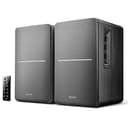
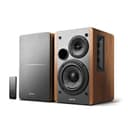
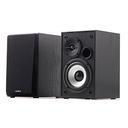
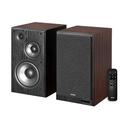
How these were ranked
- What the pair publishes, not what it is said to sound like. This is the first filter and it reorders the range. Five of the six models publish no frequency response figure anywhere in their feature set; only the S1000MKII states one (45 Hz to 40 kHz). That single absence is the honest reason the S1000MKII leads this page: it is the one pair whose low-frequency claim can be held against a number rather than taken on trust.
- Whether a turntable can physically plug in, and how.Four of the six publish dual RCA line-level inputs, which is what a deck’s output lead expects. The R980T publishes two 3.5 mm AUX inputs instead and bundles an RCA-to-3.5 mm cable to bridge the gap. That works, and it is a real difference worth knowing before the box arrives rather than after.
- What the published wattage is a figure for. Edifier quotes 42 W for the R1280 line and 66 W for the R1700BTs as system totals. The S1000MKII is published as 60 W per speaker, and the R2750DB MKII as 144 W across four Class D stages in a three-way layout. Those are not the same kind of number, and lining them up as though they were is the easiest way to mis-buy in this range.
- Whether the system can grow.A subwoofer output with a working crossover is the difference between a pair you keep and a pair you replace. The R1700BTs and the R2750DB MKII publish one; the R1280Ts does too. The R1280T, the R980T and — surprisingly, given its price — the S1000MKII do not publish a sub output at all.
- What it does for the room’s other sources. A record player is rarely the only thing plugged in. Optical and coaxial arrive at the R1280DB, optical at the S1000MKII, and HDMI eARC only on the R2750DB MKII. If a television shares the shelf, that last one is the only pair here that can take its return channel.
The phono rule, stated once and then relied on
A turntable’s cartridge puts out a signal roughly a thousand times smaller than a phone’s headphone socket, and cut to a standardized curve that has to be undone before it sounds like music. The box that does both jobs is a phono preamp. Something in the chain has to contain one.
Across all six Edifier models on this page, the published specification is the same: no phono input, no internal phono stage. The R2750DB MKII listing names a turntable among its compatible sources, and that is true — but only of a turntable whose own stage is switched on. Nothing in its published feature set is a phono input. So:
- If your deck publishes a switchable built-in preamp— the Fluance RT81 and RT81+, the Audio-Technica AT-LP60X, AT-LP70X and AT-LP120XUSB, the Sony PS-LX310BT — switch it to LINE and any pair here works today.
- If your deck publishes no internal stage— the Fluance RT82, RT85, RT85N and RT87, the Pro-Ject Debut Carbon EVO, the Rega Planar 1 — budget for a separate box. Our sub-$100 phono preamp roundup is the cheapest honest fix, and the full roundup covers what more money buys.
Getting this wrong does not sound like a small mistake. It sounds like a thin, tinny whisper at full volume, and it sends a steady stream of perfectly good speakers back to the retailer every month.
What 24, 42, 66, 120 and 144 watts actually buy
Published wattage is the figure buyers rank on and the one that changes the least about the result. Doubling amplifier power is worth roughly 3 dB, which is a smaller step than most people expect, and none of these pairs is short of volume for a room with furniture in it. What the ladder really buys is headroom— the ability to pass a loud passage without the amplifier running out of road — and, further up, bigger drivers in bigger cabinets.
That is why the jump worth paying for is not 42 W to 66 W but the one where the driver changes. The R980T, R1280T, R1280DB and R1700BTs all publish a 4-inch woofer. The S1000MKII publishes a 5.5-inch aluminum alloy midrange bass driver, and the R2750DB MKII publishes a genuine three-way layout — a 7-inch woofer, a 4.5-inch midrange and a 1-inch silk dome tweeter — so its midrange never has to attempt the bottom octave. A 4-inch driver in a small box runs out of air before a 7-inch one does, and no wattage figure changes that.
Our powered speaker roundup puts these against the rest of the powered field, and the under-$500 powered page is the one to read if a live price is what decides it.
Which Edifier for which room
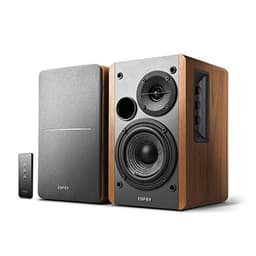
A desk, a bedroom or a first system. The R1280T. 42 W, dual RCA, a remote and tone controls, and the lowest price at which the whole job gets done properly. The R980T saves money and costs 24 W and the RCA sockets; take that trade only if the budget genuinely requires it.
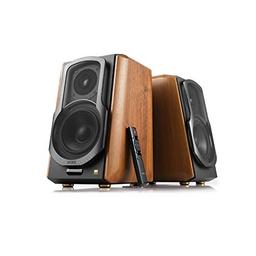
A living room where the deck is the point.The S1000MKII. It is the only pair here with a published response figure, it has the biggest drivers short of the three-way, and the optical input means a streamer can share the cabinets without a switch box. Note the published weight — 36.8 lb for the pair — and the 20.5 inches of published carton width: this needs stands or a real shelf, not a desk.
A room where a subwoofer is coming later.The R1700BTs. 66 W, a 19 mm silk dome tweeter, aptX HD over Bluetooth 5.0, and a sub output with a built-in crossover that Edifier publishes as auto-detecting — so the main pair only hands off the bottom end once something is actually plugged in.
A television and a turntable on one pair. The R2750DB MKII, and not by a narrow margin: it is the only model here that publishes HDMI eARC, which is what lets a TV send its sound back down one cable with the volume following the TV remote. Optical, coaxial and line-in sit beside it, so the deck still has a home.
A phone, a TV and a deck on a budget.The R1280DB — the R1280T with Bluetooth, optical and coaxial added. For a turntable alone it is the same speaker as the cheaper model, so only pay the difference for the inputs.
Two things that improve any pair here for almost nothing
Placement first, because it is free and it is worth more than a step up the range. Get a bookshelf pair off the desk surface, up to roughly seated ear height, and pulled away from the wall behind so the rear ports are not loading into plasterboard. Toe them in slightly toward the listening seat. Our placement guide covers the distances, and getting the deck level and away from the speakers removes the acoustic feedback that makes vinyl sound boomy through any pair.
Then the stylus, because speakers reproduce whatever reaches them, problems included. A worn tip sounds dull and smeared through all six of these, and a replacement costs a fraction of new cabinets. If you are assembling the whole chain from scratch, our beginner setup guide puts the order of operations in one place.