PLATTER & PLINTH

Best Powered Speakers Under $500

Five powered pairs under five hundred dollars, ranked on whether the phono stage is already inside - because under this ceiling, that one line decides what the system actually costs.

By Stephen V.Last updated How we pick

The verdict

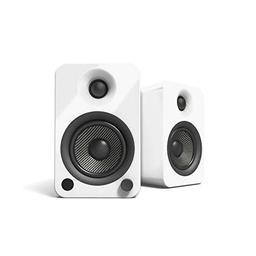
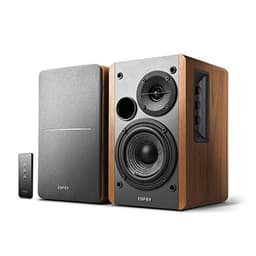
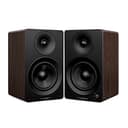
The Kanto YU4 is the powered pair to buy under $500. It has a phono preamp built in, so a turntable with no internal stage plugs straight into it and the shopping list ends there — and it publishes 140 W peak with aptX Bluetooth, in cabinets small enough for a desk or a narrow shelf. It is for the person replacing a whole system at once. The budget pick is the Edifier R1280T, the cheapest complete powered pair here at roughly a third of the ceiling — 42 W RMS, two RCA line inputs, a remote — with the honest caveat that it has no phono stage and no Bluetooth, so a deck without its own preamp needs one added. If the turntable physically has nowhere to go, the Andover Spinbase 2 is the single cabinet the deck sits on top of, with the phono stage inside and anti-feedback isolation built in.

Kanto YU4

Best overall

Kanto YU4

$289.99 · View on Amazon

Price as of November 22, 2026. #ad How we’re funded

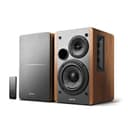
Edifier R1280T

Budget pick

Edifier R1280T

$109.99 · View on Amazon

$149.9927% off

Price as of November 22, 2026. #ad How we’re funded

Every pick sat under $500 at the last price check, as of November 22, 2026, and each button below carries that stamp with its own live number.

Five hundred dollars is the ceiling where powered speakers stop being a compromise and start being the obvious answer. Below it, a powered pair — amplifier inside the cabinet — buys you a finished system for the price of the cabinets alone, and the amplifier was chosen by the people who designed the drivers. Above it you start paying for streaming platforms and HDMI, which is a different purchase.

The spec that actually decides this page is not watts. It is whether a phono preamp is inside. Three of the five below have one and two do not, and the gap is worth about the price of the difference between them: a deck with no internal stage needs a phono preampadded to the bill, and suddenly the cheap pair is not cheap. Check your turntable first — do I need a phono preampsettles it in about thirty seconds — and then read the table’s phono column as the price column.

This page is the sub-$500 cut of the powered field. If you want the whole range including the premium pairs, our powered speakers roundup is the parent list, and best speakers under $500 covers the same ceiling with passive pairs in the mix, where the amplifier is a separate purchase.

How this is funded: we earn a commission if you buy through our links, at no extra cost to you. It never changes which product we recommend, and we’ll tell you plainly when to skip one. Full disclosure.

Quick picks

Ranked on published specs, drive/motor design and buyer fit. Select a row to jump to the full write-up. We have not heard most of these units — here is exactly what we do instead.

#ProductBest forPrice
1
Kanto YU4

Kanto YU4

The smaller of Kanto's two vinyl-ready pairs, and the one most people should buy: a built-in phono preamp means a preamp-less turntable plugs straight in, and the 4-inch Kevlar drivers fit a desk or a narrow shelf where the YU6 will not. You are paying for the phono stage and the cabinet, not for watts.

Best overall
$289.99 · View on Amazon

Price as of November 22, 2026. #ad How we’re funded

2
Klipsch R-50PM

Klipsch R-50PM

The shortest complete Klipsch system for a record player. Klipsch's own spec sheet lists the analog input as "Phono/Line analog (with switch and ground screw terminal)", so a deck with no preamp plugs straight in and its earth wire has a post to land on - and the manual carries a page headed CONNECTIONS - TURNTABLE. 120 W total, a 5.25" TCP woofer and a published 55 Hz limit.

Best published power
$449.99 · View on Amazon

$649.9931% off

Price as of November 22, 2026. #ad How we’re funded

3
Fluance Ai41

Fluance Ai41

A step up in size and output from the entry powered speakers: 5-inch drivers, a 90-watt amp, Bluetooth, optical and a subwoofer output, in a properly finished cabinet. The pick when you want fuller sound and room to grow without moving to separates.

Best for a bigger room
$269.96 · View on Amazon

$299.9910% off

Price as of November 22, 2026. #ad How we’re funded

4
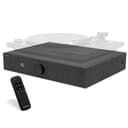
Andover Audio Spinbase 2

Andover Audio Spinbase 2

A single-box speaker system the turntable physically sits on top of, with the phono stage inside. Its patented ISOGroove anti-feedback design exists precisely because a deck on a speaker is normally a terrible idea — this is the one product built to make that arrangement work when you have one shelf and no more.

Best for a tight space
$299.00 · View on Amazon

$349.0014% off

Price as of November 22, 2026. #ad How we’re funded

5
Edifier R1280T

Edifier R1280T

The default powered-speaker recommendation for a turntable: active speakers with the amplifier built in, dual RCA inputs and a remote, at a price that undercuts almost everything. Feed them from a deck with a built-in preamp and you have a complete system for the cost of a cartridge.

Best value
$109.99 · View on Amazon

$149.9927% off

Price as of November 22, 2026. #ad How we’re funded

The picks in full

#1Best overall

Kanto YU4

The smaller of Kanto's two vinyl-ready pairs, and the one most people should buy: a built-in phono preamp means a preamp-less turntable plugs straight in, and the 4-inch Kevlar drivers fit a desk or a narrow shelf where the YU6 will not. You are paying for the phono stage and the cabinet, not for watts.

Strengths

  • Built-in phono preamp — a turntable with no internal stage connects directly
  • Compact enough for a desk at 5.5 x 7.5 x 8.7 inches per cabinet
  • aptX Bluetooth and a remote, so the same pair serves streaming duty

Trade-offs

  • 4-inch drivers give up real low end to the 5.25-inch YU6
  • One phono input — a second source has to use the line or Bluetooth input
TypePowered (active) bookshelf
Phono preampYes — built in
Drivers4" Kevlar woofer, 1" silk dome tweeter
BluetoothYes — Qualcomm aptX
Peak power140 W (published)
Cabinet size5.5" W x 7.5" D x 8.7" H each

Note. Peak power is a marketing figure, not an RMS rating — Kanto does not publish RMS for this pair, so treat 140 W as a ceiling, not an output. The reason to buy it is the phono stage and the size, not the number. One timing note as of October 2026: Kanto has a next-generation YU4 listed as Coming Soon on its own site and has called this pair the outgoing version, so finishes are starting to disappear — the gloss black we linked before went unavailable. The new pair keeps the built-in phono preamp but is announced at a higher price, which makes the current YU4 a run-out buy rather than a mistake.

Specifications read from the manufacturer / product listing, on October 19, 2026. “Not published” means the maker does not state that figure.

#2Best published power

Klipsch R-50PM

The shortest complete Klipsch system for a record player. Klipsch's own spec sheet lists the analog input as "Phono/Line analog (with switch and ground screw terminal)", so a deck with no preamp plugs straight in and its earth wire has a post to land on - and the manual carries a page headed CONNECTIONS - TURNTABLE. 120 W total, a 5.25" TCP woofer and a published 55 Hz limit.

Strengths

  • Switchable phono/line input WITH a ground screw terminal - the detail most powered speakers leave off
  • 120 W total system power and a published 55 Hz - 20 kHz response, the most of any powered model here
  • Optical, USB, 3.5 mm, Bluetooth and a subwoofer output, so the turntable is not the only thing it serves

Trade-offs

  • One cabinet is active and the other is passive, so mains has to reach the right speaker and the supplied 4 m of wire has to reach the left
  • Klipsch publishes no sensitivity or nominal impedance for it - normal for a powered design, but it means you cannot compare it with the passive pairs on the figure that decides those
  • Bluetooth is input-only and there is no network streaming at this price; that is what The Fives II adds
TypePowered (active) bookshelf pair, bass-reflex (rear port)
Phono preampYes - switchable phono/line with ground screw terminal
Woofer5.25" spun-copper TCP
Tweeter1" aluminum LTS on a 90x90 square Tractrix horn
Frequency response55 Hz - 20 kHz (dynamic bass extension 44 Hz)
Total system power120 W (240 W peak), 60 W per channel continuous at under 1% THD
Maximum output104 dB
Crossover1,663 Hz (passive)
SensitivityNot published
InputsBluetooth, phono/line RCA, 3.5 mm, USB digital, optical digital
OutputsSingle RCA line-level subwoofer output
CabinetMDF, 14 x 7 x 10.8", 24.8 lbs

Note. The ground screw terminal is why this sits above the powered pairs that offer only a phono input. A moving-magnet cartridge picks up mains hum through an unearthed deck, and a phono input with nowhere to put the earth wire is a phono input you may end up not using. Klipsch prints the terminal on the spec sheet and labels it in the manual.

Specifications read from the manufacturer / product listing, on September 29, 2026. “Not published” means the maker does not state that figure.

#3Best for a bigger room

Fluance Ai41

A step up in size and output from the entry powered speakers: 5-inch drivers, a 90-watt amp, Bluetooth, optical and a subwoofer output, in a properly finished cabinet. The pick when you want fuller sound and room to grow without moving to separates.

Strengths

  • 5-inch woven drivers and 90W of power fill a real room
  • Bluetooth, optical and RCA inputs, plus a subwoofer output
  • Handsome cabinet and included remote

Trade-offs

  • No built-in phono preamp — the turntable still needs a stage
  • Bigger footprint than the compact entry speakers
TypePowered (active) bookshelf
Power90W total
Drivers5-inch woven
InputsRCA, optical, Bluetooth 5
Phono preampNo
ExtrasSubwoofer output

Note. The subwoofer output is the standout here — it gives you an easy path to add low end later without changing speakers.

Specifications read from the manufacturer / product listing, on July 24, 2026. “Not published” means the maker does not state that figure.

#4Best for a tight space

Andover Audio Spinbase 2

A single-box speaker system the turntable physically sits on top of, with the phono stage inside. Its patented ISOGroove anti-feedback design exists precisely because a deck on a speaker is normally a terrible idea — this is the one product built to make that arrangement work when you have one shelf and no more.

Strengths

  • Phono input built in, so a preamp-less deck needs nothing else
  • ISOGroove anti-feedback design is engineered for a turntable placed on top of it
  • Bluetooth, analog, optical and USB inputs alongside the phono stage

Trade-offs

  • One cabinet means no stereo separation worth the name — soundstage is the price of the footprint
  • Not upgradeable: you cannot keep the speakers and add a better preamp later
TypeSingle-cabinet powered speaker system for turntables
Phono inputYes — built in
Other inputsBluetooth, analog, optical digital, USB
AmplificationDual Direct Drive (published)
IsolationPatented ISOGroove anti-feedback
ControlIR remote — input, volume, tone

Note. Andover does not publish an RMS power figure or a frequency response for the Spinbase 2, which is why neither appears above. Buy it for the footprint and the feedback engineering, not for a spec sheet.

Specifications read from the manufacturer / product listing, on August 19, 2026. “Not published” means the maker does not state that figure.

#5Best value

Edifier R1280T

The default powered-speaker recommendation for a turntable: active speakers with the amplifier built in, dual RCA inputs and a remote, at a price that undercuts almost everything. Feed them from a deck with a built-in preamp and you have a complete system for the cost of a cartridge.

Strengths

  • Amplifier built in — no separate amp needed
  • Two RCA inputs, so a turntable and a second source can both stay connected
  • Remote control and tone controls; famously good value

Trade-offs

  • No built-in phono preamp — your turntable or an external box must provide one
  • No Bluetooth on this model (the R1280DB adds it)
TypePowered (active) bookshelf
Power42W RMS total
Inputs2 x RCA (line level)
Phono preampNo
BluetoothNo

Note. These take a LINE-level signal, so your turntable needs a preamp somewhere — either its own switchable built-in stage set to ON, or a separate box. Our 'do I need a phono preamp' guide walks through it.

Specifications read from the manufacturer / product listing, on July 24, 2026. “Not published” means the maker does not state that figure.

How these were ranked

  • Phono stage inside, or not.The Kanto YU4, the Klipsch R-50PM and the Andover Spinbase 2 all publish a built-in phono input — the Klipsch with a switchable phono/line selector and a ground screw terminal, which is the detail that stops a turntable humming. The Fluance Ai41 and the Edifier R1280T publish none. That is not a flaw, it is a price decision, but it belongs in the budget.
  • Published power, read carefully. Klipsch publishes the most complete figure here and the only one with a distortion condition attached: 120 W total, 60 W per channel continuous at under 1% THD. Fluance publishes 90 W total. Edifier publishes 42 W RMS total. Kanto publishes a 140 W peak figure, which is a different kind of number and we label it as such rather than lining it up against the continuous ones. Our wattage explainer covers why peak and RMS are not comparable.
  • What the cabinet has to fit into.The YU4’s smaller cabinets go where the Fluance and the Klipsch will not. The Spinbase 2 goes further still: it is a single cabinet the turntable sits directly on top of, with a patented anti-feedback design that exists because a deck on a speaker is normally a terrible idea. If your furniture is the constraint rather than your budget, start there.
  • Room to grow.Four of the five publish a subwoofer output, so the bottom end can be added later rather than paid for now. The Edifier R1280T does not, and its 42 W is the floor of this page — which is exactly why it is the value pick rather than the overall one.

What changes above and below this ceiling

Under about $200, the field narrows to the Edifier pairs and passive bookshelves that still need an amplifier — our best speakers under $200 roundup is the right page for that budget, and it is a genuinely different shortlist.

Above $500, what the extra money buys is mostly connectivity rather than drivers: HDMI-ARC so the speakers also serve a television, Wi-Fi streaming platforms, and larger cabinets. The Klipsch The Fives II and the Kanto YU6 are where that starts, and our alternatives to The Fives page compares the two bands directly.

Three things worth doing before you spend more

Placement. Off the desk surface, onto standsat roughly seated ear height, pulled away from the wall behind so the rear ports are not loading into plasterboard. This is free and it changes more than the difference between any two pairs on this page — our placement guide has the distances.

The stylus. Speakers reproduce what arrives at them, worn tips included, and a replacement stylus costs a fraction of a new pair of speakers.

The ground wire.If you buy a pair with a phono input, use the ground terminal. Most hum complaints after a speaker upgrade are a disconnected ground lead, not a faulty speaker — our hum and grounding guide covers it. We have not heard any of these five pairs; every figure above is read from the maker’s published specification on a dated visit, per our methodology.

Frequently asked questions

What are the best powered speakers under $500?

The Kanto YU4 for most turntable owners, because it has a phono preamp built in - so a deck with no internal stage plugs straight in and nothing else is needed - plus aptX Bluetooth and a published 140 W peak in cabinets small enough for a desk. The cheapest complete pair here is the Edifier R1280T, which has no phono stage, so budget for one if your turntable lacks its own.

Do powered speakers under $500 have a phono input?

Some do. The Kanto YU4, the Klipsch R-50PM and the Andover Spinbase 2 all publish a built-in phono input, and the Klipsch adds a ground screw terminal. The Fluance Ai41 and the Edifier R1280T publish none, so a turntable without its own switchable preamp needs a separate phono stage added to the cost.

How many watts do I need for powered speakers?

Fewer than the marketing suggests, and the number only means something with a condition attached. Klipsch publishes 60 W per channel continuous at under 1% THD for the R-50PM; Edifier publishes 42 W RMS total for the R1280T and it is perfectly loud in a bedroom. Peak figures, like Kanto's 140 W, measure something different and should not be compared against continuous ratings.

Are powered speakers better than passive ones for a turntable?

Not inherently, but they are simpler. A powered pair has the amplifier matched to its own drivers and removes a box, a pair of cables and a purchase from the system. A passive pair lets you upgrade the speakers and the amplifier separately and usually costs less for the cabinets alone. Our powered versus passive page covers the trade.

Can I put my turntable on top of the Andover Spinbase 2?

Yes - that is what it is designed for, and it is the only product here you should do that with. Andover publishes a patented ISOGroove anti-feedback design precisely because a deck sitting on a speaker normally produces acoustic feedback. On any other pair on this page, keep the turntable on a separate surface.

Do I need a subwoofer with powered speakers under $500?

Not to start with. Four of the five picks here publish a subwoofer output, so you can add one later if the room turns out to need it. Bookshelf cabinets at this price roll off in the bottom octave, which most rock and jazz records do not depend on; placement and a bit of wall reinforcement usually close the gap for free.

What is the difference between the Klipsch R-50PM and the R-40PM?

Power and cabinet size. Klipsch publishes 120 W total for the R-50PM against 70 W for the R-40PM, and a 55 Hz low-frequency limit against 60 Hz. Both share the same input panel, including the switchable phono/line input with a ground screw terminal, so the smaller pair is the same idea in a smaller room.

Sources

  • Kanto Audio — YU4 powered speakers — Manufacturer page for the built-in phono preamp, aptX Bluetooth and cabinet dimensions (accessed August 19, 2026)
  • Klipsch — R-50PM powered monitors spec sheet (PDF) — Manufacturer specification table, read live. System description "Powered Monitor (pair)", frequency response 55 Hz - 20 kHz, "DYNAMIC BASS EXTENSION 44Hz", maximum output 104 dB, "120W Total System Power (240W Peak)" and "60W per channel cont. @ <%1 THD", 1" (2.5 cm) aluminum LTS tweeter on a 90 x 90 square Tractrix horn, "Single 5.25" (13.3cm) spun-copper TCP woofer", crossover "1663 Hz (Passive)", MDF, "Bass-reflex via rear-firing port", 14" (35.6 cm) H x 7" (17.8 cm) W x 10.8" (27.4 cm) D, 24.8 lbs (11.2 kg). The input list is the reason this model is on the page: "Bluetooth wireless technology / Phono/Line analog (with switch and ground screw terminal) / 3.5mm analog mini jack / USB digital / Optical digital", with a "Single RCA line level output for connection to subwoofer". The header badges read TURNTABLE READY, PC READY, TV READY and NO RECEIVER NEEDED. NO sensitivity and NO nominal impedance row is printed — which is why this site records both as not published for the powered models (accessed September 29, 2026)
  • Klipsch — R-40PM and R-50PM owner's manual (PDF) — The manual both powered models share. Cited for three things the spec sheet only implies: the contents page carries a section headed "CONNECTIONS - TURNTABLE" (page 9), the rear-panel legend labels a "Phono/Line Switch", "Phono Inputs" and a "Ground Screw Terminal" as separate numbered items, and the diagram labels the pair as "RIGHT SPEAKER (ACTIVE)" — so the powered cabinet is the right one, the left is passive, and the supplied 4 m speaker wire has to span the gap (accessed September 29, 2026)
  • Andover Audio — Spinbase 2 — Manufacturer page: phono input, ISOGroove anti-feedback design for a turntable placed on top (accessed August 19, 2026)
  • Crutchfield — Home speakers buying guide — Reference on choosing passive vs powered speakers, room size and amplifier pairing (accessed August 11, 2026)
  • Crutchfield — Understanding speaker and amplifier wattage ratings — On RMS versus peak power, and matching an amplifier's output to a speaker's rating (accessed August 11, 2026)
  • Crutchfield — How to choose a phono preamp — On why a phono signal needs a preamp and never running two at once (accessed July 24, 2026)

Keep reading