AT-LP60X vs AT-LP70X
Audio-Technica's entry automatic against the automatic built to replace its ceiling. Same one-button operation, same fixed arm, same conical tip in the box — and one published figure that decides everything else.
How this is funded:we earn a commission if you buy through our links, at no extra cost to you. It never changes which product we recommend, and we’ll tell you plainly when to skip one. Full disclosure.
Audio-Technica sells two fully automatic turntables, and at the button they behave the same. Press START on either and the platter spins, the arm cues to the lead-in groove and lowers itself; at the end of the side the arm lifts, returns to its rest and the platter stops. Both are belt drive, both play 33 1/3 and 45 RPM, both have a switchable phono/line preamp with 36 dB of gain, both ship with a felt mat, a 45 adapter, a hinged dust cover and an external AC adapter, and neither has a counterweight or an anti-skate dial. Audio-Technica publishes the same wow and flutter for both: less than 0.25% (WTD).
The AT-LP70X changes the cartridge, and almost everything that separates the two decks follows from that. The AT-LP60X carries the AT3600L, the conical Dual Magnet cartridge Audio-Technica has fitted to its entry decks for decades, integrated into the headshell. The AT-LP70X carries a fixed-body AT-VM95C, which is the conical member of the VM95 family — the same family the AT-LP120XUSB and several of this site’s cartridge picks belong to. Two published figures move with it: cartridge output goes from 2.5 mV to 4.0 mV, and the deck’s signal-to-noise figure from more than 50 dB to more than 55 dB. Around the cartridge, the LP70X gets a J-shaped arm with published geometry, a clamp on the arm rest, a lift lever instead of a button, a ground terminal and a proper dual-RCA cable, and what Audio-Technica calls a three-piece anti-resonance chassis.
The question that decides it: will you ever change the stylus for a better one?
The short answer
- Buy the AT-LP70X if there is any chance the stylus in the box is not the stylus you end up with. Its cartridge accepts every VM95-series stylus — elliptical, nude elliptical, micro-linear, Shibata — and it was built around a cartridge that tracks at about 2 g. You keep the one-button automation the whole way up the ladder.
- Buy the AT-LP60X if you want the automation and will never touch the cartridge. It is the cheaper of two decks that behave identically at the button, it is not unsafe for records, and the difference between them does more for a first system spent on powered speakers than on a stylus socket you never use.
Criterion one: the force each arm was built for
Neither deck has a counterweight, so on both the tracking force is whatever the factory set for the cartridge it fitted. Audio-Technica publishes no set figure for either arm and we have not measured one. What the maker does publish is the range each cartridge was designed for, on the cartridge and stylus pages rather than on the turntable pages, and the two ranges are not close.
The AT3600L family — the stock ATN3600LC conical and the ATN3600LE elliptical both — is published at 3.0 to 4.0 g, 3.5 g standard. The AT-VM95C is published at 1.8 to 2.2 g, 2.0 g standard. That is the difference between a cartridge Audio-Technica says has been in service for more than fifty years, designed for light fixed arms that needed the extra downforce to keep a conical tip in the groove, and a current moving-magnet design that tracks at the figure most cartridges on this site track at. Both are inside their own maker’s range, and this site has said in the AT-LP60X review and will say again here that 3.5 g on a conical tip does not ruin records. But it is a heavier hand on the groove than the alternative, and it is the reason the LP60X family’s upgrade path is as short as it is: a finer tip profile on a 3.5 g arm is a finer tip pressed harder, which is not what finer tips are for.
This is also why the LP70X’s better cartridge is not simply a spec-sheet flourish. A cartridge designed for 2 g on an arm built to deliver 2 g is the combination that lets a bonded elliptical, and later a nude or micro-linear tip, do the work it is shaped for. Our guide to when a stylus needs replacing covers the other half of the same physics.
Criterion two: one rung against five
The stylus in the box is the same shape on both decks: a 0.6 mil bonded conical. Out of the box, the two cartridges are more alike than the price gap suggests. The difference is what each can become.
Audio-Technica lists exactly one upgrade for the AT-LP60X: the ATN3600LE, a 0.3 x 0.7 mil bonded elliptical that snaps onto the AT3600L body in place of the conical. It is a real step and it is the only one. There is no micro-linear or Shibata for that body, its published stylus life is about 300 hours against 300 to 500 for the conical it replaces, and it tracks at the same 3.0 to 4.0 g because the force belongs to the arm. The LP60X’s cartridge body cannot be changed — it is integrated into the headshell on a proprietary mount — so the ladder is that one rung.
Audio-Technica lists four upgrades above the conical for the AT-LP70X, on the product page itself: the AT-VMN95E bonded elliptical, the AT-VMN95EN nude elliptical, the AT-VMN95ML micro-linear and the AT-VMN95SH Shibata. The maker’s own wording is that the fixed-body VM95C “is compatible with any VM95 Series replacement stylus”, and every one of those styli is published in the same 1.8 to 2.2 g band as the conical, so each swap is a two-second job with nothing else to change. Our replacement stylus roundup covers what each rung is worth; the short version is that the VMN95E is the one most people should buy first, and the VMN95ML is where the family stops being an entry cartridge.
Be precise about what the LP70X does not offer, because the listing copy blurs it. The specification says the cartridge “cannot be removed”. This is a stylus ladder, not a cartridge ladder: you cannot fit an Ortofon, a Nagaoka or a Grado to this deck, and you cannot fit a VM95 body that Audio-Technica has not built into it. If you want automation and a standard removable headshell, that is the Denon DP-300F, and it costs accordingly. Within Audio-Technica’s own automatics, the LP70X is the one with somewhere to go; the LP60X is the one that is finished when you open the box.
Criterion three: the numbers on the two spec tables
Output. The AT3600L is published at 2.5 mV; the AT-VM95C at 4.0 mV, both at 1 kHz and 5 cm/sec. Both decks run the same 36 dB internal stage, so the line-level outputs scale with the cartridge: 150 mV from the LP60X, 252 mV from the LP70X. Higher output is not better sound in itself. What it buys is headroom — the internal stage and whatever is downstream have more signal to work with relative to their own noise floor, which is the mechanism behind the next figure, and it means the volume knob on a pair of powered speakers sits a little lower for the same loudness.
Signal to noise. Audio-Technica publishes more than 50 dB (DIN-B) for the AT-LP60X and more than 55 dB for the AT-LP70X. The LP70X figure does not state a weighting, so treat the two as the maker’s claims on the maker’s terms rather than as a measured five-decibel gap; the direction is what the higher cartridge output would predict.
Wow and flutter. Identical: less than 0.25% (WTD), with the LP60X adding “at 3 kHz”. Neither the platter change (both are anti-resonance die-cast aluminum with a felt mat) nor the chassis change moved this figure, and we make no claim that the LP70X holds speed better. It is a belt-drive automatic in the same class, and the published number says so. For a deck whose maker publishes a much tighter figure, the Fluance RT82 is the comparison to read, and it is not automatic.
The arm. The LP60X page says only that its tonearm base and headshell were redesigned from the older LP60; no geometry is published. The LP70X publishes a J-shaped arm with a 220 mm effective length, 18 mm overhang and less than 2.0 degrees of tracking error. Publishing the numbers is not the same as having better numbers, but an arm whose maker states its geometry is an arm the maker was prepared to be judged on.
What else changed, and what it is worth
The ground terminal. The LP70X has one on the rear panel and ships with a dual-RCA cable that carries a ground wire. The LP60X’s rear panel lists the preamp switch, the output terminals and the power jack, and its cable is a 3.5 mm plug to dual RCA. If you run either deck in LINE mode into powered speakers this does not matter. If you run it in PHONO mode into the phono input of a receiver or a separate stage, the ground connection is the difference between a quiet background and the hum that sends people to our troubleshooting guide. It is a small item on the table and a large one in a living room.
The chassis. Audio-Technica describes the LP70X’s as a “three-piece chassis construction” that “dampens resonance for improved sound quality”, and footnotes the claim “compared to AT-LP60X”. That is the maker comparing its own two decks, which is worth knowing, and it is also a claim without a published measurement behind it. The deck is heavier — 6.4 lb against 5.73 lb — and it draws 1.5 W against 1.0 W, neither of which tells you anything about resonance.
The footprint. The LP70X is wider and shallower: 16 x 13 in against 14.15 x 14.70 in. On a shelf that is short front-to-back the LP70X fits where the LP60X does not, and on a narrow shelf the reverse. Measure before you choose; this is the one row on the table that can decide the purchase on its own.
The small controls. The LP70X lifts its arm with a lever rather than the LP60X’s button, and clamps the arm on its rest, which Audio-Technica lists as reducing the risk of stylus damage. Its manual publishes a 300-hour stylus replacement rule of thumb and a once-a-year belt suggestion, and warns that the automation may not work with the start or end of some records. Neither deck has a power switch — both manuals say so and tell you to unplug the adapter if the deck will sit unused — and both have the 12 in / 7 in size selector that tells the automatic mechanism where the lead-in groove is.
What neither deck does
Neither has a counterweight or anti-skate, so neither lets you dial tracking force to a cartridge’s published figure — that is the trade both make for automation, and the automatic-versus-manual guide is the page that argues it in full. Neither plays 78s. Neither has USB. Neither has Bluetooth, although both exist in a Bluetooth version (the AT-LP60XBT and AT-LP70XBT) that adds it to the same deck. Neither includes speakers, and neither needs a separate phono preamp unless you choose to add one. The LP70X manual also says, in so many words, “Do not use a disk stabilizer” — the small motor and light platter of a budget automatic are exactly the case our record weight guide tells readers not to load.
The value calculation
Price the LP70X as the LP60X plus three things: a cartridge from a current family, an arm built for the force that family tracks at, and a stylus socket with four rungs above the one in the box. The gap between the two decks, when we checked, sat in the same bracket as a single VM95-series elliptical stylus. Put that way the arithmetic is simple. The LP60X plus its one elliptical ends at a bonded elliptical on a 3.5 g arm. The LP70X plus the equivalent elliptical gets you a bonded elliptical at 2 g, with the nude, micro-linear and Shibata tips still ahead of it — and the automation intact at every step.
The argument runs the other way when the stylus will never change. A first system that still needs speakers, or a cleaning kit for a second-hand collection, gets more from that money than a stylus socket does, and the LP60X is the deck that makes the trade available. It is the safest automatic in the range, it is still this site’s beginner pick with the LP70X sitting one rung above it, and buying it is not settling. Buying it and then wishing you could fit a micro-linear stylus is the one outcome this page exists to prevent.
The decision, in one paragraph
These are the same automatic mechanism built around two cartridges from two eras, so the question is not which deck is better at the button — they are the same there — but whether you want a stylus ladder or not. Buy the AT-LP70X if the answer is yes or even maybe: the VM95C body tracks at about 2 g, accepts every VM95 stylus Audio-Technica makes, and the arm, output and ground terminal around it are all built for the same purpose. Buy the AT-LP60X if the answer is a confident no, because it does the automatic job identically for less, and the money is better spent on what the turntable plugs into.
The spec matrix
Eleven of the twenty-eight rows are the same. The rows that carry the whole difference are the cartridge, the tracking-force range it was built for, and the stylus list under it.
| Specification | AT-LP60XAudio-Technica | AT-LP70XAudio-Technica |
|---|---|---|
| Drivesame | Belt drive | Belt drive |
| Operationsame | Fully automatic | Fully automatic |
| Motor | DC servo-controlled | DC motor (as published) |
| Speedssame | 33 1/3 and 45 RPM | 33 1/3 and 45 RPM |
| Plattersame | Anti-resonance die-cast aluminum, felt mat | Anti-resonance die-cast aluminum, felt mat |
| Wow and fluttersame | < 0.25% (WTD) at 3 kHz | < 0.25% (WTD) |
| Signal to noise | > 50 dB (DIN-B) | > 55 dB |
| Cartridge | AT3600L Dual Magnet, integrated into the headshell | AT-VM95C Dual Moving Magnet, fixed body (cannot be removed) |
| Stylus as shippedsame | 0.6 mil conical, bonded (ATN3600LC) | 0.6 mil conical, bonded round shank (AT-VMN95C) |
| Cartridge tracking-force range (published) | 3.0-4.0 g (3.5 g standard) | 1.8-2.2 g (2.0 g standard) |
| Tracking force set on the decksame | Not published | Not published |
| Counterweight / anti-skatesame | None / none | None / none |
| Stylus upgrades the maker lists | One: ATN3600LE elliptical (0.3 x 0.7 mil) | Four above the stock conical: AT-VMN95E, AT-VMN95EN, AT-VMN95ML, AT-VMN95SH |
| Published stylus life | Approx. 300-500 hours (conical) | Replace after 300 hours (manual) |
| Cartridge output (phono) | 2.5 mV at 1 kHz, 5 cm/sec | 4.0 mV at 1 kHz, 5 cm/sec |
| Line output (preamp on) | 150 mV | 252 mV |
| Built-in preampsame | Yes, switchable phono/line, 36 dB | Yes, switchable phono/line, 36 dB |
| Tonearm | Fixed; geometry not published | J-shaped; 220 mm effective length, 18 mm overhang, < 2.0 deg tracking error |
| Tonearm lift | Button | Lever |
| Tonearm rest | Rest | Rest with clamp |
| Ground terminal | Not listed on the rear panel | Yes |
| Output cable | Detachable, 3.5 mm to dual RCA | Detachable, dual RCA to dual RCA with ground wire |
| Chassis | Not published | Three-piece anti-resonance (maker's claim, "compared to AT-LP60X") |
| Record size selectorsame | 12 in / 7 in | 12 in / 7 in |
| Dimensions (W x D x H) | 14.15 x 14.70 x 3.84 in | 16 x 13 x 4.3 in |
| Weight | 5.73 lb (2.6 kg) | 6.4 lb (2.9 kg) |
| Power consumption | 1.0 W | 1.5 W |
| Bluetooth versionsame | AT-LP60XBT | AT-LP70XBT |
Every figure is Audio-Technica’s own: the AT-LP60X and AT-LP70X product pages and user manuals, and the AT-VM95C, ATN3600LC and ATN3600LE pages. The AT-LP70X’s wow-and-flutter cell was blank on the web table, so that figure is from its manual. All read 2026-09-18 — see Sources below. “Not published” means the figure is not stated in the sources cited below — it is never a value we estimated. Rows marked same are the ones where these decks do not differ.
Both decks, with live prices
Prices are pulled live and dated. Audio-Technica and Amazon discount these two independently, so the gap between them moves more than the hardware does — check both before deciding.
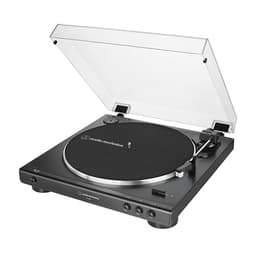
Audio-Technica AT-LP60X
A safe, genuinely automatic first deck under $200
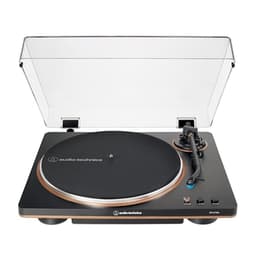
Audio-Technica AT-LP70X
Automatic convenience with a real step-up cartridge
Price as of September 19, 2026. #ad How we’re funded
The upgrade each deck can take
The whole argument on this page, as two parts. The ATN3600LE is the one step the AT-LP60X is offered. The AT-VMN95E is the first of four steps the AT-LP70X is offered, and it tracks at the force the deck was built for.
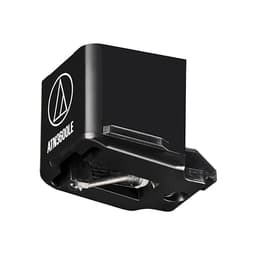
Audio-Technica ATN3600LE Elliptical Upgrade Stylus
The one upgrade an AT-LP60X or AT-LP60XBT can take
Price as of September 19, 2026. #ad How we’re funded
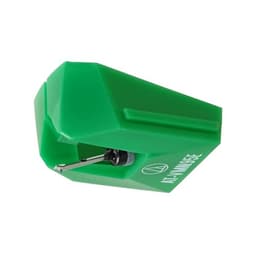
Audio-Technica AT-VMN95E Replacement Stylus
Replacing a worn stylus without touching the alignment
Price as of September 19, 2026. #ad How we’re funded
Frequently asked questions
What is the difference between the AT-LP60X and the AT-LP70X?
Both are fully automatic belt-drive turntables with a fixed tonearm, no counterweight or anti-skate, a switchable built-in phono preamp and 33 1/3 and 45 RPM. The AT-LP70X changes the cartridge — a fixed-body AT-VM95C in place of the AT3600L — which is a cartridge Audio-Technica publishes at 1.8-2.2 g tracking force rather than 3.0-4.0 g, with 4.0 mV output instead of 2.5 mV, and a socket that accepts any VM95-series stylus. The LP70X also gets a J-shaped arm with published geometry, a tonearm clamp, a ground terminal with a dual-RCA cable, a three-piece chassis and a signal-to-noise figure five decibels higher. The published wow and flutter is the same on both.
Is the AT-LP70X worth the extra money over the AT-LP60X?
It is if you will ever change the stylus for a better one. The gap between the two decks is in the same bracket as a single VM95-series elliptical stylus, and that stylus on the LP70X gives you an elliptical tracking at 2 g with three more rungs above it. The LP60X plus its own elliptical option gives you an elliptical tracking at 3.5 g and nothing above it. If you will never change a stylus at all, the LP60X is the right buy and the difference does more good spent on speakers.
Can you upgrade the cartridge on the AT-LP70X?
No — the stylus, yes; the cartridge, no. Audio-Technica's own specification says 'This product is equipped with an AT-VM95C Dual Moving Magnet Stereo Cartridge. The cartridge cannot be removed.' What the fixed body accepts is any AT-VMN95 replacement stylus, which is where the VM95 family keeps its differences anyway: conical, elliptical, nude elliptical, micro-linear and Shibata all share one body. If you want a deck that takes a different cartridge outright, that is the Denon DP-300F with its standard removable headshell, not either of these.
Can you upgrade the stylus on the AT-LP60X?
Once. Audio-Technica sells the ATN3600LE, a 0.3 x 0.7 mil bonded elliptical that snaps onto the AT3600L body in place of the conical ATN3600LC, and lists it as compatible with the AT-LP60X series. It is a real step in tip profile. It is also the whole ladder — there is no micro-linear or Shibata for that body — and it carries the same published 3.0-4.0 g tracking range as the conical, because the force is set by the arm and not by the stylus.
Does the AT-LP70X track lighter than the AT-LP60X?
The cartridge each deck is built around is published at different forces — 1.8-2.2 g (2.0 g standard) for the AT-VM95C and 3.0-4.0 g (3.5 g standard) for the AT3600L family — and since neither arm has a counterweight, the force is whatever the factory set for that cartridge. Audio-Technica publishes no set figure for either deck, and we have not measured one, so the honest statement is about the cartridge, not the deck: the LP70X is built around a cartridge designed for roughly 2 g, the LP60X around one designed for roughly 3.5 g. Both are inside their own maker's published range; neither is unsafe for records.
Do the AT-LP60X and AT-LP70X need a separate phono preamp?
No. Both have a switchable phono/line preamp with 36 dB of gain, so both plug straight into powered speakers or any line input as they come, and both can be switched to phono if you later add a separate stage or an amplifier with a phono input. The LP70X's higher cartridge output means its line output is also higher — 252 mV against 150 mV — which in practice means the volume knob on a pair of powered speakers sits a little lower for the same loudness.
Which one has Bluetooth?
Neither of the two decks on this page. Both exist in a Bluetooth version — the AT-LP60XBT and the AT-LP70XBT — which add wireless output to the same deck and cost more. If you will only ever use the RCA output, the wired version is the same turntable for less.
Which is the better first turntable?
The AT-LP60X if 'first turntable' means you want nothing to set and nothing to think about later — it is the cheaper of two decks that behave identically at the button. The AT-LP70X if you suspect the first turntable will not be the last stylus: it is the same automation with a cartridge that has somewhere to go. Neither is a deck for someone who wants to balance an arm; for that the Fluance RT81 is the next page to read.
Sources
- Audio-Technica — AT-LP60X turntable — Manufacturer specs for the fully automatic belt-drive AT-LP60X (accessed August 11, 2026)
- Audio-Technica — AT-LP60X user manual — The light end of the same question: 359.5 mm (14.15 in) wide x 97.5 mm (3.84 in) high x 373.3 mm (14.70 in) deep, 2.6 kg (5.73 lb). It fits every platform here with room to spare — and at about 1.4 lb per corner it sits below the load range every compliant isolator on this page publishes (accessed September 11, 2026)
- Audio-Technica — AT-LP70X fully automatic belt-drive turntable — The maker's own product page and specification table. Features as published: "Fully automatic belt-drive turntable operation with two speeds: 33-1/3, 45 RPM"; "A fixed-body AT-VM95C Integral Dual Moving Magnet phono cartridge is compatible with any VM95 Series replacement stylus"; "Stylish three-piece chassis construction dampens resonance for improved sound quality*" with the footnote "*Compared to AT-LP60X"; "J-shaped tonearm is engineered to minimize tracking errors"; "Tonearm lock reduces risk of stylus damage"; "Built-in switchable phono/line pre-amplifier"; "Anti-resonance, die-cast aluminum platter with felt mat"; "Includes detachable RCA output cable (dual RCA male to dual RCA male with ground), 45 RPM adapter, and removable hinged dust cover"; "Available in Black/Gray, Black/Bronze, and White/Silver". Spec table: DC motor; belt drive; die-cast aluminum platter; signal-to-noise > 55 dB; "This product is equipped with an AT-VM95C Dual Moving Magnet Stereo Cartridge. The cartridge cannot be removed."; output PHONO 4.0 mV and LINE 252 mV nominal at 1 kHz, 5 cm/sec; phono pre-amp gain 36 dB nominal, RIAA equalized; power consumption 1.5 W; 400 mm (16 in) W x 330 mm (13 in) D x 110 mm (4.3 in) H; approx. 2.9 kg (6.4 lb); effective arm length 220 mm (8.7 in); overhang 18 mm (0.71 in); tracking error angle less than 2.0 degrees; replacement stylus AT-VMN95C; AC adapter 12 V DC, 0.5 A. The upgrade-path block on the same page lists the AT-VMN95C, AT-VMN95E, AT-VMN95EN, AT-VMN95ML and AT-VMN95SH as compatible styli, and the description states the stylus "can also be easily upgraded with any other styli (elliptical, micro linear, or Shibata) in our VM95 Series". The wow-and-flutter cell on the web table was empty on the access date; the figure is taken from the manual instead (accessed September 18, 2026)
- Audio-Technica — AT-LP70X user manual (EN) — The published manual (351709420-02-01 ver.1, 2024.07.15). Turntable specifications: "Wow and flutter < 0.25% (WTD)", "Signal-to-noise ratio > 55 dB", output PHONO 4.0 mV / LINE 252 mV, pre-amp gain 36 dB. Tonearm: effective length 220 mm, overhang 18 mm, tracking error less than 2.0 degrees. Cartridge: "This product is equipped with an AT-VM95C Dual Moving Magnet Stereo Cartridge. The cartridge cannot be removed."; stylus "0.6 mil bonded conical"; cantilever "Aluminum pipe"; recommended load 47,000 ohms. Rear panel lists a pre-amplifier selector switch, stereo output terminals, a ground (earth) terminal and the power input jack; the tonearm carries a 12 in / 7 in size selector, a lift control lever and a "tonearm rest with clamp". Also states: "This product does not have a power switch"; "As a rule of thumb, replace the stylus after 300 hours of use"; "As a rule of thumb, we suggest replacing the belt once a year"; "Do not use a disk stabilizer"; "Automatic operation may not work with the start or end of songs on some records"; and, on the tracking-force question, nothing — the manual publishes no set force for the arm (accessed September 18, 2026)
- Audio-Technica — AT-VM95C cartridge — The cartridge the AT-LP70X is built around, on its own spec page: frequency response 20-20,000 Hz; channel separation 18 dB at 1 kHz; vertical tracking force "1.8-2.2 g (2.0 g standard)"; stylus construction "Bonded round shank", shape "0.6 mil conical"; cantilever "Aluminum pipe"; output 4.0 mV (1 kHz, 5 cm/sec); recommended load 47,000 ohms and 100-200 pF; replacement stylus AT-VMN95C; and the line the whole upgrade argument rests on: "Compatible with any AT-VMN95 replacement stylus". This page describes the half-inch-mount version; the AT-LP70X carries a fixed-body variant with the same stylus socket (accessed September 18, 2026)
- Audio-Technica — ATN3600LC replacement stylus — The replacement conical stylus for the AT3600L cartridge fitted to the AT-LP60X, and the only place Audio-Technica publishes that cartridge's tracking-force range: "Vertical Tracking Force 3.0 to 4.0 g (3.5 g standard)"; "Conical bonded", 0.6 mil; stylus life "Approx. 300-500 hours"; compatible with the AT-LP60X series, AT-LP60 series, AT-LP2D series, AT-PL300 series, AT-SB727, AT-SB2022, AT-LPGO-BT and AT-PL50 (accessed September 18, 2026)
- Audio-Technica — ATN3600LE elliptical replacement stylus — The AT-LP60X's one upgrade rung, from the maker: "This elliptical bonded stylus makes it easy to upgrade the sound quality of any turntable equipped with an ATN3600L or ATN3600LC conical stylus, such as the turntables in our popular AT-LP60X series"; stylus shape "Elliptical bonded", dimensions "0.3 x 0.7 mil"; "Vertical Tracking Force 3.0 to 4.0 g (3.5 g standard)"; stylus life "Approx. 300 hours"; the same compatibility list as the ATN3600LC. Read alongside the VM95C page, this is the fact the comparison turns on: the LP60X's elliptical option still tracks at 3.5 g, because the force is set by the arm and the cartridge body it was designed for, not by the stylus (accessed September 18, 2026)
- Audio-Technica — VM95 Series cartridges — The shared-body VM95 range and its interchangeable stylus upgrade path (accessed July 24, 2026)
- Audio-Technica — AT-VMN95E replacement stylus — Manufacturer page for the elliptical VM95-series replacement stylus and its fitment list (accessed August 11, 2026)
Keep reading
Audio-Technica AT-LP60X Review
The full case for the cheaper deck, and exactly where its ceiling is.
Read the reviewAT-LP60X vs AT-LP120XUSB
The other step inside Audio-Technica's range — the one that gives you a counterweight and takes away the automation.
Compare themBest Automatic Turntables
Both decks ranked against the Denon and Pro-Ject automatics that do keep a counterweight.
See the picksBest Replacement Styli
What each rung of the VM95 ladder is worth, and which one to buy first.
See the styli