Sony PS-LX310BT Review
The most-featured deck at its price: automatic operation, Bluetooth out, USB out and a three-position gain switch. Everything except a tonearm you can adjust.
How this is funded: we earn a commission if you buy through our links, at no extra cost to you. It never changes which product we recommend, and we’ll tell you plainly when to skip one. Full disclosure.
The short version
Sony PS-LX310BT
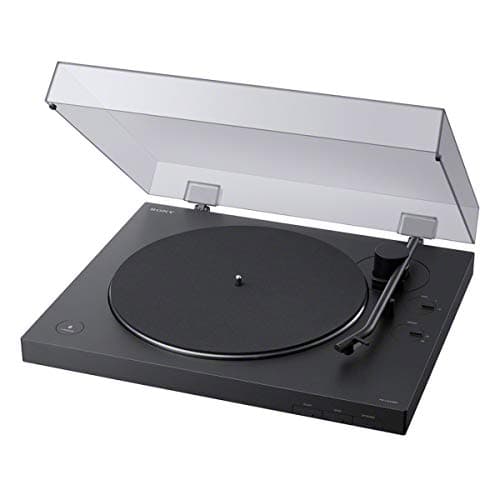
A fully automatic belt-drive turntable that will send a record to a Bluetooth speaker, a computer or a wired amplifier, with a switchable phono stage and three gain settings — an unusually complete feature set for the money. Sony replaced it in February 2026 with the PS-LX3BT, which keeps that whole feature set and adds aptX Adaptive, so buy the PS-LX310BT only if it is clearly cheaper than its successor. Skip both if you intend to change the cartridge, because these arms are not designed for that.
Strengths
- Bluetooth output pairs straight to a wireless speaker — no other gear needed
- Fully automatic, with a low-profile design and switchable preamp
- USB output for digitizing records
Trade-offs
- Bluetooth trades some fidelity versus a wired connection
- Low-mass plastic build; the tonearm and cartridge are entry level
- Succeeded by the PS-LX3BT (February 2026); remaining stock is thin and often priced above the new model
| Drive | Belt drive |
|---|---|
| Operation | Fully automatic |
| Wireless | Bluetooth output |
| Built-in preamp | Yes — switchable |
| Speeds | 33 1/3 and 45 RPM |
| USB output | Yes |
Specifications read from the manufacturer / product listing, accessed 2026-07-24. We have not measured this unit — what we do instead.
Price as of October 14, 2026. #ad How we’re funded
First, the 2026 successor
Since this review was written, Sony has replaced the PS-LX310BT. On January 22, 2026 it announced the PS-LX3BT and PS-LX5BT, and the PS-LX3BT is the direct successor to this deck: the same one-button automatic belt drive, the same switchable phono stage, the same USB output with a three-level gain control, and Bluetooth out that now supports aptX and aptX Adaptive rather than the base codec. The PS-LX5BT above it adds a one-piece chassis, an aluminum tonearm and a higher-grade cartridge.
That changes the buying advice, not the description. Everything below about how the PS-LX310BT works still holds, and it holds for the PS-LX3BT too, because the design brief is identical. What no longer holds is that this is the deck to buy new: remaining PS-LX310BT stock is thin and, at the time of this update, was listed above the price of the deck that replaced it. Buy the PS-LX310BT only at a clear discount to the PS-LX3BT; otherwise the successor is the pick, and it now holds this deck’s place in the Bluetooth roundup. Our Sony PS-LX3BT review covers the newer deck in full, including the two things this one does better on paper: a clearly documented USB output, and a chassis nobody complained about.
What Sony has actually built here
The PS-LX310BT is a belt-drive, fully automatic turntable with an aluminum die-cast platter and a straight aluminum tonearm. So far, so ordinary. What makes it unusual is the back panel, which offers three separate ways out of the deck: RCA, USB and Bluetooth, with a switchable phono stage feeding the first two.
That is a genuinely different proposition from the decks it competes with. Most turntables at this money give you one output and expect you to build a system around it. This one is designed to slot into whatever you already own — a Bluetooth speaker in the kitchen, a laptop, a soundbar, an old receiver — without you buying anything else.
The three gain settings, which nobody explains
The specification that gets skipped over is the three-position gain switch, and it is the most quietly useful thing on the deck. Gain is how much the internal preamp amplifies the cartridge’s output before it leaves the turntable.
Why three positions matter: the correct output level for a Bluetooth speaker is not the same as for a receiver’s line input, and neither is the same as what a computer’s recording input wants. Too much gain and the signal clips — on a digital recording that is permanent, audible distortion on the loudest passages. Too little and you raise the noise floor along with the music. Most decks give you one fixed level and leave you to cope. Being able to pick is a real advantage if you use more than one of the three outputs, and the reason it exists on a deck that also does USB.
Set it by ear with the loudest record you own: turn it up until the peaks distort, then back off one position. Our gain and impedance guide explains the underlying arithmetic if you want the reasoning rather than the recipe.
The tonearm is the limit
Here is the honest ceiling. The arm is a straight aluminum pipe with no counterweight, because that is what full automation at this price requires: the cueing mechanism is mechanical, driven off the platter, and it needs the arm to be a known, fixed mass with a known, fixed tracking force.
The consequences are the same on every automatic deck in this class, and worth stating plainly:
- Tracking force is set at the factory and is correct for the fitted cartridge. You cannot change it, and you have no reason to unless you change the cartridge.
- You cannot change the cartridge. A different pickup has a different mass and wants a different force; there is no counterweight to rebalance the arm with. The stylus is replaceable; the cartridge is not, in practice.
- There is no anti-skate dial, because there is no variable for it to compensate.
None of that makes the deck bad. It makes it a finished product rather than a platform. If you want to start with an elliptical cartridge and later fit a micro-linear, you want a manual deck with a counterweight — the Fluance RT81 is the standard answer at a similar price, and the trade is set out in automatic vs manual.
Bluetooth: what it is good for
Bluetooth on a turntable is a convenience feature that gets argued about as if it were a fidelity feature. Two facts settle it.
First, Bluetooth is lossy. The signal is compressed to fit the radio link and decompressed at the other end. On a wireless speaker in a kitchen that is inaudible in any meaningful sense; on a good pair of speakers in a quiet room, next to the same record played over the RCA outputs, it is not.
Second, there is latency — a delay of tens to hundreds of milliseconds. Irrelevant for listening, fatal if you ever want to play along with a record on an instrument.
The right way to think about it: the wired output is the deck’s real output, and the Bluetooth is a second, lower-quality one that costs nothing to include and occasionally saves the day. Sony giving you both, rather than making you choose, is the correct design. Our Bluetooth turntable roundup goes through the codec question in more depth.
USB, and what it does not include
The USB output turns the deck into an audio input device for a computer. Plug it in, select it as the recording source, and any audio application can capture the side.
What Sony does not bundle is software worth using. That is fine — the free options are better than what typically ships in the box, and the workflow (sample rate, level, splitting tracks, tagging) is the same regardless of the deck. We cover the whole process in how to record vinyl to a computer.
One caveat specific to this deck: because the internal preamp is switchable and the gain is adjustable, it is possible to record at a level that is far too hot or far too quiet without realizing. Set the level with the meters in your recording software before you commit a side to disk.
Setting it up
Almost nothing to do, which is the point of an automatic deck. Fit the platter, drop the belt over the pulley, place the mat, remove the stylus guard, choose the speed, press start. There is no arm to balance, no tracking force to dial and no anti-skate to match.
The two decisions that are yours: set the PHONO/LINE switch correctly for what you are plugging into — LINE for powered speakers, an AUX input or the Bluetooth path, PHONO only if the receiver has its own phono stage — and pick a gain setting. Getting the first one wrong is the most common “my new turntable sounds broken” complaint there is, and phono vs line explains why.
Who should buy it
Buy the PS-LX310BT if you want records to play through equipment you already own with the minimum of new purchases and no setup ritual; if a Bluetooth speaker is part of your listening life; or if digitizing a collection is on your list — and only if a retailer is clearing it for less than the PS-LX3BT, which does all of the same things and is the one Sony now makes.
Buy the AT-LP60X instead if you want the same automatic simplicity for less and do not need wireless or USB. Buy the Fluance RT81 instead if you want an adjustable arm and a cartridge upgrade path, and are willing to cue by hand for it. And if USB recording is the actual priority rather than a bonus, the AT-LP120XUSB does that job with a proper adjustable tonearm attached — see the USB roundup for the full field.
Frequently asked questions
Has the Sony PS-LX310BT been replaced?
Yes. Sony announced the PS-LX3BT and PS-LX5BT on January 22, 2026 as its new wireless turntables; the PS-LX3BT is the direct successor, with the same one-button automatic belt drive, switchable phono stage, USB output with three-level gain and Bluetooth out, plus aptX and aptX Adaptive. The PS-LX310BT is still listed by some retailers as run-out stock, sometimes above the new deck's price. It is only the better buy at a clear discount.
Does the Sony PS-LX310BT have a built-in preamp?
Yes, and it is switchable. A rear PHONO/LINE switch takes the internal stage in or out of circuit, and Sony additionally provides three gain settings so you can match the output level to whatever you are feeding — a Bluetooth speaker, a line input or an external phono stage.
Can you change the cartridge on the Sony PS-LX310BT?
Not in any practical sense. Like most fully automatic decks at this price, the tonearm is designed around a known cartridge mass and a factory-set tracking force, with no counterweight to rebalance. Sony sells a replacement stylus for the fitted cartridge; that is the upgrade path.
Is the Bluetooth on the PS-LX310BT good enough for real listening?
It is good enough to be genuinely useful and not good enough to be the reason you buy a turntable. Bluetooth compresses the signal and adds latency; the wired RCA output is the better path when you have the choice. Think of the Bluetooth as the feature that gets a record playing in a room with no wired system in it.
Does the Sony PS-LX310BT work with a computer?
Yes — it has a USB output that presents the deck to a computer as an audio input, so you can record a side into any audio software. Our guide to recording vinyl to a computer covers sample rates, level setting and splitting a side into tracks.
Is the PS-LX310BT better than the Audio-Technica AT-LP60X?
It is more capable and costs more. Both are fully automatic belt-drive decks with switchable preamps and non-adjustable arms, but the Sony adds Bluetooth, USB and gain switching. If you need none of those, the AT-LP60X does the same core job for less.
Is the Sony PS-LX310BT safe for records?
Yes, in the way any correctly-designed automatic deck is: the tracking force is set at the factory to suit the fitted cartridge, and the arm cues and returns itself, which removes the two most common ways people damage records by hand. What it will not do is let you dial that force in yourself.
Sources
- Sony Electronics — press release: Sony Expands Its Turntable Lineup with New Wireless Models (January 22, 2026) — The maker's own announcement of the PS-LX3BT and PS-LX5BT. Both models: "one-button full auto playback and Bluetooth connectivity supporting aptX, aptX-Adaptive, and Hi-Res Wireless Audio", a "USB output with three-level gain control" for recording vinyl to digital, an aluminum platter, a transparent dust cover and 33 1/3 and 45 RPM playback. The PS-LX3BT is the newcomer model at $399.99 (pre-sale from January 22, 2026) with a built-in phono equalizer and an attached audio cable; the PS-LX5BT ($499.99, spring 2026) adds a "rigid one-piece body and aluminum tone arm", a "high-grade cartridge" and a gold-plated audio jack. Sony's US and UK product pages return 403 to scripted agents, so this release and the live Amazon listing (aluminum die-cast platter, pivot-bearing aluminum tonearm, MM cartridge at 3.5 +/- 0.5 g stylus pressure, switchable phono EQ) are the spec sources for the registry entry (accessed September 21, 2026)
- Crutchfield — How to choose the right turntable — Buying-guide reference on drive type, cartridges, preamps and setup (accessed July 24, 2026)
- Crutchfield — How to choose a phono preamp — On why a phono signal needs a preamp and never running two at once (accessed July 24, 2026)
- Elusive Disc — Turntable setup guide: tracking force & anti-skate — Step-by-step on balancing the tonearm, setting tracking force and anti-skate (accessed July 24, 2026)
Keep reading
Essential Indie Records on Vinyl
What to spin first: current pressings of current records.
See the picksSony PS-LX3BT Review
The 2026 deck that replaced this one, reviewed in full.
Read the reviewBest Bluetooth Turntables
Where this deck sits against the rest of the wireless field.
See the picksAudio-Technica AT-LP60X Review
The cheaper automatic this is usually cross-shopped against.
Read the reviewHow to Record Vinyl to a Computer
What the USB output on the back is actually for.
Read the guideAutomatic vs Manual Turntables
The trade this deck makes, argued in general.
Read the comparison