PLATTER & PLINTH

The Best Headphone Amps for Vinyl

Most headphone amps sold today are USB-first. A record is an analog signal — so the first specification to check is not the power output. It is whether the box has an analog input at all.

By Stephen V.Last updated How we pick

The verdict

The Schiit Magni Unity is the one to buy for a record system. Schiit publishes a 50k-ohm input impedance, three gain settings and 415 mW into 300 ohms— which is the number that decides whether a 250-ohm pair plays properly or just whispers — and it has a preamp output, so the same box can feed powered speakers later. If you want the tube flavor without giving up a published spec sheet, the Schiit Vali 3 is the pick. And if all you need is a phono stage and a headphone socket in one box for under a hundred dollars, the Douk Audio T4 PROdoes both jobs and skips this page’s whole argument.

This page exists because our headphone roundup kept ending the same way: a turntable’s output cannot drive headphones, so the signal has to pass through something with a headphone amplifier in it — a receiver with a front-panel jack, a phono stage with a headphone output, or a dedicated headphone amp. We ranked the headphones and never ranked the amp. Here it is.

And the first criterion is one almost no headphone-amp roundup applies, because almost no headphone-amp roundup is written for records. The box needs an analog input.The desk “DAC/amp” category that dominates this price bracket is built for a laptop: its inputs are USB, optical and coaxial, and a turntable — even one with a built-in phono stage switched to LINE — cannot connect to any of them. An analog-input headphone amp is a smaller, cheaper, simpler product than the DAC/amp sitting next to it on the shelf, and for vinyl it is the correct one.

The second criterion is published power into 300 ohms, not into 32. Thirty-two ohms is the easy case; every amp here and most receiver jacks manage it. The pairs people actually struggle to drive are the 250-ohm beyerdynamics and their relatives, and that is the column where the amps separate. Every figure below is the maker’s own, read from the maker’s own page on the date in the sources block — and where a maker publishes nothing readable, we say so and rank the product lower for it rather than borrowing a number from a forum.

How this is funded: we earn a commission if you buy through our links, at no extra cost to you. It never changes which product we recommend, and we’ll tell you plainly when to skip one. Full disclosure.

Quick picks

Ranked on published specs, drive/motor design and buyer fit. Select a row to jump to the full write-up. We have not heard most of these units — here is exactly what we do instead.

#ProductBest forPrice
1
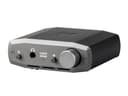
Schiit Magni Unity

Schiit Magni Unity

The one to buy if you own one pair of headphones and a turntable. Schiit publishes a 50k-ohm input impedance, three gain settings and 415 mW into 300 ohms, which is the figure that matters: a 250-ohm pair that only whispers from a receiver jack plays properly from this. It is also a preamp, so the same box can feed powered speakers.

Best overall
$149.00 · View on Amazon

Price as of November 2, 2026. #ad How we’re funded

2
Schiit Vali 3

Schiit Vali 3

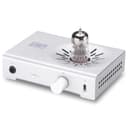
A tube hybrid with a published spec sheet, which is rarer than it should be in this class. 400 mW into 300 ohms is plenty for a 250-ohm pair, and the two gain settings are genuinely different circuits on paper: 0.007% THD on low gain against 0.35% on high. Buy it for the character and read that second number before you do.

Best tube hybrid
$189.00 · View on Amazon

Price as of November 2, 2026. #ad How we’re funded

3
Monolith Liquid Spark

Monolith Liquid Spark

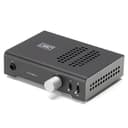
An analog-in, analog-out headphone amp designed by Alex Cavalli, and the simplest box here: RCA in, one 1/4-inch out, a volume knob. The listing publishes 1.3 W into 50 ohms. It is ranked below the two Schiits for one reason only - Monoprice's own product page refuses an automated request, so most of its specification cannot be cited.

Simplest analog box
$164.16 · View on Amazon

Price as of November 2, 2026. #ad How we’re funded

4
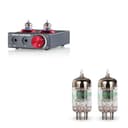
Douk Audio T4 PRO

Douk Audio T4 PRO

A moving-magnet tube phono stage that is also a headphone amp — an NE5532-based output rated for 32 to 300 ohm headphones, plus a 3.5 mm aux input and a multi-level gain knob. As a way to get a turntable into headphones for well under $100, nothing else is this tidy.

Best one-box with a phono stage
$84.99 · View on Amazon

$94.9811% off

Price as of November 2, 2026. #ad How we’re funded

The picks in full

#1Best overall

Schiit Magni Unity

The one to buy if you own one pair of headphones and a turntable. Schiit publishes a 50k-ohm input impedance, three gain settings and 415 mW into 300 ohms, which is the figure that matters: a 250-ohm pair that only whispers from a receiver jack plays properly from this. It is also a preamp, so the same box can feed powered speakers.

Strengths

  • 415 mW into 300 ohms and 220 mW into 600 ohms published - it drives the high-impedance pairs a receiver jack cannot
  • Three gain settings (0.3 / 1 / 5) so a sensitive pair is not stuck on a hot setting
  • Published output impedance under 0.1 ohms, and a preamp output for powered speakers

Trade-offs

  • Single-ended only: one 1/4-inch headphone output, no balanced jack
  • Schiit's table publishes an input impedance but does not name the input connector, so check the rear panel photo before ordering cables
  • The DAC is an optional card on a different SKU - the unit linked here is analog in, analog out, which is right for records and wrong for a laptop
TypeSolid-state, fully discrete, DC coupled, current feedback
Power, 32 ohms2.5 W RMS per channel
Power, 300 ohms415 mW RMS per channel
Power, 600 ohms220 mW RMS per channel
Gain0.3 (-10 dB), 1 (0 dB) or 5 (15 dB)
Frequency response20 Hz - 20 kHz, +/-0.01 dB
THD+N< 0.0001% (low gain), < 0.0003% (high gain), 2 V RMS into 300 ohms
Output impedance< 0.1 ohms (headphone); 75 ohms (preamp out)
Input impedance50k ohms
Outputs1/4-inch TRS headphone, plus preamp outputs
Size / weight5 x 3.5 x 1.25", 2 lb

Note. Schiit also publishes 3.0 W into 16 ohms and 1.5 W into 50 ohms, and a 3-year warranty. The spec table does not enumerate the input connector - it publishes a 50k-ohm input impedance, which is a figure only an analog input has, and notes that a USB-C input arrives only with the optional internal Mesh DAC card (a different SKU from the one linked here).

Specifications read from the manufacturer / product listing, on November 2, 2026. “Not published” means the maker does not state that figure.

#2Best tube hybrid

Schiit Vali 3

A tube hybrid with a published spec sheet, which is rarer than it should be in this class. 400 mW into 300 ohms is plenty for a 250-ohm pair, and the two gain settings are genuinely different circuits on paper: 0.007% THD on low gain against 0.35% on high. Buy it for the character and read that second number before you do.

Strengths

  • 400 mW into 300 ohms and 200 mW into 600 ohms - enough for the high-impedance pairs
  • Schiit publishes the full table including THD, SNR and output impedance per gain setting, which most tube amps at this price do not
  • Published 50k-ohm input impedance and a preamp output, so it works as the hub of a small system

Trade-offs

  • High gain measures far worse than low gain on Schiit's own figures: 0.35% THD against 0.007%, and 1.8 ohms output impedance against 0.5
  • Schiit rates tube and tube-hybrid power at under 10% THD rather than the under 1% used for its solid-state amps - so the power numbers are not directly comparable with the Magni Unity's
  • The tube is a consumable: 2-year warranty on the amp but only 90 days on the tube
TypeTube hybrid (6N3P), headphone amp and preamp
Power, 32 ohms1,500 mW per channel
Power, 300 ohms400 mW per channel
Power, 600 ohms200 mW per channel
Gain5 (14 dB) or 1 (0 dB)
Frequency response20 Hz - 20 kHz, +/-0.02 dB at 300 ohms (low gain)
THD< 0.007% (low gain), < 0.35% (high gain), 1 V RMS into 300 ohms
Output impedance0.5 ohms (low gain), 1.8 ohms (high gain)
Input impedance50k ohms
Size / weight5 x 3.5 x 2.75", 1 lb

Note. Read the power-rating footnote on Schiit's own page: tube and tube-hybrid amps are rated at less than 10% THD, where its solid-state amps are rated at less than 1%. That is the maker telling you these watts are measured on an easier test. Schiit does not publish a 16-ohm power figure for this model.

Specifications read from the manufacturer / product listing, on November 2, 2026. “Not published” means the maker does not state that figure.

#3Simplest analog box

Monolith Liquid Spark

An analog-in, analog-out headphone amp designed by Alex Cavalli, and the simplest box here: RCA in, one 1/4-inch out, a volume knob. The listing publishes 1.3 W into 50 ohms. It is ranked below the two Schiits for one reason only - Monoprice's own product page refuses an automated request, so most of its specification cannot be cited.

Strengths

  • RCA input stated on the listing - the one row that matters for a turntable chain
  • 1.3 W into 50 ohms published, which is more than any receiver headphone jack offers
  • No DAC, no Bluetooth, no app: the cheapest route to a real headphone stage for a record system

Trade-offs

  • Monoprice's own product page returns HTTP 403 to an automated request, so impedance, THD, frequency response and gain are NOT published anywhere we can cite
  • Single-ended, single input, single output - nothing is switchable
  • The listing also prints "108Db" without saying what it measures, so we do not quote it as a specification
TypeSolid-state analog headphone amplifier (Alex Cavalli design)
InputRCA (per the retail listing)
OutputSingle 1/4-inch headphone jack
Power1.3 W at 50 ohms (per the retail listing)
Output impedanceNot published
Input impedanceNot published
THDNot published
Frequency responseNot published
Gain settingsNot published

Note. Everything above is read from the live Amazon listing because monoprice.com returns 403 to a scripted request, exactly as crutchfield.com and audio-technica.com do. That is why this unit is ranked third rather than higher: it is almost certainly a fine amplifier - the Cavalli circuit has a long reputation - but this site ranks what a maker publishes, and Monoprice publishes it somewhere we cannot read.

Specifications read from the manufacturer / product listing, on November 2, 2026. “Not published” means the maker does not state that figure.

#4Best one-box with a phono stage

Douk Audio T4 PRO

A moving-magnet tube phono stage that is also a headphone amp — an NE5532-based output rated for 32 to 300 ohm headphones, plus a 3.5 mm aux input and a multi-level gain knob. As a way to get a turntable into headphones for well under $100, nothing else is this tidy.

Strengths

  • Built-in headphone amp rated for 32-300 ohm cans
  • Multi-level gain control rather than a single fixed setting
  • Ships with JAN5654 tubes rather than the cheapest 6J1 types

Trade-offs

  • Moving magnet only
  • A tube stage at this price is voiced for character, not neutrality — that is a preference, not an upgrade
Cartridge supportMoving magnet (MM)
Headphone output3.5 mm, rated 32-300 ohms
GainMulti-level control
TubesJAN5654 (included)
Extra input3.5 mm aux
EqualizationRIAA

Note. Treat the tube stage as a flavor, not a fidelity claim. What actually earns this box its place is the headphone output — a phono stage with no headphone jack means buying a second box to hear records privately.

Specifications read from the manufacturer / product listing, on September 29, 2026. “Not published” means the maker does not state that figure.

How these were ranked

  • An analog input, confirmed on the maker’s own figures. Both Schiits publish an input impedance in ohms, which is a specification only an analog input has. The Monolith’s RCA input is stated on its retail listing. The Douk takes a cartridge directly, which is as analog as an input gets. Nothing on this page needs a computer to make a sound.
  • Published power into 300 ohms. 415 mW (Magni Unity) and 400 mW (Vali 3) are the two figures here that answer the actual question a vinyl listener has, which is whether a high-impedance pair will play. The Monolith publishes 1.3 W into 50 ohms and nothing at 300. The Douk publishes a rated range rather than a power figure.
  • Output impedance, where it is published.The rule of thumb is that an amp’s output impedance wants to be well under an eighth of the headphone’s, or the frequency response starts following the headphone’s own impedance curve. Under 0.1 ohms (Magni Unity) and 0.5 ohms (Vali 3, low gain) are both fine with anything. An unpublished figure is a reason for caution, not a reason to assume the worst.
  • What the maker publishes, not what the internet repeats. Three units were dropped from this page for exactly that: see below. This is the same standard that put the Audio-Technica ATH-M50x fourth on our headphone roundup rather than higher.
  • Currently buyable, checked the day this page was written. Every ASIN here returned a live, in-stock listing with a real price on November 2, 2026. Prices come from the live price layer rather than from a number typed into the copy — if one reads “check price”, the feed could not confirm it.

The input question, in detail

Here is the shape of the mistake. You read that a turntable cannot drive headphones, so you buy a well-reviewed $150 desk amp. It arrives with a USB-C socket, an optical socket and a coaxial socket on the back, and your turntable has two RCA plugs. There is no adapter that fixes this: those are digital inputs and your signal is analog. The box is not faulty and the review was not wrong — it was reviewed for a different source.

The tell on a spec sheet is an input impedance quoted in ohms. Schiit publishes 50k ohms for both units here. A digital input has no such figure, because there is no analog voltage to load. If a product page lists inputs as a bare string — “USB/OPT/COAX/RCA” — without an input impedance anywhere, you cannot tell from the page whether that RCA is an analog line in or a second digital in.

That is not hypothetical. The FiiO K7is a popular, well-made, currently-available desk amp at about the same money as the picks here, and FiiO’s own specification list names its inputs as “USB/OPT/COAX/RCA” while listing coaxial separately and never saying which kind of RCA it means. It may well be an analog line input. We are not going to tell you it is, and we are not going to rank a product on a row we cannot confirm, so the K7 is named here as the thing to check rather than recommended. If you own one, the rear-panel labeling will settle it in two seconds; if you are buying one for a turntable, settle it before you order.

Which amp for which headphones

Work backwards from the pair you own, because that is what the amp is for.

A 250-ohm pair— the beyerdynamic DT 990 PRO in its 250-ohm form is the common one, and it is the pick on our headphone roundup that explicitly says “best with a headphone amp”. This page is the other half of that recommendation. The Magni Unity’s published 415 mW into 300 ohms, or the Vali 3’s 400 mW, is what turns that pair from quiet into properly driven. A receiver’s own headphone socket will play it; it will not drive it.

A 50 to 80-ohm pair— the Sennheiser HD 599, the beyerdynamic DT 770 PRO (80 Ohm). These play acceptably from an amplifier or phono-preamp headphone jack already, which is why our headphone roundup ranks them where it does. An amp here is an upgrade rather than a rescue: more headroom on dynamic passages, a lower noise floor, and on the Magni Unity a low gain setting that stops a sensitive pair from living in the first eighth of the volume knob.

A 32-ohm or lower pair— most consumer headphones. These are easy to make loud and harder to drive well, because a high-output impedance amp alters their frequency response. The Magni Unity’s published figure of under 0.1 ohms is the safest option on this page for a low-impedance pair, and the Vali 3’s high-gain setting (1.8 ohms) is the one to avoid with them.

In-ear monitors— honestly, none of this. IEMs are typically 16 to 32 ohms and extremely sensitive; a 2.5 W amplifier is the wrong tool and its noise floor becomes audible. Use the headphone jack you already have.

Where the amp goes in a record chain

One phono stage, then the headphone amp, then the headphones. In practice that is three valid wirings:

  • Deck with a built-in preamp → headphone amp. Switch the deck to LINE and run RCA straight into the amp. Simplest route, and the reason a deck with a switchable built-in stage is worth having.
  • Deck → separate phono preamp → headphone amp. Two boxes, better phono stage. Our phono preamp picks are the middle link.
  • Deck → a phono stage that already has a headphone output. One box, one purchase, no amp needed — which is exactly what the Douk T4 PRO is doing on this page, and why it is here at all.

The failure mode to avoid is two phono stages in series: the deck left on PHONO into a phono preamp, or a built-in stage feeding another one. It produces distorted, uncontrollably loud mud, and it is the most common wiring mistake in vinyl. Our do I need a phono preamp page walks the decision, and phono vs line explains the two input labels that cause it.

A preamp output is worth noticing on both Schiits. It means the amp can sit permanently between your phono stage and a pair of powered speakers, acting as the volume control for the room and the headphone amp for late nights, with one set of cables. For a desk-based record setup that is the tidiest arrangement available.

What a headphone amp will not fix

It will not fix a worn stylus, a dirty record, or a badly set tracking force — it will make all three more obvious, because that is what more resolution does. If records sound harsh through headphones, the first stop is cleaning the stylus, then checking the tracking force, then replacing the stylus if it has the hours on it. An amplifier bought to cure a mechanical problem is money spent in the wrong place, and this site will keep saying so.

Dirty records are the other half of that. Headphones put you closer to surface noise than speakers ever do, so a used pressing that passed across the room will announce every bit of groove contamination through a well-driven pair. A brush and a fluid handle most of it; for a collection fed by thrift shops, the mechanism that reaches the rest is ultrasonic, which our HumminGuru HG01 review covers — including the case for not buying one.

It also will not add bass that is not on the record. Vinyl is cut with limited energy below about 40 Hz because large low-frequency excursions push a stylus out of the groove — part of why 45 RPM pressings exist. A headphone amp with more power plays louder and holds together better when it does; it does not change what was cut.

Three units we did not rank, and why

TOPPING L30 II.Live, in stock, and at $149 it would have been a natural pick — its NFCA modules measure extremely well by reputation. But toppingaudio.com would not serve its specifications tab to an automated request on two separate dates, and the retail listings contradict each other on the headline power figure: the listing we resolved prints 560 mW per channel, others print 3,500 mW, one retailer prints 4,000 mW. No figure could be cited honestly, so it is not on the page. Same call we made on the HIFIMAN HE400se.

iFi ZEN CAN 3.An analog headphone amp, which is the right category — but ifi-audio.com returned HTTP 429 on both dates we tried, and the only live listing read “Only 1 left in stock”. A money page does not get built on a single-unit listing with no citable spec table.

Mackie HM-4.The four-output headphone splitter-amp is a real answer to a real request — two or three people listening to one side of a record together, which nothing else on this page does. It is live at about $50. We did not rank it because Mackie’s own product page publishes no input impedance, no output impedance, no frequency response and no THD for the HM-4 (those rows exist only for the rackmount HM-400 and HM-800), and its owner’s manual PDF would not yield text to an automated read. For a shared listen it is worth knowing about; just understand you are buying a box whose output impedance the maker does not state, which matters most with low-impedance headphones.
Frequently asked questions

Do I need a headphone amp for vinyl?

Only if your headphones ask for one. At 50 to 80 ohms, the headphone output on an ordinary receiver or phono preamp is usually enough. At 250 ohms - the beyerdynamic DT 990 PRO is the common case - a receiver jack will play the pair quietly rather than drive it, and a dedicated amp is the fix. The other reason to buy one is that you have no headphone socket anywhere in your chain, which is normal: no turntable has one.

Can I plug a turntable straight into a headphone amp?

Only if the phono stage already happened. A headphone amp has a line-level input; a cartridge's output is about a thousand times quieter and carries the RIAA curve. So either the deck has a built-in preamp switched to LINE, or a separate phono preamp sits between them - or you buy a phono stage with a headphone output built in, like the Douk T4 PRO on this page, and skip the question.

Will a USB DAC/amp work with my turntable?

Usually not, and this is the single most common wasted purchase in this category. Most desk DAC/amps at this price accept USB, optical and coaxial only - all digital. A turntable's output is analog, and no adapter converts it. Check for an input impedance quoted in ohms on the spec sheet: that figure only exists for an analog input. If the page lists inputs as a bare string like "USB/OPT/COAX/RCA" with no input impedance, the RCA could be either and you should confirm before ordering.

How much power do I actually need?

Read the figure at your headphone's impedance, not the biggest number on the box. For a 250 to 300-ohm pair, the published 400 to 415 mW on the two Schiits here is comfortably enough for loud listening. For a 32-ohm pair, almost anything is enough and output impedance matters more than watts. Power figures into 32 ohms are the easy case and tell you least.

What is output impedance and why does it matter?

It is the amplifier's own source impedance, and the rule of thumb is that it wants to be well under an eighth of the headphone's impedance. Above that, the amp starts letting the headphone's own impedance curve shape the frequency response - a bass hump on many dynamic pairs. The Magni Unity publishes under 0.1 ohms and the Vali 3 publishes 0.5 ohms on low gain, so both are safe with anything. The Vali 3's high-gain setting is 1.8 ohms, which is still fine for a 250-ohm pair and the setting to avoid with a 16-ohm one.

Is a tube headphone amp better for records?

Different, not better, and the spec sheet is honest about the trade. Schiit publishes 0.007% THD for the Vali 3 on low gain and 0.35% on high gain, against under 0.0003% for the solid-state Magni Unity - so the tube unit measures one to three orders of magnitude worse on distortion. Some listeners want exactly that character with vinyl, and that is a legitimate preference. It is not a fidelity upgrade and the maker's own numbers say so.

Can one box be my phono preamp and my headphone amp?

Yes, and for a headphones-only record setup it is usually the right buy. The Douk Audio T4 PRO is a moving-magnet tube phono stage with an NE5532-based headphone output rated for 32 to 300 ohm headphones and a multi-level gain control, for well under $100. One box, one power supply, one purchase. You give up the measured performance and the preamp output of a separate stage plus a separate amp - that is the trade.

Do these work as a preamp for powered speakers too?

Both Schiits do: each publishes a preamp output alongside the headphone jack, and the Magni Unity publishes a 75-ohm output impedance on it. That lets one box be the volume control for a pair of powered speakers and the headphone amp for late-night listening, fed by a single phono stage. The Monolith Liquid Spark and the Douk T4 PRO are headphone-first - the Douk has a line output as a phono stage, which is a different job.

Sources

  • Schiit Audio — Magni Unity, published specifications — The maker's own table, read live on this date. Maximum power per channel, RMS: "3.0W" into 16 ohms, "2.5W" into 32 ohms, "1.5W" into 50 ohms, "415mW" into 300 ohms, "220mW" into 600 ohms. Frequency response "20Hz-20Khz, +/-0.01dB". THD+N "Less than 0.0001% (-116dB) at 2V RMS into 300 ohms" on low gain and "Less than 0.0003% (-108dB)" on high gain. SNR "Greater than 122dB" (low gain) and "Greater than 112dB" (high gain), referenced to 2V RMS. Crosstalk "Less than -80dB, 20 Hz-20 kHz, 300 ohm load". Output impedance "less than 0.1 ohms" on the single-ended 1/4" TRS output and "75 ohms" on the preamp output. Gain "0.3 (-10dB), 1 (0dB), or 5 (15dB)". Input impedance "50k ohms". Topology "Fully discrete, DC coupled, current feedback". Size "5 x 3.5 x 1.25"", weight "2 lb", 3-year limited warranty. IMPORTANT for a future run: the table does NOT enumerate the input connector - it publishes a 50k-ohm input impedance (a figure only an analog input has) and notes the USB-C input arrives only with the optional internal Mesh DAC card, which is a different SKU from the one this site links (accessed November 2, 2026)
  • Schiit Audio — Vali 3, published specifications — The tube hybrid's own table, read live the same day. Maximum power per channel, RMS: "1500mW" into 32 ohms, "1000mW" into 50 ohms, "400mW" into 300 ohms, "200mW" into 600 ohms - with the footnote that matters: Schiit rates tube and tube-hybrid amps "at less than 10% THD" against "less than 1%" for solid state, so these watts are measured on an easier test than the Magni Unity's. Frequency response "20Hz-20kHz, +/-0.02dB" at 300 ohms and "+/-0.6dB" at 32 ohms on low gain. THD "<0.007%" on low gain and "<0.35%" on high gain, 20Hz-20kHz at 1V RMS into 300 ohms. IMD "<0.014%" / "<0.45%" CCIR. SNR ">117dB" / ">105dB" A-weighted, referenced to 2V RMS. Crosstalk "-87dB" / "-70dB". Output impedance "0.5 ohms" (low gain) and "1.8 ohms" (high gain). Gain "5 (14dB) or 1 (0dB)". Input impedance "50K ohms". Tube "6N3P". Size "5 x 3.5 x 2.75"", weight "1 lb". Warranty 2 years on the amp and "90 days on the tube". No 16-ohm power figure is published (accessed November 2, 2026)
  • Monolith Liquid Spark headphone amplifier — live retail listing — Cited as the listing rather than the maker's page, deliberately: monoprice.com returns HTTP 403 to an automated request, exactly as crutchfield.com and audio-technica.com do, so this is the only readable published source. The listing title prints the figures this site quotes - "Monolith 133304 Liquid Spark Headphone Amplifier - by Alex Cavalli with RCA Input, Single 1/4 Output 1.3Watt@50R, 108Db" - i.e. an RCA input, a single 1/4-inch output and 1.3 W at 50 ohms. The "108Db" is printed with no stated parameter, so this site does NOT quote it as a specification. Output impedance, input impedance, THD, frequency response and gain are not published anywhere citable, which is why the unit is ranked third on the roundup rather than higher (accessed November 2, 2026)
  • FiiO — K7 desktop DAC and amplifier, published specifications — Cited NOT as a pick but as the exact trap the headphone-amp roundup tells readers to check for. FiiO's own Basic Specifications list the inputs as "USB/OPT/COAX/RCA" and never state whether that RCA is an analog line input or a second digital input - and coaxial is listed separately, which is the ambiguity. Also published: DAC "AK4493SEQ*2", decoder "XMOS XUF 208", amplifier "Dual THX AAA 788+", output power ">=2000mW (32ohm, balanced/THD+N<1%)" and ">=1220mW (32ohm, single-ended/THD+N<1%)", SNR ">=120dB (A-weighted, UAC)", output impedance "<1ohm (32ohm load)", "Two levels of hardware gain", "112 steps of adjustable volume", about "120mm x 168mm x 55mm" and about "610g". No frequency response and no separate THD+N figure is published. Because the one row this roundup ranks on could not be confirmed, the K7 is named on the page and not ranked (accessed November 2, 2026)
  • beyerdynamic — DT 990 PRO, published specifications — The open-back sibling, read the same day. Published: operating principle "Open", frequency response "5 - 35.000 Hz", nominal sound pressure level "96 dB", soft replaceable circumaural velour pads, weight "250 g" without cable. IMPORTANT for any future run: this page carries ONE technical-data table for the whole DT 990 PRO family and prints "80 ohms" in it, while separately offering a 250-ohm version and naming "Coiled cable (250 ohms)" in its own comparison section. beyerdynamic does not break the impedance row out per version, so the 250-ohm figure this site quotes is the variant named on the retail listing, not a second maker table (accessed October 19, 2026)
  • Sennheiser — HD 599, published specifications — The maker's own table for SKU 506831, read live on this date: acoustic principle "open", ear coupling "Over-Ear", frequency response "12 Hz to 38,500 Hz", impedance "50 Ohm", sound pressure level "106dB SPL (1kHz/1Vrms)", THD "< 0.1% (1kHz, 100dBSPL)", weight "250 g", and connectors "1: 6.3mm 2: 3.5mm detachable". Note the discrepancy inside Sennheiser's own page: the specification table lists cable lengths "1: 3m 2: 1.2m" while the what's-included section describes a single "1.80 m detachable cable". The 1 Vrms condition on the 106 dB figure is what makes it comparable with another maker's voltage-referenced number and NOT with a dB/mW figure (accessed October 19, 2026)
  • Crutchfield — How to choose a phono preamp — On why a phono signal needs a preamp and never running two at once (accessed July 24, 2026)

Keep reading