Klipsch RP-600M II vs R-50M
Two horn-loaded standmounts from the same maker, printed on two spec sheets in the same format. Eleven published rows differ — and only one of them is about how loud it goes.
How this is funded: we earn a commission if you buy through our links, at no extra cost to you. It never changes which product we recommend, and we’ll tell you plainly when to skip one. Full disclosure.
The short answer
Buy the RP-600M II if it will sit on stands, in a room, with air behind it. Buy the R-50Mif it has to live on furniture, or if the difference in price is the difference between buying speakers and buying a system. That is most of the decision, because Klipsch has not used these two models to separate a good speaker from a bad one — they are two points on a consistent ladder, and the rungs are published.
What makes this comparison worth doing at all is that both numbers come from the same measuring convention. Klipsch prints both sheets in an identical format with the same sensitivity footnote, so 94.5 dB against 92 dB is a real 2.5 dB and 44 Hz against 58 Hz is a real 14 Hz. Cross-brand speaker comparisons almost never have that property, which is why our bookshelf roundupkeeps every maker’s condition attached to its figure instead of sorting one column.
The four rows that decide it, in order
1. Cabinet depth: 13.00 inches against 9 inches
This is the row we would put first for most buyers, and it is not an audio specification at all. A standard shelf is around 11 to 12 inches deep. The R-50M fits with room to spare; the RP-600M II does not fit, and where it half-fits, its rear-firing Tractrix port ends up inches from a panel. A ported cabinet pressed against a boundary thickens and smears the low end — the exact thing the internal bracing exists to prevent. Buying the better speaker and then installing it badly is a worse outcome than buying the smaller one, and it is the commonest way this purchase goes wrong.
The weights say the same thing from another direction: 18.1 lb against 11 lb per cabinet. That is a stand decision as much as a speaker decision, and stands for an 18 lb pair cost more than stands for an 11 lb pair.
2. Low-frequency limit: 44 Hz against 58 Hz, both at ±3 dB
Fourteen hertz, on the same test, from the same maker — which is the only circumstance in which subtracting two response figures means anything. The mechanism is published too: a 6.5-inch Cerametallic woofer in a larger braced cabinet against a 5.25-inch spun-copper cone in a smaller one.
For records the difference is smaller than it looks but not zero. Vinyl is cut with little energy below roughly 40 Hz, because large low-frequency excursions are what push a stylus out of the groove — part of the reason 45 RPM pressingsexist. So the RP-600M II’s extra reach is mostly headroom rather than new information. The honest complaint runs the other way: 58 Hz is high enough that a bass-forward pressing will sound lighter through the R-50M than it was cut, and in a larger room that is audible.
3. Sensitivity: 94.5 dB against 92 dB
The surprise here is the direction. Normally the larger, deeper-reaching speaker is the harder load, because low-frequency extension is usually bought with efficiency. Klipsch publishes the opposite: the bigger RP-600M II is 2.5 dB more sensitive, which means it needs a little under half the amplifier power of the R-50M to reach the same level. Horn loading is why — the expanded Tractrix horn on the RP-600M II is doing more acoustic work than the square horn on the Reference model.
In practice both are easy loads and the row rarely changes a purchase, because 92 dB is already high enough that 20 to 30 W is plenty. It matters in exactly one case: a genuinely low-power amplifier, the single-digit-watt tube variety, where 2.5 dB is the difference between comfortable and compressed. Anything in our amplifier picks drives either pair without complaint.
4. Driver and horn materials
Klipsch publishes a Cerametallic cone with Faraday rings and a titanium LTS vented tweeter on the RP-600M II, against a spun-copper TCP cone and an aluminumLTS tweeter on the R-50M. Faraday rings in the motor system reduce the distortion that comes from the voice coil’s own inductance varying with excursion; a stiffer cone material pushes the frequency at which the cone stops behaving as a piston higher up the band. Both are genuine engineering rather than finish choices, and both are the kind of improvement you notice as an absence of hardness rather than as a feature.
What Klipsch does not publish for either model is a distortion figure, a measured nominal impedance curve, or a port tuning frequency. We are not going to infer any of them. “8 ohms compatible” is the maker’s own wording on both sheets, and it is a compatibility statement rather than a measurement.
The rows that are the same, and why that is the useful part
Three rows are identical, and they are the three that would change the shopping list if they differed. Both are passive two-way bass-reflex standmounts, both are rated 8 ohms compatible, and neither has a phono input. So the rest of the system is the same purchase either way: an amplifier, and exactly one phono stagesomewhere between the cartridge and that amplifier — in the deck, in the amplifier, or in its own box. Two in series is the most common wiring mistake in vinyl and it sounds like distorted mud.
Both also have rear-firing ports, which means both want space behind them and neither is a wall-mount or an in-shelf speaker. If the only available position is tight against a wall, that is an argument for a sealed or powered alternative rather than for either of these.
If neither is quite right
Smaller and cheaper: the R-40M sits a rung below the R-50M in the same range, with 91 dB, 71 Hz and a 1,770 Hz crossover from a 4-inch woofer. We have it reviewed in full and compared with the R-50M.
No amplifier in the budget:Klipsch’s own powered monitors solve a different problem. The R-50PM publishes a phono/line switch with a ground terminal, which makes a turntable a one-cable connection and removes the amplifier and the phono box from the shopping list entirely. It is the better system at the money, and the lesser speaker.
A gentler tweeter: if most of the collection is second-hand, the horn is a liability rather than an asset. Our picks under $500 include soft-dome pairs that forgive a worn stylus, and the Q Acoustics 3020cis the clearest alternative in character — though at 87 dB it asks considerably more of the amplifier than either Klipsch does.
The spec matrix
Three of sixteen rows are identical: the two-way bass-reflex topology, the 8-ohm compatible rating, and the fact that neither has a phono input. Everything else moves, and the four rows that decide the purchase are the woofer, the low-frequency limit, the sensitivity and the depth of the cabinet.
| Specification | RP-600M IIKlipsch | R-50MKlipsch |
|---|---|---|
| Range | Reference Premiere (2nd generation) | Reference Next-Generation |
| Typesame | Passive 2-way standmount, bass reflex | Passive 2-way standmount, bass reflex |
| Woofer | 6.5" Cerametallic cone with Faraday rings | 5.25" spun-copper TCP |
| Tweeter | 1" titanium LTS vented, hybrid cross-section expanded Tractrix horn | 1" aluminum LTS, 90 x 90 square Tractrix horn |
| Frequency response (+/-3 dB) | 44 Hz - 25 kHz | 58 Hz - 21 kHz |
| Sensitivity (2.83 V / 1 m, half-space anechoic) | 94.5 dB | 92 dB |
| Nominal impedancesame | 8 ohms compatible | 8 ohms compatible |
| Crossover | 1,500 Hz | 1,560 Hz |
| Power handling | 100 W continuous / 400 W peak | 75 W continuous / 300 W peak |
| Port | Rear-firing Tractrix port | Rear-firing ports |
| Enclosure | MDF, internally braced | MDF |
| Inputs | Dual aluminum binding posts (bi-wire / bi-amp) | Single gold-plated binding posts |
| Dimensions (H x W x D) | 15.75 x 7.95 x 13.00" | 13.9 x 7 x 9" |
| Weight (each) | 18.1 lb | 11 lb |
| Finishes | Ebony, Walnut | Black textured wood grain vinyl |
| Phono inputsame | No - passive | No - passive |
Every figure is from Klipsch’s own spec sheet for each model, cited in Sources. We have not measured either pair. Both sheets carry the same sensitivity footnote— SPL at 1 m, half-space anechoic, with a 2.83 V input — which is precisely what makes these two numbers comparable with each other. Do not read either of them against a maker who publishes at -6 dB or in dB/mW as though it were the same test. “Not published” means the figure is not stated in the sources cited below — it is never a value we estimated. Rows marked same are the ones where these decks do not differ.
Both pairs, with live prices
Both are passive. These prices buy speakers, not systems: an amplifier is still required, and a phono stage has to exist somewhere between the cartridge and that amplifier - exactly one of them.
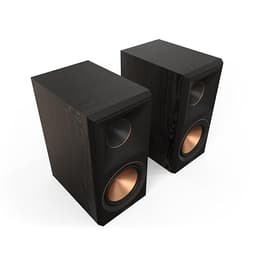
Klipsch RP-600M II
A very sensitive audiophile pair for a low-power amplifier
Price as of October 26, 2026. #ad How we’re funded
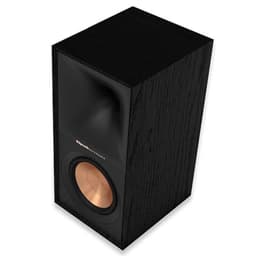
Klipsch R-50M
The passive Klipsch pair to buy if the budget stretches past the R-40M
What either pair needs behind it
This is the happy part of owning a sensitive speaker: at 92 to 94.5 dB, neither of these needs an expensive amplifier. The Fosi V3 is the cheapest honest option and needs a phono stage in front of it; the Sony STR-DH190 publishes a phono input, so one box covers both jobs.
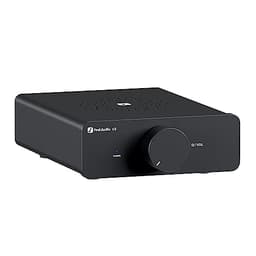
Fosi Audio V3
The cheapest amplifier worth putting behind passive speakers
Price as of October 26, 2026. #ad How we’re funded
Sony STR-DH190
One box that replaces both the phono preamp and the amplifier
Price as of October 26, 2026. #ad How we’re funded
Frequently asked questions
What is the difference between the Klipsch RP-600M II and the R-50M?
Range, driver materials and cabinet size, and the published figures that follow. Klipsch prints 94.5 dB sensitivity, 44 Hz to 25 kHz plus or minus 3 dB, a 6.5-inch Cerametallic woofer, a titanium tweeter, 100 W continuous power handling and dual bi-wire binding posts for the RP-600M II, against 92 dB, 58 Hz to 21 kHz, a 5.25-inch spun-copper woofer, an aluminum tweeter, 75 W and single posts for the R-50M. Both are passive two-way bass-reflex standmounts rated 8 ohms compatible, and neither has a phono input.
Is the RP-600M II worth the extra money over the R-50M?
If the pair is going on stands in a room rather than onto furniture, yes: 14 Hz of published low-frequency extension on the same plus or minus 3 dB test, a larger Cerametallic woofer and an internally braced cabinet are real differences rather than badge engineering. If the speakers have to sit on a sideboard or a shelf, the answer flips - a 13-inch-deep ported cabinet loses more to bad placement than it gains on paper, and the R-50M's 9-inch depth is the figure that makes it liveable.
Which is easier to drive?
The RP-600M II, by 2.5 dB on an identical measurement condition - which means it needs a little under half the amplifier power of the R-50M for the same level. That is the opposite of the usual pattern, where the bigger speaker is the harder load. Both are rated 8 ohms compatible, and both are sensitive enough that 20 to 30 W of honest power is plenty in a normal room.
Which is better for records specifically?
Either, and the deciding factor is not the speaker. Vinyl carries little energy below about 40 Hz by design, so the RP-600M II's 44 Hz advantage over the R-50M's 58 Hz is smaller in practice than on paper - though 58 Hz is high enough that a bass-heavy pressing will sound lighter than it should. What both pairs do is show you the deck: a worn stylus or a dirty record is audible through a horn-loaded tweeter in a way it is not through a soft dome.
Can I use either one with a Sonos Amp or a cheap class-D board?
Yes, and this is where the sensitivity pays. A Sonos Amp or a modest class-D integrated has more than enough power for a 92 to 94.5 dB speaker. The thing neither supplies is a phono stage - so the turntable needs a built-in preamp, or a separate phono box has to sit between the deck and the amplifier.
Do these need stands?
The RP-600M II effectively requires one: 15.75 inches tall, 13 inches deep and 18.1 lb per cabinet is a stand speaker that the category calls a bookshelf. The R-50M at 13.9 x 7 x 9 inches and 11 lb will genuinely sit on a wide shelf, though both have rear-firing ports and both want air behind them. Stands are the cheapest real improvement available after the speakers are chosen.
What about the R-40M?
It is the step below the R-50M in the same range, and Klipsch prints its sheet in the same format: 91 dB sensitivity, 71 Hz to 21 kHz plus or minus 3 dB and a 1,770 Hz crossover from a 4-inch woofer. So the ladder is consistent - each step up buys a lower crossover, a lower bass limit and about a decibel of sensitivity. We have the R-40M reviewed separately and compared with the R-50M.
Why does the crossover frequency matter?
Because it decides how much of the vocal range comes out of the horn. The RP-600M II crosses at 1,500 Hz and the R-50M at 1,560 Hz - both low for a two-way, and both lower than the R-40M's 1,770 Hz. A lower crossover hands more of the upper midrange to the tweeter and less to the woofer, which is the technical root of the Klipsch house sound: forward, articulate, and unforgiving of a bad pressing.
Sources
- Klipsch — Reference Premiere RP-600M II spec sheet (PDF) — Manufacturer specification table, read live: frequency response 44 Hz - 25 kHz +/-3 dB, sensitivity "94.5dB @ 2.83V / 1m", power handling 100 W / 400 W, nominal impedance "8 Ohms Compatible", crossover 1,500 Hz, high-frequency driver "1" Titanium LTS Vented Tweeter with Hybrid Cross-Section Expanded Tractrix Horn", low-frequency driver "6.5" Cerametallic Cone Woofer with Faraday rings", enclosure "MDF (Internally Braced)", "Bass Reflex via rear-firing Tractrix Port", inputs "Dual aluminum binding posts/bi-wire/bi-amp", 15.75" (40.0 cm) H x 7.95" (20.2 cm) W x 13.00" (33.0 cm) D, 18.1 lb (8.20 kg), finishes Ebony and Walnut, and "Cork pads replace rubber bumpers for security on a stand or table". Same sensitivity footnote as the Reference sheets (accessed September 29, 2026)
- Klipsch — Reference R-50M spec sheet (PDF) — Manufacturer specification table, read live: frequency response 58 Hz - 21 kHz +/-3 dB, sensitivity 92 dB (In-Room), power handling 75 W / 300 W, nominal impedance "8 ohms Compatible", crossover 1,560 Hz, high-frequency driver "1" Aluminum LTS tweeter mated to a 90 x 90 square Tractrix Horn", low-frequency driver "Single 5.25" spun-copper TCP woofer", enclosure MDF, "Bass-Reflex via rear-firing ports", inputs "Single Gold Plated Binding Posts", 13.9" (354 mm) H x 7" (178 mm) W x 9" (229 mm) D, 11 lbs (5 kg), Black Textured Wood Grain Vinyl. The sensitivity asterisk reads "SPL at 1M, half-space anechoic with 2.83V input". Read alongside the R-40M sheet, which is printed in the identical format — the two are directly comparable line for line (accessed September 29, 2026)
- Klipsch — Reference R-40M spec sheet (PDF) — Manufacturer specs: 91 dB in-room sensitivity, 71 Hz - 21 kHz +/-3 dB, 8 ohms compatible, 1,770 Hz crossover, 50 W / 200 W power handling (accessed August 28, 2026)
- Crutchfield — Home speakers buying guide — Reference on choosing passive vs powered speakers, room size and amplifier pairing (accessed August 11, 2026)
- Crutchfield — Understanding speaker and amplifier wattage ratings — On RMS versus peak power, and matching an amplifier's output to a speaker's rating (accessed August 11, 2026)
Keep reading
Klipsch RP-600M II Review
The more expensive pair in full, including why 94.5 dB is the most important number on its sheet.
Read the reviewKlipsch R-40M vs R-50M
The step below this comparison, on the same two-sheet method.
Compare themBest Klipsch Speakers for Vinyl
The whole range ranked for a turntable, powered and passive.
See the picksBest Speaker Stands
What the RP-600M II requires and the R-50M quietly wants.
See the picks