Sony PS-LX3BT Review
One button, aptX Adaptive Bluetooth and a switchable phono stage in a chassis two reviewers described very differently. What you are actually paying for here, and who should pay it.
How this is funded: we earn a commission if you buy through our links, at no extra cost to you. It never changes which product we recommend, and we’ll tell you plainly when to skip one. Full disclosure.
The short version
Sony PS-LX3BT
Sony's February 2026 replacement for the PS-LX310BT, and the most capable connect-to-anything automatic we list: one-button belt drive, a switchable phono stage, a three-position gain switch and the best Bluetooth implementation on any deck here. Buy it for the radio and the mechanism, which are genuinely good. Do not buy it for the chassis, the arm or an upgrade path, because there effectively isn't one — the stylus is a Sony part and Sony says other styluses are not supported.
Strengths
- Bluetooth out pairs straight to a wireless speaker or headphones; aptX Adaptive supports Hi-Res wireless up to 96 kHz / 24-bit
- One-step auto start, stop and return, with a switchable phono EQ for wired setups
- Three-level gain select (−4 / 0 / +6 dB) to match the output to whatever is receiving it
- Aluminum die-cast platter and a precision pivot-bearing aluminum tonearm
Trade-offs
- Bluetooth trades some fidelity versus a wired connection
- Fixed cartridge tracking at 3.5 g; no counterweight, so the stylus is the only upgrade
- The stylus is a Sony part and Sony states other styluses are not supported — no Sony-branded replacement for it is sold on Amazon
- The RCA lead is permanently attached, and there is no ground terminal
- Sony publishes no wow-and-flutter or signal-to-noise figure for it
| Drive | Belt drive |
|---|---|
| Operation | Fully automatic (one-step start, stop, return) |
| Wireless | Bluetooth output — SBC, aptX, aptX Adaptive (Hi-Res wireless up to 96 kHz / 24-bit with an aptX Adaptive receiver) |
| Built-in preamp | Yes — switchable, with a rear phono/line selector |
| Gain select | Low (−4 dB) / Mid (0 dB) / High (+6 dB) |
| USB output | Type-B output port per Sony's spec sheet — but two hands-on reviews list none |
| Analog output | Captive RCA lead, standard (not gold-plated) jacks; no ground terminal |
| Cartridge | Moving magnet, factory-fitted; stylus pressure 3.5 ± 0.5 g; headshell not exchangeable |
| Tonearm | Aluminum alloy, precision pivot bearing; no counterweight |
| Platter | 11.65 in aluminum die-cast |
| Speeds | 33 1/3 and 45 RPM (7 in / 12 in size selector; 45 adapter included) |
| Wow & flutter | Not published |
| Signal-to-noise | Not published |
| Weight | Approx. 7 lb 11.5 oz (3.5 kg) |
Specifications read from the manufacturer / product listing, accessed 2026-09-22. We have not measured this unit — what we do instead.
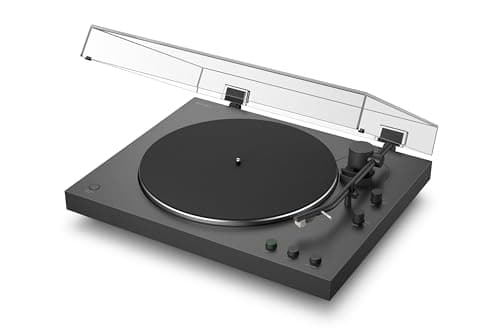
Price as of September 23, 2026. #ad How we’re funded
Two reviewers had this deck. They did not agree.
Most turntables at this money get reviewed once, politely, and everyone moves on. The PS-LX3BT got two hands-on reviews that read like they are describing different products. What Hi-Fi? gave it five stars out of five and called it hard to top, praising a robust, well-organised sound with excellent detail levels and a good quality built-in phono stage. TechRadar ran theirs under the headline a competent entry-level turntable with a major price problem and described a competent performer marred by a cheap chassis and high asking price.
We own no units and have measured nothing, so we cannot break the tie by listening — what we do instead is read both carefully and work out what they actually disagree about. And they barely disagree at all on the things you can check. Both say it sounds good. Both say the built-in phono stage is better than it needs to be. Both say the Bluetooth works properly. What they disagree about is whether the object you hold in your hands is worth what Sony asks for it, and that is a judgment about plastic, not about sound.
So the useful way to read this deck is: the parts that make noise are good, the parts you touch are not, and Sony priced it as though both were good. Whether that is a fair deal depends on one question, which the rest of this review is really about — are you going to use the radio?
What Sony actually built
The PS-LX3BT is a fully automatic belt-drive turntable. One button starts it: the arm lifts, travels to the lead-in groove, lowers, plays the side, returns to its rest and stops the platter without you touching anything. Sony’s sheet lists auto start, auto stop and auto return separately, and all three are present. There are chunky switches for speed — 33 1/3 and 45 RPM — and for record size, 7-inch or 12-inch, which is how the mechanism knows where the lead-in groove is. A 45 adapter is included.
Underneath is an 11.65-inch aluminum die-cast platter with a rubber mat, driven by a belt. The arm is an aluminum-alloy tube on a precision pivot bearing. It has no counterweight, which is the defining fact about this class of deck: tracking force is set at the factory, published at 3.5 g plus or minus 0.5 g, and you cannot change it. The headshell is not exchangeable. The cartridge is a moving magnet unit fitted at the works and, for practical purposes, permanent.
That is the standard bargain every fully automatic deck at this price makes, and we argue it at length in automatic versus manual turntables: cheap, reliable automation is paid for at the tonearm. A light arm with a fixed force and no anti-skate is exactly what makes the mechanism cheap and dependable. You are not being cheated; you are being given a machine that does the fiddly part for you, at the cost of never being able to adjust it.
Two figures Sony does not publish are worth naming because their absence is itself information: there is no wow-and-flutter figure and no signal-to-noise figure for this deck, or for either of its two stablemates, anywhere in Sony’s own comparison sheet. Decks that measure well tend to say so. We record both as not published rather than guessing, and we would treat any review quoting a number for them with suspicion.
The radio is the product
Strip away the marketing and the thing that justifies this deck’s existence over a cheaper automatic is the Bluetooth, and specifically the codecs. It transmits SBC, aptX and aptX Adaptive. That last one is the interesting part: with a receiver that also supports aptX Adaptive, Sony claims hi-res wireless up to 96 kHz and 24-bit.
The honest caveat is that the receiver has to support it too, and most Bluetooth speakers do not. Pair this to a typical portable speaker and you are on SBC or plain aptX, which is fine but is not what you paid for. The feature only pays off if you own headphones or speakers on the aptX Adaptive list, so check yours before letting this line sell you the deck.
When it does line up, both reviewers were struck by it. TechRadar called the wireless the star of the show and said it sounds indistinguishable from its analog alternative, which is not a thing anyone has been able to say about turntable Bluetooth until fairly recently. What Hi-Fi? found it straightforward to pair but flagged a real trap worth knowing about: if the deck is sitting in pairing mode and nothing has connected, you get no sound at all, and getting back out sometimes needs a power cycle. If your new turntable is silent on day one, that is the first thing to check.
The phono stage and the gain switch
The built-in phono stage is switchable, with a phono/line selector on the back. That matters more than it sounds, and it is the criterion we rank the whole category on in best turntables with a built-in preamp: a stage you cannot switch off caps the deck forever, while a switchable one lets you keep the turntable and improve everything after it later. Both reviewers rated Sony’s stage well above the budget norm — TechRadar said it came out clear and full where cheap stages are usually brittle or a little saturating.
What Hi-Fi? did the comparison that answers the upgrade question directly. Running the deck into an Arcam A5+ integrated amplifier, they found the Arcam’s own phono input more open and dynamic than Sony’s internal stage — but going back to Sony’s did not produce a disastrous drop-off. Read that as: the internal stage is good enough that a separate phono preamp is a genuine improvement rather than a rescue, and it can wait.
The three-position gain switch is the feature buyers most often misunderstand. Sony publishes the positions as Low at −4 dB, Mid at 0 dB and High at +6 dB. It is a level-matching control and nothing else. A quiet pressing feeding a line input may want High; a loud one feeding sensitive powered speakers may want Low. No position sounds better than another, and if you are running into a proper amplifier you can leave it at Mid and forget it exists.
The one spec we cannot confirm
Here is where we have to be straight with you rather than tidy. Sony’s own specification sheet lists a USB Type-B output port on this deck. Sony’s launch press release describes a USB output with three-level gain control that makes it easy to record vinyl to digital. US dealers list USB ripping among the headline features, and at least one retailer puts “USB output” in the product title itself.
And yet both hands-on reviews we read list USB as No in their specification boxes. TechRadar, who had the deck on a bench, lists the in-box extras as a USB-C power adapter and a 45 adapter — a USB-C connector for power, which is exactly the kind of thing that gets mistaken for an audio port in both directions. Neither review discusses USB recording anywhere in its prose.
We cannot resolve this without a unit in our hands, and we are not going to pretend otherwise. Sony’s product and specification pages block every request we can make, including from a browser user-agent, so we cannot read the primary document. The balance of published evidence — the maker’s press release, the maker’s spec sheet as reprinted by the trade, and three US dealers — says the port is there. Two people who physically handled the deck say it is not. Our advice is unglamorous and firm: if USB recording is your reason for buying this turntable, confirm it with the retailer before you order, and if it is not, ignore the whole question. Should you want that capability guaranteed, the decks in best USB turntables are not in any doubt, and how to record vinyl to a computer covers the audio-interface route that works with any turntable at all.
Where the money did not go
This is the half of the deck TechRadar was unhappy about, and their specifics are checkable enough to take seriously. The chassis is light and, on inspection, almost every element was some form of plastic apart from the die-cast platter. They describe a pretty nasty-feeling finish on the chassis shell, a flimsy tonearm rest clasp that doesn’t actually clasp, and a spring-assisted tonearm that inspires little confidence. What Hi-Fi?, who liked the deck overall, independently described the control buttons as feeling cheap, while noting they are large and clearly labeled enough that anybody can work them.
Three concrete consequences are worth listing, because they are the kind of thing that annoys owners rather than reviewers. The RCA lead is captive — permanently attached, standard jacks, not a socket — so you cannot substitute a better cable or replace a damaged one without a repair. There is no ground terminal, which is fine while you use the internal phono stage and becomes a nuisance if you ever feed an external one that expects a ground wire. And the power switch is on the back with no indicator light, so you lean over the deck to turn it on and have no way to see that you did.
None of this affects the sound. All of it affects living with the thing for ten years, which is the timescale a turntable should be judged on.
The upgrade path is one stylus, and it is Sony’s
Because the cartridge is fixed, the only part you will ever replace is the stylus — a wear item, not an option, and one you should expect to buy every few hundred hours of playing. Our guide to replacing a turntable stylus covers the job itself, which on a deck like this is a thirty-second pull-and-click.
The complication is where you buy it. TechRadar went looking and reports that the stylus looks strikingly like one of Audio-Technica’s AT-3600 series and appears to be an AT3600LAX — a conical stylus on a carbon-fiber cantilever — but that Sony describes it as designed specifically for this turntable and states that other styluses are not supported. Their verdict on that framing was blunt: it trends a little too close to being anti-consumer. We would put it more plainly — you are expected to buy the wear part through Sony’s channel, at Sony’s price, for as long as you own the deck.
That has a practical edge. A specialist dealer does list the correct part as “Sony: Replacement Stylus For PS-LX3BT, PS-LX5BT (AT3600LAX)”, so it genuinely exists and can be ordered. But when we searched Amazon for a replacement stylus for this deck on the day we wrote this, not one Sony-branded result came back — only third-party needles for much older Sony turntables, none of which lists the PS-LX3BT as compatible. Do not let a keyword match talk you into one of those. If the stylus supply chain for a deck you will own for a decade matters to you, that is a real argument for a turntable built around a standard cartridge instead.
Who should buy it, and who should buy something else
Buy the PS-LX3BT if your speakers are wireless. That is the clean case. If the sound system in your house is a Bluetooth speaker, or a pair of headphones, and you want to play records through it without building a hi-fi first, this deck is the most complete answer on the market and both reviewers agree it sounds good doing it. It is our top pick in best Bluetooth turntables for exactly that reason.
Buy the outgoing PS-LX310BT instead if you find it cheap. It is the same design one generation back, on the base Bluetooth codec, still sold as run-out stock and sometimes well under the new deck. Our PS-LX310BT review sets out exactly what you give up, which is less than the model numbers suggest.
Buy an Audio-Technica instead if you will never use the radio. TechRadar’s price complaint lands hardest here: there are automatics that cost less and give you a better arm. If a real upgrade ladder matters, the AT-LP70X takes any VM95-series stylus, and AT-LP60X versus AT-LP70X compares the pair on the tracking forces their cartridges are actually published at. The wider field sits in best automatic turntables.
Look at the PS-LX5BT if you liked all this but want the arm sorted. Sony’s step-up model, announced alongside this one, adds a rigid one-piece body, an aluminum tonearm, a thicker mat, a gold-plated output jack with a detachable cable and a higher-grade cartridge tracking at a lighter 2.0 g. It is the answer to most of the criticisms above, one price bracket up.
And whichever you choose: the deck is only as good as what follows it. A turntable with a built-in phono stage still makes no sound on its own, so budget for powered speakers if you do not already own something to plug it into.
Frequently asked questions
Is the Sony PS-LX3BT worth it?
It depends entirely on whether you will use the Bluetooth. If your speakers are wireless, or you want records playing through headphones without wiring a system, this is the most complete deck of its kind and it is worth its money. If you are going to plug it into an amplifier and leave it there, you are paying for a radio you will never switch on, and a cheaper automatic with a better arm will serve you better for less.
Does the Sony PS-LX3BT have a USB output?
Sony's own specification sheet lists a USB Type-B output port, and Sony's press release and US dealers describe USB recording with three-level gain control. However, both hands-on reviews we read — What Hi-Fi? and TechRadar — list USB as 'No' in their spec boxes, and TechRadar lists the only USB item in the box as a USB-C power adapter. We cannot reconcile that, and we have not had a unit in hand. If USB recording is the reason you are buying this deck, confirm it with the retailer before you order.
Can you change the cartridge on the Sony PS-LX3BT?
No. The headshell is not exchangeable and there is no counterweight, so the tracking force is set at the factory to suit the fitted cartridge. You can replace the stylus, and that is the whole upgrade path. Sony sells that stylus as its own part and states that other styluses are not supported.
What is the tracking force on the Sony PS-LX3BT?
Sony publishes 3.5 g plus or minus 0.5 g. It is factory-set and not adjustable. TechRadar measured the arm on their own unit at 3.7 g, which is inside Sony's stated tolerance but at the heavy end of it.
What do the three gain settings do?
Sony publishes them as Low at minus 4 dB, Mid at 0 dB and High at plus 6 dB. They shift the deck's output level so it suits whatever is receiving it — a quiet pressing into a line input may want High, while a hot pressing into a sensitive powered speaker may want Low. It is a level-matching control, not a tone control, and it does not make the deck sound better in any position.
Is the PS-LX3BT better than the PS-LX310BT it replaced?
On the wireless side, clearly: the PS-LX3BT adds aptX and aptX Adaptive where the older deck ran the base codec. The mechanism, the switchable phono stage and the gain switch are the same idea carried over. The catch is price — the PS-LX310BT is run-out stock and sometimes sells well below the newer deck. If you find it cheap and you do not care about the codec, it is still a good buy.
Does the Sony PS-LX3BT have a ground terminal?
No. Sony's specification sheet lists no earth terminal, and the RCA lead is permanently attached rather than a socket you plug your own cable into. For most buyers this is irrelevant, because the built-in phono stage means you are usually running line level. It matters if you intend to bypass Sony's stage and feed an external phono preamp that expects a ground wire.
Should I use the Bluetooth or the wired output?
Wired, when you have the choice — every reviewer who compared them preferred the cable, and a good external phono stage opened the sound up further still. The Bluetooth is there to put a record on in a room with no wired system in it, and by both accounts we read it does that unusually well for a turntable.
Sources
- Sony Electronics — press release: Sony Expands Its Turntable Lineup with New Wireless Models (January 22, 2026) — The maker's own announcement of the PS-LX3BT and PS-LX5BT. Both models: "one-button full auto playback and Bluetooth connectivity supporting aptX, aptX-Adaptive, and Hi-Res Wireless Audio", a "USB output with three-level gain control" for recording vinyl to digital, an aluminum platter, a transparent dust cover and 33 1/3 and 45 RPM playback. The PS-LX3BT is the newcomer model at $399.99 (pre-sale from January 22, 2026) with a built-in phono equalizer and an attached audio cable; the PS-LX5BT ($499.99, spring 2026) adds a "rigid one-piece body and aluminum tone arm", a "high-grade cartridge" and a gold-plated audio jack. Sony's US and UK product pages return 403 to scripted agents, so this release and the live Amazon listing (aluminum die-cast platter, pivot-bearing aluminum tonearm, MM cartridge at 3.5 +/- 0.5 g stylus pressure, switchable phono EQ) are the spec sources for the registry entry (accessed September 21, 2026)
- ecoustics — Sony PS-LX3BT and PS-LX5BT announcement, with a PS-LX3BT / PS-LX5BT / PS-LX310BT specification table — A trade write-up of the launch whose value is the three-column table built from Sony's own specification sheets, which is where several PS-LX3BT figures Sony's 403-walled product page would otherwise hold are readable. For the PS-LX3BT: "Gain Select — Low (-4 dB) / Mid (0 dB) / High (+6 dB)"; "USB connector — Output port Type-B"; "Platter — 11.65" dia. aluminum die-cast"; "ARM Pipe Material — Aluminum Component Alloy"; "Exchangeable Head Shell — No"; "Earth Terminal — No"; "RCA Terminal or Cables — Standard Jacks, RCA cable" (the PS-LX5BT's row reads "Gold-Plated Jacks"); "Phono/Line Selector Switch — Yes"; "Auto Return / Auto Start / Auto Stop — Yes"; "Power Requirement — AC 100-240 V 50 / 60 Hz"; "Power Consumption — 1.8 W"; dimensions 430 x 117 x 366 mm (17 x 4-5/8 x 14-1/2 in); weight 7 lb 11.5 oz / approx. 3.5 kg; list price $399.99. The table carries NO wow-and-flutter and NO signal-to-noise row for any of the three decks, which is the basis for this site recording both as not published rather than as unknown (accessed September 22, 2026)
- What Hi-Fi? — Sony PS-LX3BT review (five stars) — A hands-on review on a unit the outlet had in its own test rooms, scored 5 out of 5: "As an affordable and effective way to get your records spinning, the Sony PS-LX3BT is hard to top - it's easy to use, easy to listen to, and very easy to recommend." For: "Robust, well-organised sound with excellent detail levels", "Good quality built-in phono stage", "Bluetooth connectivity", "Easy to set up and use". Against: "Purist alternatives have the edge in performance terms", "Limited upgrade potential for cartridges". Build detail cited here: "an aluminium tonearm with a precision pivot bearing, as well as an aluminium die-cast platter and a rubber mat" and "a pre-fitted moving magnet cartridge with a tracking force of 3.5g, but as there's no easy way to remove the cartridge from the tonearm, your options for upgrading are pretty limited - though it is possible to replace the stylus". Usability detail: the control buttons "feel cheap and a little tacky" but are "so large and clearly marked" anyone can use them; the power switch is at the back and there is no power-on light; a Bluetooth trap where, stuck in pairing mode, "you'll get no sound from your deck" and escaping it "sometimes requires a bit of a manual reset". On the phono stage, against an Arcam A5+'s: through the Arcam "the performance is more open and dynamic", but switching back to Sony's "doesn't evidence a disastrous drop-off". Their spec box lists "USB? No", which contradicts Sony's own spec sheet - the disagreement this site's review reports rather than resolves (accessed September 22, 2026)
- TechRadar — Sony PS-LX3BT review: "a competent entry-level turntable with a major price problem" — The dissenting hands-on review, by James Grimshaw, on a unit the outlet had in hand. Verdict: "The Sony PS-LX3BT is a competent performer marred by a cheap chassis and high asking price", and on value, "its launch price far overshot similarly specced, and better-featured, turntables in the same market", naming the Audio-Technica AT-LP70XBT as the most compelling undercut. Build: "almost every element was some form of plastic - besides occasional aspects, and the die-cast aluminum platter", with "a pretty nasty-feeling finish on the chassis shell, a flimsy tonearm rest clasp that doesn't actually clasp, and a spring-assisted tonearm that inspires little confidence". Connection detail found nowhere else: the RCA lead is captive - "a hard-wired stereo RCA cable out from the back. It's an odd choice to use a permanently attached cable instead of a port" - and there is no 3.5 mm output. On the stylus: it "looks strikingly like one of Audio-Technica's AT-3600 series" but is "designed specifically for this turntable" per Sony's FAQ, appears to be "Audio-Technica's AT3600LAX, a conical stylus with a carbon-fiber cantilever", and Sony indicates that "other styluses are not supported" - which the reviewer calls "a little too close to being anti-consumer". Their own measurement of the factory tracking force came out at 3.7 g against Sony's published 3.5 g. On sound they agree it is good: the built-in preamp is "clear and full" where budget stages are often "brittle or a little saturating", and aptX Adaptive Bluetooth "sounds indistinguishable from its analog alternative". Their spec box also reads "USB - No" and lists the in-box extras as a "USB-C power adapter, 45 adapter", and gives Bluetooth as 4.2. Also the source for the PS-LX5BT's lighter 2.0 g +/- 0.5 g stylus pressure and its gold-plated output jack (accessed September 22, 2026)
- Abt Electronics — Sony PS-LX3BT product listing (authorized US dealer) — A US authorized dealer's listing, used to confirm on the US-market unit what the two UK reviews' spec boxes deny. Feature list: "Bluetooth with aptX Adaptive", "Built-in Switchable Phono EQ", "USB Ripping", "Aluminum Diecast Alloy Platter", "Tonearm Lock", and in full sentences "USB ripping makes it possible to rip your vinyl records to digital files" and "Gain select switch allows you to switch the gain to match the audio level of your record". Specification rows: "Bluetooth Supported Codec: SBC, aptX, aptX Adaptive" - the only source read that names SBC alongside the two aptX codecs - plus "Operation Type: Automatic", "Cartridge Type: Moving Magnet", "Drive Method: Belt Drive", "Speeds: 33 1/3, 45" and "45 RPM Adapter: Yes" (accessed September 22, 2026)
- Turntable Lab — Sony replacement stylus for PS-LX3BT and PS-LX5BT (AT3600LAX) — A specialist dealer listing the maker-sanctioned wear part for this deck, titled "Sony: Replacement Stylus For PS-LX3BT, PS-LX5BT (AT3600LAX)". Cited as evidence that the replacement stylus is a real, orderable part with a real part number rather than a theoretical one, and that the channel for it is a turntable specialist rather than Amazon: a live Amazon Creators API search on the access date for "Sony PS-LX3BT replacement stylus" returned no Sony-branded result at all, only third-party needles for much older Sony decks (PS-LX250H, PS-LX300USB, PS-LX310, PS-T1 and similar), none of which lists this turntable (accessed September 22, 2026)
- Crutchfield — How to choose the right turntable — Buying-guide reference on drive type, cartridges, preamps and setup (accessed July 24, 2026)
- Crutchfield — How to choose a phono preamp — On why a phono signal needs a preamp and never running two at once (accessed July 24, 2026)
Keep reading
Best Bluetooth Turntables
This deck is our top pick — here is the rest of the wireless field it beat.
See the picksSony PS-LX310BT Review
The deck this one replaced, and when the outgoing model is still the better buy.
Read the reviewAT-LP60X vs AT-LP70X
The automatic pair to cross-shop if a real stylus ladder matters more than Bluetooth.
Compare themHow to Record Vinyl to a Computer
What a USB output and a gain switch are actually for, start to finish.
Read the guideAutomatic vs Manual Turntables
The trade every fully automatic deck makes at the tonearm, argued in general.
Read the comparison