One alternative per published limit
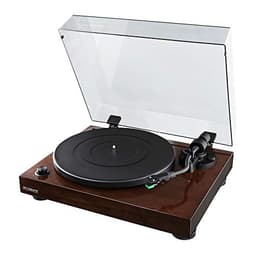
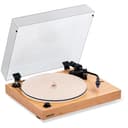
- “I want a figure I can compare.” The Fluance RT85. It publishes 0.07% wow and flutter with an isolated, speed-controlled motor, a high-density acrylic platter, and an Ortofon 2M Blue nude elliptical fitted from the factory. That is three published numbers and a named cartridge where the Planar 1 offers a set of engineering decisions. Both approaches are defensible — only one of them can be checked.
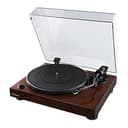
- “I do not want to lift the platter to play a single.” The Pro-Ject Debut Carbon EVO, which publishes electronic speed changealong with a one-piece carbon-fiber tonearm, a heavy damped platter and height-adjustable isolation feet. It is the closest thing here to the Planar 1’s philosophy — a European hi-fi marque selling build quality — with the one daily annoyance engineered out.
- “I want an elliptical stylus for my money.” The Fluance RT82, with an Ortofon OM10 elliptical and a servo-controlled motor, at a lower price than the Planar 1. Same recipe otherwise: belt drive, fully manual, no internal stage, so the signal path stays short.
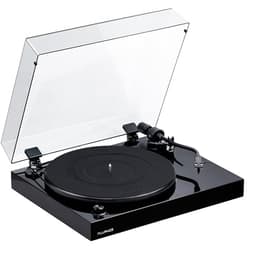
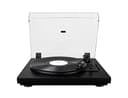
- “I need a phono stage in the box.” Two answers, depending on budget. The Fluance RT81 publishes a switchable built-in preamp with a full bypass, so it works with anything today and steps aside when you add a better stage. The Pro-Ject Automat A1 publishes a switchable moving-magnet stage and a fully mechanical automatic start, with the same Ortofon OM 10 on a carbon-reinforced headshell, tracking force and anti-skate pre-adjusted at the factory.
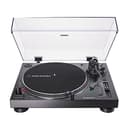
- “I want to record my records, or play 78s.” The Audio-Technica AT-LP120XUSB. A USB output, three speeds including 78 RPM, a switchable preamp, a detachable headshell and full manual control of counterweight, anti-skate and pitch. It is the one deck here the Planar 1 cannot be made to imitate at any price.
What you give up by leaving Rega
An honest alternatives page has to run in both directions, so here is the other column. Nothing on this page is hand-assembled in Britain, and none of these arms carries the RB110’s automatic bias with the maker stating in print that no setting is required. On every pick here except the Automat A1 you set tracking force yourself with a counterweight — which is a skill worth having and takes a first-timer twenty minutes with a tonearm balancing guide and ideally a force gauge. The Planar 1 removes that step entirely.
There is also an upgrade path argument that goes Rega’s way. The Planar 1 sits at the bottom of a ladder that continues through the Planar 2 — the same deck with a 10 mm Optiwhite float-glass platter, an 11 mm self-securing brass bearing and the RB220 arm, whose manual documents adjustable bias and a tracking force set by rotating the balance weight 360 degrees for 2 grams — and onward from there. Buying into that range is buying into a dealer relationship and a set of parts that keep fitting.
And the thing that most often decides it: availability. Rega distributes through authorized dealers, which means a shop visit, a wait, or both. Every pick on this page is a live marketplace listing with a price on it today. That is not a quality argument, and we are not pretending it is one — it is simply the reason a lot of people type this search in the first place.
The cartridge question, which is where most of the money goes
A turntable’s fitted cartridge accounts for more of the audible result than almost anything else on the spec sheet, and it is the clearest difference between the Planar 1 and this page. Rega fits its own Carbon, a moving-magnet cartridge with a conical stylus tip. A conical tip is a sphere: it sits in the groove and reads the average of what is there. An elliptical tip is narrower across the groove wall, so it follows fine modulation a conical rounds off, and a nudeelliptical — the 2M Blue on the RT85 — mounts the diamond directly rather than bonding it to a metal shank, which lowers the tip mass again.
Every pick on this page arrives with an elliptical: Ortofon OM10 on the RT82 and the Automat A1, Ortofon 2M Blue on the RT85, Sumiko Rainier on the Debut Carbon EVO, AT-VM95E on the AT-LP120XUSB, and an AT95-type elliptical on the RT81. Our cartridge roundup covers what the next step up buys, and the moving-magnet versus moving-coil comparison explains the fork after that. Worth noting in Rega’s favor: the Carbon is a moving-magnet cartridge, so it can be replaced with something better later — the Planar 1’s headshell is fixed and the cartridge mounts with two screws, so a swap is a cartridge job rather than a headshell swap.
Whichever you buy, two things matter more than the choice
Get it level and get it away from the speakers.A platter that is not level makes the stylus ride unevenly and pulls the arm to one side, and a deck that shares furniture with a playing speaker picks up its own output through the plinth — which is the single most common cause of muddy, booming vinyl. Our leveling guide and turntable stand picks cover the furniture side; the stands are ranked on published top-surface weight limits rather than on looks.
Budget for the phono stage before you budget for the deck. Four of the six picks here publish no internal stage, exactly like the Planar 1, so something in the chain has to supply one. Our sub-$100 phono preamp roundup is the cheapest honest answer and the explainer settles whether you already have one. If you are building the whole chain from scratch, our beginner setup guide puts the order of operations in one place, and the Edifier speaker roundup is where most first systems end up for the other end of the chain.