PLATTER & PLINTH

Alternatives to the Audio-Technica AT-LP60X

The AT-LP60X is the most recommended first turntable there is, and for good reasons. Here they are — and the four decks worth buying instead, each matched to the reason you are looking.

By Stephen V.Last updated How we pick

The verdict

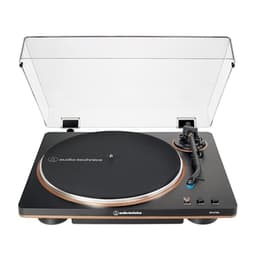
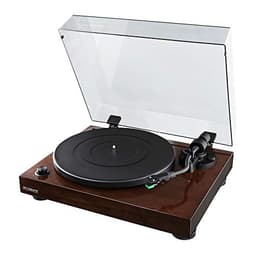
The Audio-Technica AT-LP70X is the alternative to buy for most people looking for one. It keeps the single feature that makes the AT-LP60X worth recommending — full automation, so nothing can be set up wrong — and upgrades the part that actually limits it: the cartridge becomes an AT-VM95C from the VM95 family, which means the stylus ladder above it is open to you. It is for someone who wants the AT-LP60X experience without the ceiling. If you are willing to balance a tonearm, the Fluance RT81 is the real step up: an adjustable counterweight, anti-skate and an elliptical cartridge. The budget pick is the Victrola Eastwood II— cheaper than the AT-LP60X and the only pick here with its own speakers, which matters because the AT-LP60X makes no sound on its own.

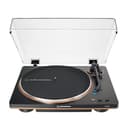
Audio-Technica AT-LP70X

Closest alternative

Audio-Technica AT-LP70X

$249.00 · View on Amazon

Price as of November 22, 2026. #ad How we’re funded

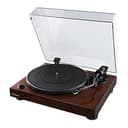
Fluance RT81

The real step up

Fluance RT81

$299.99 · View on Amazon

Price as of November 22, 2026. #ad How we’re funded

First, what the AT-LP60X is good at, because that is the part most “alternatives” pages skip. It is fully automatic: the arm cues, plays and returns on its own, so the two mistakes a new owner actually makes — dropping a stylus onto a record and leaving an arm riding a locked groove for an hour — are both removed by the machine. It has a replaceable magnetic cartridge rather than a sealed ceramic one, so it tracks at a sane force and the stylus is a cheap part. And it publishes a switchable phono stage, which means it plugs into powered speakers with nothing in between. At its price, nothing else does all three. Our full review is the long version.

So people do not usually look for an alternative because the AT-LP60X is bad. They look because of one of four specific things: the cartridge cannot be upgraded far, the tonearm has no counterweight to adjust, it has no speakers, or it will not digitize records or play 78s. Each pick below answers exactly one of those.

Every deck here is one this site already ranks, with a live price on its button and an as-of date beside it. Availability was checked the day this page was written. Nothing on this page is a suitcase player with a sealed pickup, and nothing is an upgrade in name only.

How this is funded: we earn a commission if you buy through our links, at no extra cost to you. It never changes which product we recommend, and we’ll tell you plainly when to skip one. Full disclosure.

Quick picks

Ranked on published specs, drive/motor design and buyer fit. Select a row to jump to the full write-up. We have not heard most of these units — here is exactly what we do instead.

#ProductBest forPrice
1
Audio-Technica AT-LP70X

Audio-Technica AT-LP70X

The automatic that grew up: it keeps the one-button convenience of the LP60X but adds a proper VM95-series cartridge and a die-cast platter, so it sounds a clear step better while still cueing itself. The natural pick if you want automation without the budget-deck ceiling.

Closest alternative
$249.00 · View on Amazon

Price as of November 22, 2026. #ad How we’re funded

2
Fluance RT81

Fluance RT81

The best-value entry into real hi-fi: a manual belt-drive deck with an adjustable counterweight and anti-skate, an aluminum platter, and a genuine Audio-Technica elliptical cartridge — for the price of a good all-in-one. The switchable built-in preamp means it works today and upgrades later.

Best step up
$299.99 · View on Amazon

Price as of November 22, 2026. #ad How we’re funded

3
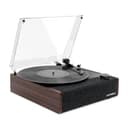
Victrola Eastwood II

Victrola Eastwood II

The all-in-one we can actually recommend: a belt-drive player with built-in speakers, a replaceable Audio-Technica cartridge, and Bluetooth in and out — so it plays records on day one but can also stream to a bigger speaker when you outgrow the built-ins. That upgrade path is what separates it from a throwaway suitcase.

Budget pick
$124.99 · View on Amazon

$149.9917% off

Price as of November 22, 2026. #ad How we’re funded

4
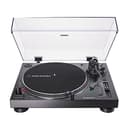
Audio-Technica AT-LP120XUSB

Audio-Technica AT-LP120XUSB

The tinkerer's deck: a direct-drive, fully manual turntable with adjustable tracking force, anti-skate, selectable pitch and a USB output for digitizing records. It ships with the VM95E elliptical and a switchable preamp, so it's ready to play and ready to grow.

Best for USB and 78s
$349.00 · View on Amazon

$449.0022% off

Price as of November 22, 2026. #ad How we’re funded

The picks in full

#1Closest alternative

Audio-Technica AT-LP70X

The automatic that grew up: it keeps the one-button convenience of the LP60X but adds a proper VM95-series cartridge and a die-cast platter, so it sounds a clear step better while still cueing itself. The natural pick if you want automation without the budget-deck ceiling.

Strengths

  • Fully automatic operation, like the LP60X
  • Integral AT-VM95C cartridge takes any VM95-series replacement stylus — a real upgrade ladder
  • Anti-resonance die-cast aluminum platter

Trade-offs

  • Costs more than the LP60X for a similar convenience level
  • Still no on-arm tracking-force adjustment
DriveBelt drive
OperationFully automatic
CartridgeAudio-Technica AT-VM95C (conical, VM95 series)
Built-in preampYes — switchable
Speeds33 1/3 and 45 RPM
PlatterDie-cast aluminum

Note. Because it uses the VM95 cartridge body, you can later drop in a VM95E elliptical or higher stylus without changing the whole cartridge — a real upgrade path the LP60X doesn't offer.

Specifications read from the manufacturer / product listing, on October 5, 2026. “Not published” means the maker does not state that figure.

#2Best step up

Fluance RT81

The best-value entry into real hi-fi: a manual belt-drive deck with an adjustable counterweight and anti-skate, an aluminum platter, and a genuine Audio-Technica elliptical cartridge — for the price of a good all-in-one. The switchable built-in preamp means it works today and upgrades later.

Strengths

  • Adjustable counterweight and anti-skate — you can set tracking force correctly, which the cheap automatics can't
  • Ships with an Audio-Technica AT95-type elliptical cartridge, a real step up from a conical
  • Built-in preamp is switchable, so you can bypass it when you add a better one

Trade-offs

  • Manual operation — you cue and lift the arm yourself
  • No Bluetooth or USB; this is a wired, listen-at-home deck
  • The fitted AT95E cartridge and its ATN95E stylus are both badged discontinued on Audio-Technica's own site — budget a current cartridge as the first upgrade
DriveBelt drive
OperationManual
CartridgeAudio-Technica AT95E (bonded elliptical)
Built-in preampYes — switchable, full bypass
Speeds33 1/3 and 45 RPM
PlatterAluminum, 1.22 lb (553 g), rubber mat
Wow and flutter0.2%

Note. The counterweight and anti-skate are the reason this deck belongs in a different class from the sub-$150 automatics: it lets you dial in tracking force to the cartridge's spec instead of accepting a fixed factory setting.

Specifications read from the manufacturer / product listing, on October 5, 2026. “Not published” means the maker does not state that figure.

#3Budget pick

Victrola Eastwood II

The all-in-one we can actually recommend: a belt-drive player with built-in speakers, a replaceable Audio-Technica cartridge, and Bluetooth in and out — so it plays records on day one but can also stream to a bigger speaker when you outgrow the built-ins. That upgrade path is what separates it from a throwaway suitcase.

Strengths

  • Uses a replaceable Audio-Technica cartridge rather than a sealed ceramic one
  • Bluetooth OUT lets you send records to a proper speaker as you upgrade
  • Built-in speakers and preamp — genuinely plug-and-play

Trade-offs

  • Built-in speakers are convenient, not hi-fi — the sound ceiling is low
  • Not the deck for a collector who wants the best from valued pressings
TypeAll-in-one with built-in speakers
DriveBelt drive
CartridgeAudio-Technica AT-3600LA (replaceable)
Bluetooth5.1, listed as both an input and an output
Built-in preampInternal, for its own speakers; RCA output level not published
Speeds33 1/3, 45 and 78 RPM
OutputsBluetooth, headphone, RCA
CabinetMDF and plastic, 12.83 x 12.09 x 4.53", 5 lb
PowerDC 5 V / 1.0 A

Note. Victrola publishes the cartridge as an Audio-Technica AT-3600LA and lists Bluetooth 5.1 under both Inputs and Outputs, but it does NOT publish a speaker driver size, a power rating, a stylus type, or whether the RCA output is line level or phono level - so none of those appears above. Do not confuse this with the Eastwood II Signature (VTA-7320), which Victrola lists with a different pickup.

Specifications read from the manufacturer / product listing, on October 19, 2026. “Not published” means the maker does not state that figure.

#4Best for USB and 78s

Audio-Technica AT-LP120XUSB

The tinkerer's deck: a direct-drive, fully manual turntable with adjustable tracking force, anti-skate, selectable pitch and a USB output for digitizing records. It ships with the VM95E elliptical and a switchable preamp, so it's ready to play and ready to grow.

Strengths

  • Direct drive with high torque — instant speed and a stable, DJ-style platter
  • USB output records vinyl straight to a computer
  • Full manual control: counterweight, anti-skate, pitch, and three speeds including 78 RPM

Trade-offs

  • Fully manual — no auto return
  • Heavier and larger than the belt-drive decks; overkill if you only ever play at home casually
DriveDirect drive
OperationManual
CartridgeAudio-Technica AT-VM95E (elliptical)
Built-in preampYes — switchable
Speeds33 1/3, 45 and 78 RPM
USB outputYes

Note. 78 RPM plus USB makes this the obvious deck for archiving older records, but note that true 78s need a dedicated stylus — the stock elliptical is cut for modern microgroove records.

Specifications read from the manufacturer / product listing, on October 5, 2026. “Not published” means the maker does not state that figure.

Match the alternative to the reason you are looking

1. You want a cartridge with somewhere to go.The AT-LP60X uses an AT3600L-family pickup, and the only tip available for it is an ATN3600 — conical as standard, with an elliptical version as the one upgrade. That is a short ladder. The AT-LP70X instead carries an AT-VM95C, and the VM95 family runs from conical through elliptical and microlinear to a Shibata-profiled tip, all of which drop into the same body. Our styli under $50 page sets out both ladders side by side, and it is the single clearest reason to spend the extra money.

2. You want to set tracking force yourself.No AT-LP60X has a counterweight — the arm is balanced as built, at a force Audio-Technica sets. That is deliberate and it is why nothing can be adjusted wrong, but it also means you cannot correct it or dial in a different cartridge. The Fluance RT81 publishes an adjustable counterweight and anti-skate, which is what makes balancing a tonearm a thing you can do rather than read about.

3. You have no speakers.This is the most common disappointment with the AT-LP60X and it is not the deck’s fault: a component turntable makes no sound on its own. Either budget for powered speakerson top, or buy a player with speakers inside. The Victrola Eastwood II is the one we rank, and it is cheaper than the AT-LP60X — the trade is a lower sound ceiling, which our turntables with speakers page prices as whole systems.

4. You want USB, 78 RPM or a removable headshell. The AT-LP120XUSB is the deck in this family that does all three, plus direct drive and a pitch fader. We have the two compared directly in AT-LP60X vs AT-LP120XUSB, which is the head-to-head most people arriving here have already half-made.

How these were ranked

  • It has to beat the AT-LP60X at something specific and published. A cartridge family with a longer stylus ladder, an adjustable counterweight, built-in speakers, a USB output. Not “sounds better” — this site does not claim listening it has not done.
  • Nothing that gives up the AT-LP60X’s safety floor.Every pick here has a replaceable magnetic cartridge tracking at a normal force. A player with a sealed ceramic pickup would be cheaper than all four and is not an alternative to anything — see are suitcase record players bad.
  • The total cost is stated, not hidden. Two of these have a switchable phono stage and two do not; one has speakers and three do not. Where a pick needs something else bought, the entry says so.
  • Live and in stock, checked on the day.Every ASIN here returned a buyable offer with a real price, and prices render from the price feed with their own as-of stamp — never a number typed into this page.

Where the AT-LP60X is still the right answer

Three cases, and they cover most first-time buyers. If the deck is a giftand you do not know what the recipient owns, full automation and a switchable preamp make it the hardest deck to get wrong — which is why it leads our turntable gift guide.

If nobody in the house wants to set anything up, the counterweight you would gain on an RT81 is a liability rather than a feature. An arm set wrong tracks heavy and wears records, and the AT-LP60X removes that possibility entirely. Our page on automatic versus manual makes that argument properly.

If the budget is fixed at around its price and speakers are still to buy, spending more on the deck is the wrong move. A cheaper deck plus real speakers beats a better deck plus none, every time — our picks under $200 are built around that arithmetic.

What none of these fixes

Whichever deck you land on, the stylus does more for how a record sounds than the choice between any two of them. Set the deck level, set the tracking force to the published figure if the arm allows it, keep the tip clean with a brush from our accessories under $25 page, and replace the stylus on schedule. Our upgrade-order page sets out why that sequence beats buying a different turntable, and on an entry deck it is almost always the honest answer.
Frequently asked questions

What is a good alternative to the Audio-Technica AT-LP60X?

The Audio-Technica AT-LP70X for most people: it keeps full automation - the feature that makes the AT-LP60X worth recommending - and fits an AT-VM95C cartridge, which opens the whole VM95 stylus ladder above it. The Fluance RT81 if you are willing to balance a tonearm, because it publishes an adjustable counterweight, anti-skate and an elliptical cartridge. The Victrola Eastwood II if you have no speakers, since it has its own.

What is the AT-LP60X known for?

Being the safest first turntable. It is fully automatic, so the arm cues, plays and returns on its own and the common beginner mistakes are removed by the machine; it uses a replaceable magnetic cartridge rather than a sealed ceramic one, so it tracks at a sane force; and it publishes a switchable phono stage, so it plugs straight into powered speakers. At its price nothing else does all three, which is why it is the standard recommendation.

Why can't I upgrade the AT-LP60X cartridge?

Its pickup is from the AT3600L family, which takes an ATN3600 stylus - conical as standard, with an elliptical version as the one available upgrade. That is the whole ladder. The VM95 family on the AT-LP70X and AT-LP120XUSB runs from conical through elliptical and microlinear to a Shibata tip, all interchangeable in the same body, which is a much longer runway for the same deck.

Is the Fluance RT81 better than the AT-LP60X?

It is the better turntable on published specification - a high-mass MDF plinth, an adjustable counterweight with anti-skate, an elliptical cartridge - and the worse choice for someone who does not want to set anything up, because an arm balanced wrong tracks heavy and wears records. The RT81 also costs meaningfully more. Both publish a switchable phono stage, so both plug into powered speakers directly.

Do I need speakers with the AT-LP60X or its alternatives?

Yes for three of the four picks here, because a component turntable makes no sound on its own. The AT-LP60X, AT-LP70X, RT81 and AT-LP120XUSB all need powered speakers, or an amplifier plus passive speakers. Only the Victrola Eastwood II has speakers built in, which is why it is on this page despite being the cheapest pick.

Is there a cheaper alternative to the AT-LP60X?

The Victrola Eastwood II, and it is cheaper in a useful way: it includes speakers and a phono stage, so it is a complete purchase rather than a deck plus a shopping list. The trade is a lower sound ceiling and no adjustable arm. What we would not recommend is going cheaper than that into sealed-ceramic suitcase players, which track heavily and cannot be renewed.

Which alternative digitizes records?

The AT-LP120XUSB. It has a USB output, three speeds including 78 RPM, a pitch fader and a removable headshell - none of which any AT-LP60X offers. It is direct drive rather than belt drive, which is a different trade rather than a straight upgrade, and our belt drive versus direct drive guide covers what each buys.

Sources

  • Audio-Technica — AT-LP60X turntable — Manufacturer specs for the fully automatic belt-drive AT-LP60X (accessed August 11, 2026)
  • Audio-Technica — AT-LP70X fully automatic belt-drive turntable — The maker's own product page and specification table. Features as published: "Fully automatic belt-drive turntable operation with two speeds: 33-1/3, 45 RPM"; "A fixed-body AT-VM95C Integral Dual Moving Magnet phono cartridge is compatible with any VM95 Series replacement stylus"; "Stylish three-piece chassis construction dampens resonance for improved sound quality*" with the footnote "*Compared to AT-LP60X"; "J-shaped tonearm is engineered to minimize tracking errors"; "Tonearm lock reduces risk of stylus damage"; "Built-in switchable phono/line pre-amplifier"; "Anti-resonance, die-cast aluminum platter with felt mat"; "Includes detachable RCA output cable (dual RCA male to dual RCA male with ground), 45 RPM adapter, and removable hinged dust cover"; "Available in Black/Gray, Black/Bronze, and White/Silver". Spec table: DC motor; belt drive; die-cast aluminum platter; signal-to-noise > 55 dB; "This product is equipped with an AT-VM95C Dual Moving Magnet Stereo Cartridge. The cartridge cannot be removed."; output PHONO 4.0 mV and LINE 252 mV nominal at 1 kHz, 5 cm/sec; phono pre-amp gain 36 dB nominal, RIAA equalized; power consumption 1.5 W; 400 mm (16 in) W x 330 mm (13 in) D x 110 mm (4.3 in) H; approx. 2.9 kg (6.4 lb); effective arm length 220 mm (8.7 in); overhang 18 mm (0.71 in); tracking error angle less than 2.0 degrees; replacement stylus AT-VMN95C; AC adapter 12 V DC, 0.5 A. The upgrade-path block on the same page lists the AT-VMN95C, AT-VMN95E, AT-VMN95EN, AT-VMN95ML and AT-VMN95SH as compatible styli, and the description states the stylus "can also be easily upgraded with any other styli (elliptical, micro linear, or Shibata) in our VM95 Series". The wow-and-flutter cell on the web table was empty on the access date; the figure is taken from the manual instead (accessed September 18, 2026)
  • Audio-Technica — AT-VM95C cartridge — The cartridge the AT-LP70X is built around, on its own spec page: frequency response 20-20,000 Hz; channel separation 18 dB at 1 kHz; vertical tracking force "1.8-2.2 g (2.0 g standard)"; stylus construction "Bonded round shank", shape "0.6 mil conical"; cantilever "Aluminum pipe"; output 4.0 mV (1 kHz, 5 cm/sec); recommended load 47,000 ohms and 100-200 pF; replacement stylus AT-VMN95C; and the line the whole upgrade argument rests on: "Compatible with any AT-VMN95 replacement stylus". This page describes the half-inch-mount version; the AT-LP70X carries a fixed-body variant with the same stylus socket (accessed September 18, 2026)
  • Fluance — RT81 Elite turntable, published specifications — Manufacturer specification table, read live: belt drive, DC motor on three-point rubber isolation, 33 1/3 and 45 RPM (78 RPM "No"), speed variation +/- 1.00%, wow and flutter 0.2%, signal-to-noise "67 dB or higher (A-weighted, 20 kHz LPF)" and "60 dB or higher (unweighted, 20 kHz LPF)", aluminum platter 12 in / 1.22 lb (553 g) / 0.62 in (16 mm) with a rubber mat, static-balanced S-type aluminum tonearm 8.82 in (224 mm) effective length and 0.99 oz (28.2 g) effective mass, adjustable 100 g counterweight, anti-skating, cueing lever, pivot bearing, H-4 bayonet headshell 0.38 oz (10.7 g), "Audio Technica: AT95E" dual moving magnet cartridge with a 0.4 x 0.7 mil bonded elliptical diamond on an aluminum cantilever at 2.0 g tracking force, 20-20,000 Hz, 20 dB channel separation at 1 kHz, 3.5 mV phono output and 140 mV (-17 dBV) line output, switchable PHONO/LINE preamp with full bypass and a ground terminal, MDF plinth in real wood veneer, tinted dust cover, defeatable auto-stop, suspension isolation feet, 14.1 lb (6.4 kg), 1.5 W. Listed at 299.99 USD on the access date with no discontinuation notice. Re-read live on 2026-10-05 for the RT81 vs AT-LP120XUSB head-to-head and the 2M Blue review, every figure above unchanged and still listed at 299.99 USD; two rows quoted on those pages are confirmed verbatim from the same table — "Supported Cartridge Weight: 0.12 to 0.23 oz (3.5 to 6.5 g)", which EXCLUDES the 7.2 g Ortofon 2M Blue, and "Cartridge Weight: 5.7 g (+/- 0.5 g)" (accessed September 26, 2026)
  • Audio-Technica — AT-LP120XUSB user manual, full published specification — The complete published table, re-read in full on this date (this manual was previously cited on this site only for the deck's dimensions). Turntable: type "Direct drive", motor "DC servo motor", "3-speed, fully manual operation" at 33-1/3, 45 and 78 RPM, die-cast aluminum platter, starting torque "> 1.0 kgf.cm", braking system "Electronic brake", wow and flutter "< 0.2% WRMS (33 RPM) at 3 kHz", signal-to-noise "> 50 dB", output PHONO "4 mV nominal at 1 kHz, 5 cm/sec" and LINE (MM) "240 mV nominal at 1 kHz, 5 cm/sec", phono pre-amp gain "36 dB nominal, RIAA equalized". Tonearm: "Static balanced S-shaped tonearm", effective length 230.5 mm, overhang 16 mm, maximum tracking error angle "Less than 3", stylus pressure adjustment range "0 to 4 g", applicable cartridge weight range "3.5 to 8.5 g". Cartridge and headshell: AT-VM95E, VM type, 47,000 ohms recommended load, 4.0 mV output, "0.3 x 0.7 mil bonded elliptical stylus", aluminum pipe cantilever, tracking force range "1.8 to 2.2 g (2.0 g standard)", cartridge weight 6.1 g, headshell AT-HS6 at 9 g including lead wire, headshell overhang adjustment "+/- 5 mm". USB function "16 bit 44.1 kHz or 48 kHz USB A/D, D/A selectable", computer interface "USB 1.1 Compliant". General: 452.0 mm (17.80") x 352.0 mm (13.86") x 141.6 mm (5.57"), 8 kg (17.6 lbs) without dust cover, 2.75 W, replacement stylus AT-VMN95E, replacement headshell AT-HS6, with a stylus target light, USB cable and RCA audio cable in the box (accessed October 5, 2026)
  • Victrola — Eastwood II, published specifications — The maker's own Specifications block, read live on this date: power input "DC 5V/1.0A", turntable "BELT-DRIVEN 3-SPEED" at 33 1/3, 45 and 78 RPM, inputs "BLUETOOTH", outputs "BLUETOOTH, HEADPHONE, RCA", cartridge "AUDIO TECHNICA AT-3600LA", Bluetooth version "5.1", materials "MDF AND PLASTIC", dimensions "L 12.83" X W 12.09" X H 4.53" (32.6 CM x 30.7 CM x 11.5 CM)", weight "5 LBS | 2.27 KGS", colors "Black - VTA-74-BL; Espresso - VTA-74-ESP; Oak - VTA-74-OAK", plus "Built-in, custom tuned speakers" and a "Removable dust cover" in Features & Benefits. What Victrola does NOT publish, recorded because the review is built around it: no speaker driver size, no amplifier power rating, no stylus profile, no auto-stop, no tracking force, and no statement of whether the RCA output is line level or phono level. A separate model, the Eastwood II Signature (VTA-7320), is listed with a different pickup - do not merge the two (accessed November 2, 2026)

Keep reading